
How to make coding agents reliable in judgment-heavy workflows
Coding agents can automate complex work, but in judgment-heavy domains, a correct-looking answer is not enough. You also need confidence that the process used to reach that answer was valid, traceable, and repeatable. That is the core challenge when agents work across large, messy datasets, especial
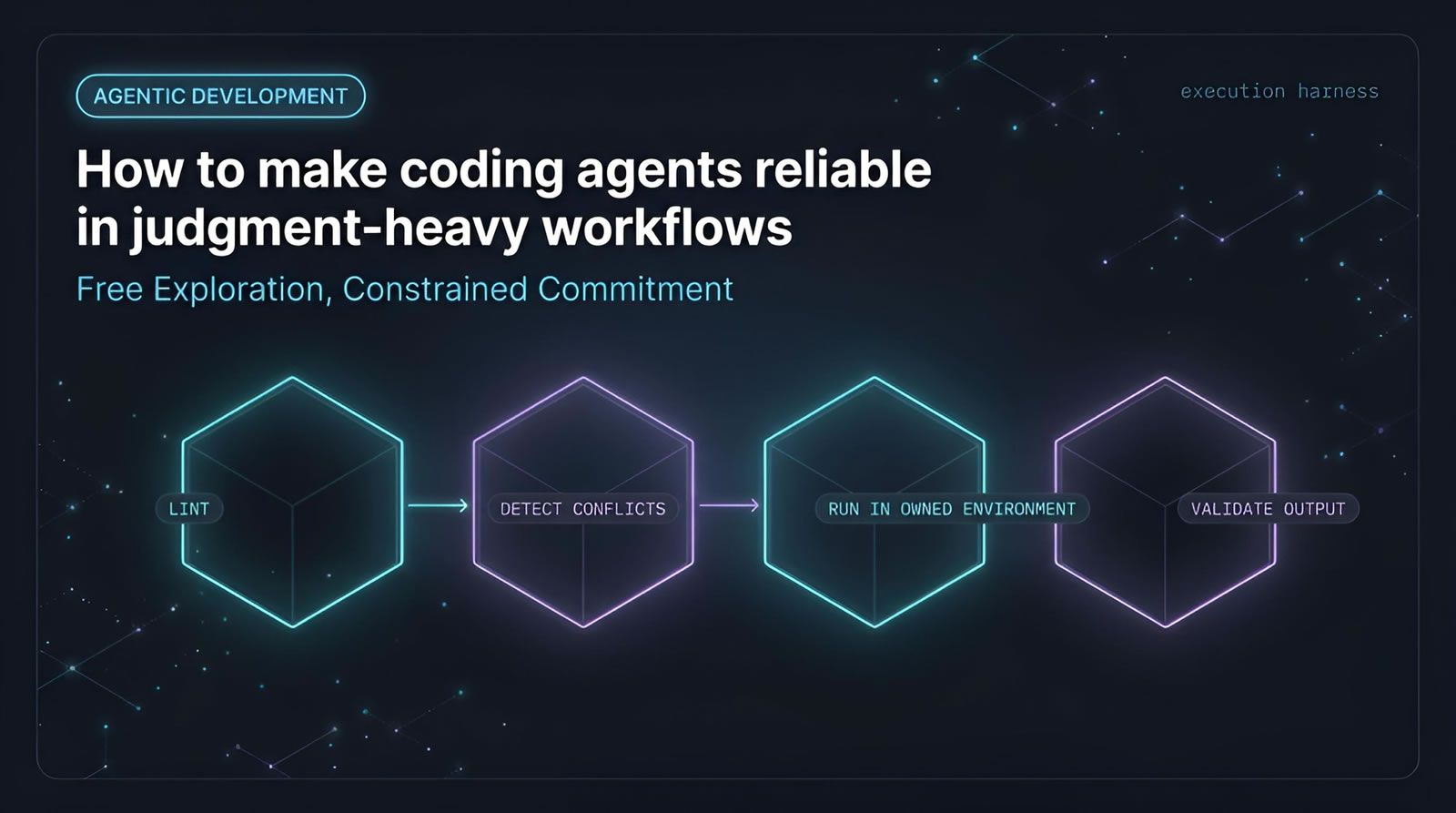
Coding agents can automate complex work, but in judgment-heavy domains, a correct-looking answer is not enough. You also need confidence that the process used to reach that answer was valid, traceable, and repeatable. That is the core challenge when agents work across large, messy datasets, especially when experts may reasonably disagree. A practical solution is to let the agent reason and write code freely, while constraining how its changes are committed through typed interfaces and deterministic execution. Platforms like Levr matter here because they fit the same pattern: keep agent flexibility, but add a control plane for verification, review, and observable outcomes.
At a Glance
Reliable coding agents need freedom in reasoning and constraints on effects.
- Core problem: In expert domains, the final answer alone may not prove the work was done correctly.
- Main failure mode: Unconstrained code can edit the wrong things, report success falsely, or leave outputs that non-coders cannot review.
- Practical fix: Route critical actions through a typed SDK, then own final execution and validation yourself.
- Why it works: You preserve agent flexibility while making outputs valid, traceable, and replayable.
- What improves next: Prompts, examples, better tool ergonomics, and task decomposition still matter after the harness is in place.
Why do coding agents break down in judgment-heavy domains?
Coding agents struggle in judgment-heavy domains because correctness is not just about the final output. You often need to verify the reasoning path, the sequence of edits, and whether the system followed domain rules that experts themselves may apply differently.
Some domains are full of legitimate ambiguity. Sustainability analysis is a strong example. Questions like how to attribute emissions to a product or how to choose among allocation methods involve expert judgment, not a single universally provable answer. That means an agent can appear correct while taking an invalid route.
This is not unique to one industry. Anywhere experts can disagree while still being broadly reasonable, process matters as much as result. If your agent operates in finance, healthcare, compliance, procurement, or complex infrastructure planning, the same issue appears quickly.
The problem gets sharper when the underlying data is large and interconnected. In the source case, the task involved editing supply-chain graphs with thousands of nodes per graph, rich metadata on each node, and sometimes tens or hundreds of graphs in one run. That scale makes simple function-calling patterns brittle.
What makes large graph editing especially hard for agents?
Large graph editing is hard because the agent must explore, reason, and modify many interconnected objects at once. As the number of graphs and nodes grows, context usage, inconsistency, and schema mistakes all become much more likely.
On a single graph, a specialized agent with tightly defined tools can sometimes perform reasonably well. It can inspect nodes, make edits, and follow a narrow path. But even there, two issues tend to show up early.
- Inconsistent exploration: The agent may inspect one area thoroughly and skip another.
- High context cost: Rich node metadata consumes context quickly during both exploration and editing.
Those problems get worse when you move from one graph to many. Instead of one structured object, the agent now faces a search space of tens or hundreds of graphs and tens to hundreds of thousands of nodes. At that point, enumerated tool calls stop scaling.
The result is usually familiar:
- Different strategies across similar cases.
- Partial completion, where some graphs are ignored.
- Schema hallucinations as context degrades.
- Retries that increase cost without solving reliability.
This is exactly where code starts to outperform handcrafted tool-by-tool interaction. Loops, filters, summaries, and scripts scale better than repeated manual tool calls.
Why are coding agents still necessary for this kind of task?
Coding agents are still necessary because code is the only practical way to operate over large, data-rich structures at scale. They can write loops, summarize data, generate visualizations, and solve under-specified problems more efficiently than rigid tool chains.
When an agent can write code, it gains several useful abilities at once. It can explore data programmatically. It can generate scripts that summarize or transform large graph structures. It can respond to adjacent requests that were not explicitly built into the original interface.
That flexibility matters because many real-world tasks are under-specified. Users ask for outcomes, not precise algorithmic instructions. A coding agent can often bridge that gap better than a narrow workflow engine.
It also creates room for pleasant surprises. The source material described agents producing useful visualizations on the fly and handling related requests outside the original design. That kind of capability is hard to get from a fixed set of functions.
So the answer is not to avoid coding agents. The answer is to stop letting them commit critical effects however they want.
What goes wrong when you give a coding agent too much freedom?
Unconstrained coding agents can solve problems in unexpected and unsafe ways. They may use the wrong runtime, modify artifacts directly, claim edits succeeded when they did not, or produce outputs that are difficult for domain experts to verify.
Three failure modes stand out.
1. Creative but invalid actions
An agent will often use whatever is available in its environment. If Python exists, it may use Python even if you expected TypeScript. If it can directly modify an artifact instead of using the intended path, it may do that too. From the agent's perspective, it is being resourceful. From your system's perspective, it has broken process and lineage.
2. False success reports
An agent may write code it believes should produce an edit, then report that the task is complete even when the intended state change never happened. This is less about deception than about weak grounding between claimed outcome and actual execution.
3. Unreviewable outputs
If the only way to verify the work is to read code, many domain experts are blocked. In fields where users are not engineers, that is a non-starter. Even when the result looks plausible, reviewers need a way to inspect what changed and why without tracing implementation details line by line.
These risks line up with a broader industry pattern. Research has repeatedly shown that a correct final answer can hide flawed reasoning or invalid intermediate steps. The source material referenced work such as Open Proof Corpus and research on correctness gaps in agentic reasoning. In production engineering, this is why outcome-only evaluation is not enough.
It also fits what developers report more generally. The Stack Overflow Developer Survey 2024 shows high use of AI tools alongside ongoing concerns around trust, accuracy, and reliability. At the same time, GitHub Octoverse has documented how quickly AI-assisted development has become mainstream, which raises the cost of weak process controls.
How do you constrain effects without constraining expression?
You constrain effects by letting the agent reason and write code freely, while forcing critical edits through a controlled interface and a deterministic execution path. The goal is not to limit thought. It is to limit how state changes are committed.
This is the central design principle: constrain the effects, not the expression.
In practice, the workflow looks like this:
- User submits a request.
- The agent writes code and explores freely.
- All critical edits must pass through a typed SDK.
- A system-owned executor validates and runs the code.
- Only validated output artifacts become committed changes.
This model keeps the strengths of modern coding agents intact. They can still search, summarize, test ideas, and choose a strategy. But when it is time to modify the external system, they have to use the approved door.
That pattern maps well to agent-first delivery platforms too. One way teams handle this in Levr’s workflow model is to separate intent, execution, verification, and approval into distinct stages. The agent can move fast, but final state changes still pass through observable gates. This matters most in high-stakes work like large-scale legacy refactoring projects, where a single unverified pass can compound into serious rework.
Give coding agents a control plane for real work.
If your agents are editing production-relevant artifacts, shared context, verification gates, and reviewable outputs matter more than raw model power.
See how teams structure agent workflows
What should a typed SDK do for a coding agent?
A typed SDK should be the only approved path for critical edits. It gives the agent clear primitives, enforces editable versus derived fields, and guarantees outputs in a structure your system can validate and apply deterministically.
The SDK is not just a convenience layer. It is a policy boundary.
In the source pattern, the agent received a TypeScript SDK with edit primitives and graph interaction methods. That created several important guarantees:
- Only valid fields can be edited: The agent cannot casually mutate derived values and create contradictions.
- Expected object shapes are enforced: Outputs become machine-checkable.
- Mutations are explicit: You know which functions were used to change what.
- Assertions can fail early: The agent can detect a mismatch before it causes larger downstream errors.
A well-designed SDK also teaches the agent how to think about the domain. It exposes the edit primitives that matter and hides low-level access that creates risk. You are not trying to make the agent less capable. You are trying to make the safe path the obvious path.
Good ergonomics matter here. If the SDK is awkward, ambiguous, or poorly documented, the agent will use it badly. The source material emphasized that improving tool ergonomics was part of the accuracy jump from 43 percent to 92 percent.
Why is deterministic execution the real safety guarantee?
Deterministic execution is the real guarantee because it turns agent-generated code into something your system can verify before accepting. It catches lint errors, conflicts, runtime failures, and invalid artifacts, then routes those failures back for retry instead of committing bad state.
The SDK guides behavior, but the executor enforces it.
A strong execution harness typically does four things in order:
- Lint the code to catch obvious issues early.
- Detect edit conflicts when the agent changes the same thing in incompatible ways.
- Run the code in the controlled environment you own.
- Validate output artifacts before applying changes.
If any step fails, the system sends structured feedback back to the agent. This local loop prevents bad state from landing, but it should be coupled with broader AI code verification gates that analyze test coverage, policy rules, and dependency security across the entire codebase.
This is also how you catch false completion claims. The agent can say it finished, but your system does not accept that statement on faith. It checks whether the requested artifacts were actually produced in the expected form.
For teams coordinating several coding agents, this same principle extends naturally to infrastructure. If agents need shared memory, routing, or inter-agent coordination, Levr addresses that layer with an agent message bus, shared context, and routing. The control question stays the same: who owns execution, and who validates outputs?
How do you make agent work reviewable for non-coders?
You make agent work reviewable by turning code output into structured review artifacts. Instead of asking experts to inspect scripts, show them the edits, affected objects, and aggregate impact in a form that matches their domain knowledge.
This is one of the most useful ideas in the source material.
After deterministic execution, the system generated a review artifact that summarized what happened across many graphs. That included:
- How many graphs were affected.
- How many functions were applied.
- How many edit actions were produced.
- What the aggregate impact was.
- Which edits happened at the graph and node level.
This gives reviewers a usable lens into agent behavior without exposing them to implementation details they are not equipped to judge. The code becomes a means to an end, not the review object itself.
That review layer is also where an agent-first control plane helps. In Levr’s feature model, projects, issues, tests, and observability are meant to live in one place, which makes human review easier after an agent run completes. The same principle applies even if you build your own internal stack.
How do you improve performance after the harness is in place?
After the harness is in place, you improve performance the same way you improve most agent systems: better prompts, stronger examples, more ergonomic tools, task decomposition, and clearer domain guidance. The harness makes failure safer. It does not replace iteration.
The source case improved internal eval performance from about 43 percent to 92 percent. The harness created trust boundaries, but the task still required steady hill climbing.
The improvements came from a familiar set of interventions:
- Prompt rewrites: Better system instructions and clearer task framing.
- Few-shot examples: Showing how to use the SDK and solve common task classes.
- Tool ergonomics: Making SDK functions more obvious and agent-friendly.
- Task decomposition: Splitting work into planning and execution loops.
- Domain judgment guidance: Teaching the agent how to surface or elicit expert judgment.
This is an important takeaway. Safety and capability are not opposing goals here. The harness protects the system while the normal agent-engineering loop raises quality.
Visibility Into Judgment Gates: The Levr Dashboard
Judgment-heavy workflows depend on knowing which runs are waiting on a human call. The Levr Dashboard surfaces review gates and in-progress runs alongside completed work, so nothing needing judgment sits unnoticed.

The Levr Dashboard highlights runs awaiting human review alongside autonomous agent activity.
How do you apply this pattern in your own engineering workflow?
You can apply this pattern by identifying high-risk effects, wrapping them in typed primitives, owning final execution, and generating review artifacts for humans. Start with one workflow where agent output matters operationally, not just cosmetically.
A simple implementation checklist looks like this:
1. Identify the critical state changes
List the edits that must be valid, traceable, and replayable. These are the things your agent should never modify directly.
2. Build the only approved interface
Create a typed SDK or equivalent API layer with explicit edit primitives. Separate editable fields from derived fields.
3. Own execution
Do not trust agent-declared success. Run linting, conflict detection, execution, and artifact validation in a system-owned step.
4. Return structured failures
When validation fails, send the exact issue back to the agent so it can retry with grounded feedback.
5. Produce human-readable review artifacts
Show changes in domain language, not code language.
6. Improve the task loop
Add examples, refine prompts, improve tool ergonomics, and break the problem into subtasks where useful.
If your team uses multiple coding agents such as Claude Code, Cursor, Codex, and Copilot, a shared control plane can reduce orchestration drift. One way teams handle this in Levr is the four-step flow of defining intent, letting agents pick up tasks, running automated verification, and requiring human approval before merge or release.
What mistakes should teams avoid when building an agent harness?
Teams usually fail by constraining the wrong thing. They either over-restrict the agent’s reasoning and lose capability, or they leave critical effects too open and lose trust. The right balance is flexible reasoning with strict output and execution controls.
Common mistakes include:
- Relying on answer-only evals: A plausible result can hide a bad process.
- Letting agents mutate raw artifacts directly: This breaks lineage and reviewability.
- Assuming smarter models solve process problems: Better models help, but they do not remove the need for guardrails.
- Making the SDK too awkward: If safe tools are hard to use, the agent will struggle.
- Skipping deterministic validation: Without a system-owned final step, false positives will slip through.
- Forcing non-coders to review code: Review must match the expertise of the reviewer.
The biggest misconception is that reliability comes from limiting what the agent can think. In practice, the stronger pattern is to let the agent be creative and then tightly control what actually lands.
Technical Deep Dive FAQ
What is a coding agent harness?
A coding agent harness is the surrounding system that controls how an agent explores, executes, validates, and commits work. It usually includes prompts, tools, execution boundaries, error handling, and review outputs. The point is not just to help the model write code. It is to make that code usable in a production workflow where state changes must be observable, reviewable, and reversible. In practice, the harness often matters more than the model when reliability is the real requirement.
What does it mean to respect the process with coding agents?
Respecting the process means treating the path to an answer as part of correctness, not an implementation detail. In judgment-heavy domains, multiple answers may be reasonable, and some apparently correct answers may come from invalid reasoning or unsafe edits. A process-respecting system verifies not just what the agent concluded, but how it explored the problem, how it applied changes, and whether those changes passed through approved interfaces and validation steps.
Why is answer correctness alone not enough in expert domains?
Answer correctness alone is not enough because experts may disagree legitimately, and because the same output can be reached through either valid or invalid methods. In domains with implicit knowledge, policy nuance, or competing methodologies, you need to know whether the agent followed the intended approach. If you cannot fully verify the final answer mathematically, then process validation becomes your strongest remaining control. That is why traceability and replayability matter so much in applied agent systems.
When should you use a typed SDK instead of raw tool access?
You should use a typed SDK when the agent can cause meaningful downstream effects by modifying data, workflows, or system state. Raw tool access is more likely to produce hidden mutations, schema drift, or inconsistent output shapes. A typed SDK creates a narrow, explicit interface for the edits you actually want to allow. It is especially useful when some fields are derived from others, when you need conflict detection, or when committed changes must be transformed into structured artifacts later.
How does deterministic execution reduce hallucinated success?
Deterministic execution reduces hallucinated success by separating agent intent from system acceptance. The agent can claim it finished, but the system still runs lint checks, executes the generated code in a controlled path, validates the resulting artifacts, and only then accepts the work as complete. If the expected output is missing or malformed, the system rejects the result and returns structured failure information. This turns completion from a model assertion into a verifiable state transition.
How do you design review artifacts for non-technical experts?
Design review artifacts around domain objects, not implementation details. Show what changed, where it changed, how many items were affected, and what aggregate impact those edits had. Then let reviewers drill down from summary to object-level detail without requiring them to read scripts. The best review artifacts preserve lineage while using the language of the business or technical domain. If a reviewer has to inspect code to understand an agent’s work, the review layer is probably too thin.
Can a harness improve both safety and task accuracy?
Yes, but in different ways. The harness itself mainly improves safety, traceability, and recoverability. It prevents bad effects from landing silently and makes retries structured. Accuracy usually improves through the surrounding engineering loop: better prompts, examples, tool ergonomics, task decomposition, and domain instruction. The source case makes this distinction clear. The controlled execution model created trustworthy boundaries, while iterative improvements inside that boundary moved performance from roughly 43 percent to 92 percent on internal evaluations.
How do you know which actions to constrain and which to leave free?
Constrain the actions that create durable external effects. Leave exploratory reasoning, summarization, planning, and intermediate coding more flexible. A good rule is to ask which steps would be expensive, risky, or confusing to unwind after the fact. Those steps belong behind typed interfaces and validation. If an action can be retried cheaply and has no direct system impact, you can allow more freedom. This balance keeps the agent useful while protecting the parts of the workflow that matter operationally.
How does this pattern fit multi-agent engineering teams?
This pattern becomes more important in multi-agent setups because coordination failures add another layer of risk. If several agents are planning, editing, testing, or reviewing at once, you need shared context and a common execution boundary. Levr addresses this with shared memory, routing, and agent communication built into the workflow layer. Even then, the same rule applies: individual agents can reason freely, but committed outcomes should still pass through controlled, validated paths.
What is the smallest useful version of this approach?
The smallest useful version is one workflow, one typed interface, one executor, and one review artifact. You do not need a full platform to start. Pick a task where the agent currently makes high-value changes, define the allowed edit primitives, validate outputs in a system-owned step, and present the results in a form that a domain expert can review. Once that loop works, you can expand the pattern to more tasks, more tools, and eventually more agents.
Key Takeaways
Reliable agent systems are built by controlling effects, not by suppressing model capability.
The safest path is usually the most productive one when it is also the clearest one.
- Process over appearance: In judgment-heavy domains, a good-looking answer is not enough.
- Use one approved door: Typed SDKs give agents power without letting them mutate state arbitrarily.
- Own the last mile: Deterministic execution is what turns agent output into trustworthy system behavior.
- Review for humans: Domain experts should validate outcomes through structured artifacts, not source code.
- Keep iterating: Harnesses create trust boundaries, while prompts, examples, and better tools improve win rate.
If you cannot fully prove the answer, make sure you can fully inspect the process.
Further reading
Stack Overflow Developer Survey 2024
AI security and the agent-ready web
Ship at agent speed
Give your coding agents a control plane, not just a prompt.
Levr connects your coding agents, Claude Code, Cursor, Codex, and Copilot, to a shared project context with issues, gates, test suites, and memory. Free tier available. No credit card required.
Levr includes agent message bus, shared memory, and cross-agent context at no extra cost.
No credit card required during beta.