
When should AI agents require human approval?
Human approval for AI agents is the practice of requiring a person to review or authorize an agent’s proposed action before it can affect another person, system, or business outcome. It matters most when an action is difficult to undo, uses sensitive context, or reaches...
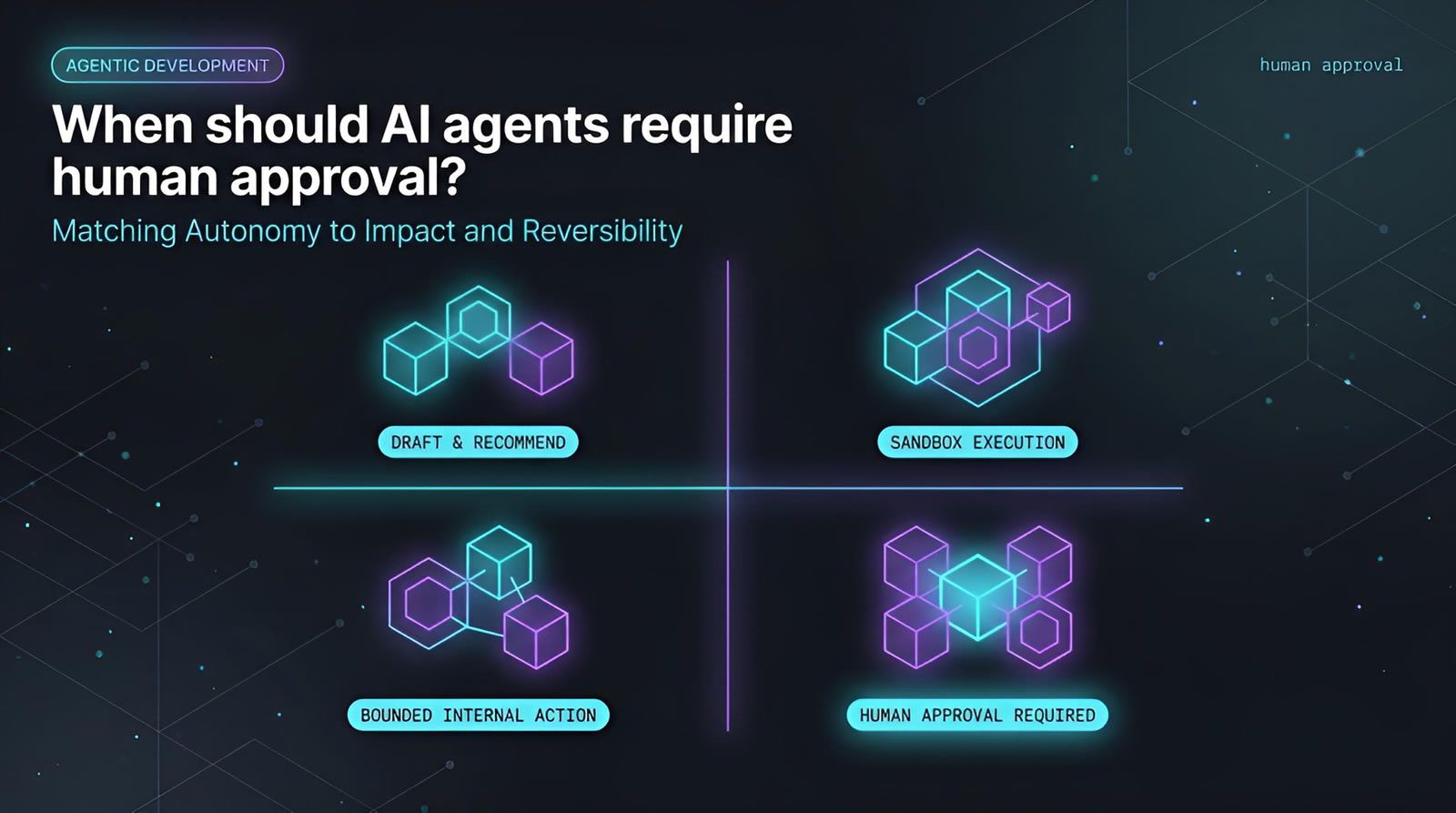
Human approval for AI agents is the practice of requiring a person to review or authorize an agent’s proposed action before it can affect another person, system, or business outcome. It matters most when an action is difficult to undo, uses sensitive context, or reaches outside the team that configured the agent. An agent can often research, draft, classify, test, and prepare work independently. The decision to publish, send, merge, spend, or modify production access needs a clearer boundary. An agent-first control plane gives teams a practical place to define those boundaries, record evidence, and keep accountability visible as agent autonomy increases.
At a Glance
The right approval level depends on impact, reversibility, and context sensitivity.
- Low-risk work: Agents can usually summarize, draft, classify, and prepare internal work without approval.
- Irreversible actions: Sending external messages, changing production systems, and spending money should have explicit controls.
- Context matters: An action becomes riskier when an agent has read sensitive personal, customer, or business information.
- Observability is required: Teams need to know what an agent accessed, proposed, executed, and why.
- Human review is not failure: It is a deliberate control for actions with meaningful consequences.
Why do some AI agent actions need human approval?
AI agents need human approval when their actions could create consequences that are hard to reverse, expose sensitive information, or affect people outside the team. The important distinction is not whether the agent can generate an output. It is whether the output can independently create a commitment, change, or reputational impact.
An agent that drafts an email is not performing the same job as an agent that sends it. Drafting keeps the result inside a controlled workspace. Sending makes the result external, potentially permanent, and attributable to the person or organization the agent represents.
This distinction applies across software development and business operations:
- Usually reversible: creating a draft, opening a pull request, generating test cases, summarizing documents, or proposing a plan.
- Potentially consequential: merging code, updating customer records, publishing content, changing permissions, or contacting a customer.
- High-impact: deploying to production, deleting data, transferring funds, modifying access controls, or sending sensitive communication.
Approval should not be a vague instruction buried in a prompt. It should be an explicit workflow state with a defined approver, a clear record of the proposed action, and enough context for that person to make a sound decision.
What makes an AI agent action irreversible?
An AI agent action is effectively irreversible when it changes another person’s understanding, modifies a live system, exposes information, or creates a commitment that cannot be fully withdrawn. Even if a technical rollback exists, the social, legal, financial, or operational consequence may remain.
External email is a useful example. A sender can issue a correction, but cannot make the recipient unsee the original message. The same is true for public posts, customer notifications, security changes, and production deployments that alter user behavior or data.
Teams should assess reversibility on more than a technical basis. Ask:
- Can the action be undone in the system?
- Can the recipient or customer experience be undone?
- Does the action disclose information that cannot be recalled?
- Does it create a contractual, financial, or reputational commitment?
- Would a human need to explain or defend the outcome afterward?
If the answer to any of these questions is yes, a review gate is usually appropriate. This is not a claim that the agent is incapable. It recognizes that model output can be uncertain and that operational accountability remains human.
How should teams decide which agent actions can run autonomously?
Teams should decide agent autonomy by evaluating the action’s impact, reversibility, access level, and confidence requirements. Start with tightly scoped, low-consequence tasks, then expand autonomy only when the workflow has reliable verification, clear ownership, and an auditable record of what happened.
A practical way to do this is to build an autonomy matrix rather than use a single global setting.
Level 1: Draft and recommend
The agent can read approved sources, prepare an output, and leave it for review. This fits email drafts, implementation plans, issue triage, code suggestions, and internal summaries.
Level 2: Execute within a sandbox
The agent can run code, test changes, inspect results, and make temporary modifications in an isolated environment. It cannot affect production systems, external contacts, or sensitive records.
Level 3: Act within defined internal boundaries
The agent can make pre-approved internal updates, such as moving work items, recording test results, or opening pull requests. These actions should still produce a traceable event history.
Level 4: Require explicit approval
The agent prepares the action but pauses before sending, merging, deploying, publishing, deleting, or changing access. The approver should see the inputs, proposed output, relevant test or validation results, and the exact action that will occur.
This staged model reflects a central lesson from agentic systems: autonomy should be earned by evidence and controls, not granted because a task appears routine.
Why is observability essential for trustworthy AI agents?
Observability makes agent behavior inspectable by recording the context, tools, actions, outputs, and results associated with a task. Without it, teams cannot confidently diagnose unexpected behavior, validate quality, or determine whether an agent acted within the permissions and workflow boundaries it was given.
When an agent produces an unreliable result, the question is not only whether the final answer was wrong. Teams need to understand the path that led to it. Did the agent read incorrect context? Use an unsuitable tool? Misinterpret an instruction? Attempt an action outside the intended scope?
A useful agent activity record should include:
- Task intent: the defined objective and acceptance criteria.
- Context: the documents, issues, repositories, or data sources used.
- Tools: which integrations, commands, or APIs the agent invoked.
- Proposed output: what the agent planned to change or communicate.
- Verification: tests, policy checks, or human review evidence.
- Final outcome: whether the action ran, was rejected, failed, or was revised.
The NIST AI Risk Management Framework emphasizes governing, mapping, measuring, and managing AI risk. In practical engineering workflows, those activities require visibility. A team cannot manage a behavior it cannot reconstruct.
Make agent work inspectable before it becomes autonomous.
Levr keeps issues, acceptance criteria, test evidence, workflow gates, and human or agent activity connected in one shared project context.
Explore agent-first workflow controls
How do evaluation metrics help catch AI agent mistakes?
Evaluation metrics help teams measure whether an AI agent’s output meets defined requirements, but they do not remove the need for human judgment in high-impact cases. Useful evaluations compare agent results against expected behavior, test outcomes, policy constraints, and real workflow acceptance criteria.
For coding work, evaluation can include whether tests pass, whether the change addresses the stated issue, and whether the agent avoided unrelated modifications. For communications, evaluation may check formatting, required facts, prohibited content, and whether the recipient or approval boundary is correct.
Metrics are strongest when they are tied to the task rather than treated as a generic model score. An agent may produce fluent text while still making an incorrect assumption, choosing the wrong recipient, or exposing inappropriate context.
The OWASP guidance on prompt injection also illustrates why output quality alone is insufficient. Agent systems can be influenced by untrusted content encountered through documents, web pages, tickets, or other inputs. Evaluation should therefore inspect both outputs and the actions an agent attempts to take.
What should a human approval workflow include?
A human approval workflow should present the proposed action, the relevant context, the evidence supporting it, and the exact consequence of approval. The reviewer should be able to approve, reject, revise, or escalate the action without needing to reconstruct the agent’s work from scattered logs.
A strong approval gate answers four questions quickly:
- What is about to happen? Show the message, deployment, merge, change, or command in its final form.
- Why is it happening? Connect the action to its issue, request, objective, and acceptance criteria.
- What evidence supports it? Include tests, validations, source references, and checks that passed or failed.
- What happens if it proceeds? State the recipient, environment, permissions, and scope of the change.
For example, an email agent can read and organize messages, identify a response that needs attention, and prepare a draft. The approval state should prevent sending until the account owner validates the recipient, tone, claims, attachments, and any information derived from sensitive inbox content.
How can engineering teams build approval gates into agentic development?
Engineering teams can build approval gates by treating agent actions as workflow transitions instead of one-off prompts. Define intent, constrain permissions, require verification, and reserve specific state changes for human approval. This creates a repeatable path from proposed work to accepted work without blocking low-risk automation.
One way to structure this in Levr’s agentic workflow is to connect agent execution to the same project objects used by the engineering team:
- Define the intent: Create an issue with structured acceptance criteria, constraints, and the intended scope of work.
- Let the agent prepare the work: The coding agent reads the task, works against the defined context, and records progress on the same issue.
- Run verification: Link tests and results to the acceptance criteria, then use workflow gates to prevent unsupported work from reaching completion.
- Require human review where it matters: A person approves the pull request, release, external communication, or other consequential transition.
- Keep the activity trail: Preserve attribution for human and agent changes so later investigation does not rely on memory.
This approach does not require every task to receive manual review. It makes the review boundary deliberate. Agents can move quickly through drafting, implementation, and testing, while people remain responsible for consequential decisions.
What mistakes weaken AI agent approval processes?
Weak approval processes usually fail because they are too broad, too hidden, or too easy to bypass. A reliable process names the action that needs approval, exposes the relevant context, and makes it clear who has authority to approve it before the agent can proceed.
- Using a single rule for every action: Requiring approval for harmless drafts creates friction, while allowing all actions creates unacceptable risk.
- Approving without context: A reviewer cannot meaningfully approve a message or deployment without seeing inputs, evidence, and scope.
- Treating a prompt as a security boundary: Instructions can guide a model, but permissions and workflow gates should constrain what it can do.
- Logging only the final output: Final text or code does not show which sources, tools, or intermediate actions influenced the result.
- Skipping verification because the output looks plausible: Fluent output can still be wrong, incomplete, or unsafe.
- Making approvals informal: A chat message or verbal confirmation may not establish a reliable record of who accepted a meaningful action.
The goal is not to make agents less useful. It is to match the control to the consequence. Low-risk work can remain fast, while high-impact work becomes reviewable and accountable.
Technical Deep Dive FAQ
What is human-in-the-loop AI?
Human-in-the-loop AI is a system design in which people participate in an AI workflow at defined points. Their role may include supplying context, reviewing a proposed output, approving a consequential action, correcting an error, or handling exceptions. It does not mean a person must inspect every token an agent generates. Instead, it means the workflow assigns human judgment where impact, uncertainty, or accountability requires it. For AI agents, the most important checkpoints are typically before external communication, production changes, access modifications, or other actions with durable consequences.
What is an AI agent approval gate?
An AI agent approval gate is a workflow control that prevents an agent from completing a specific action until an authorized person reviews and accepts it. The gate should identify the action, its scope, the context used, and any available verification evidence. An email approval gate, for example, allows an agent to write a message but blocks sending. A deployment gate can allow an agent to prepare a release and run tests while requiring a human to authorize the production change. Gates make autonomy explicit rather than assumed.
Should an AI agent be allowed to send email automatically?
An AI agent can send email automatically only when the message type, recipient scope, permissions, and consequences are tightly controlled. Draft-only behavior is a safer default for personal, customer-facing, or sensitive communication because it preserves a review point before the message leaves the organization. Automatic sending may be more appropriate for pre-approved operational notices with fixed templates and low consequence. The decision should consider what the agent has read, whether the email can disclose sensitive information, and whether a mistaken message can cause reputational or relationship damage.
How do you classify an AI agent action as high risk?
Classify an AI agent action as high risk when it can change a production system, expose sensitive data, create an external commitment, affect money or permissions, or create a hard-to-reverse outcome. Risk also increases when the agent has broad access to personal, customer, or proprietary context. A task may appear simple but still be high risk because of its recipient or environment. Sending a routine internal reminder differs substantially from sending an email to a customer or changing access in a live account. Assess both the action and the context around it.
Can tests replace human approval for coding agents?
Tests can validate important parts of a coding agent’s work, but they cannot replace human approval in every case. Automated tests may show that a change behaves as expected for covered scenarios, yet they may not confirm product intent, architecture quality, security impact, or release timing. Tests are evidence, not a universal authorization mechanism. A mature workflow uses tests to automate objective verification and then applies human review to decisions that require judgment. The appropriate review depth depends on the code’s scope, deployment target, and potential blast radius.
What should agent observability logs capture?
Agent observability logs should capture the task objective, the context available to the agent, the tools it used, actions it attempted, outputs it produced, verification results, approvals, and final outcome. The record should also establish attribution, making it clear whether a human or an agent initiated each event. For sensitive workflows, logging should respect data minimization and access controls rather than indiscriminately retaining private content. The purpose is to make behavior explainable enough for debugging, auditing, and process improvement without expanding unnecessary exposure of sensitive information.
How does prompt injection affect autonomous agents?
Prompt injection can influence an agent through instructions embedded in content it reads, including documents, tickets, repositories, web pages, or tool outputs. This matters more for autonomous agents because they may act on information rather than merely summarize it. A malicious or misleading instruction can attempt to redirect the agent toward unsafe behavior. Stronger defenses include limiting permissions, separating untrusted content from control instructions, requiring approval for consequential actions, and validating proposed tool calls. A prompt alone should not be treated as the sole security boundary.
How can an engineering manager measure agent reliability?
An engineering manager can measure agent reliability by tracking task completion against acceptance criteria, verification pass rates, rejected or revised outputs, blocked actions, failed tool calls, and the frequency of human intervention. The metrics should be segmented by task type and risk level because a coding agent’s performance on test generation may differ from its performance on release preparation. Review outcomes are especially useful: recurring corrections reveal where context, task definitions, permissions, or evaluation logic need improvement. Reliability is a workflow property, not merely a model property.
What is the safest first step for adopting autonomous agents?
The safest first step is to give agents bounded read access and draft-only responsibilities within a clearly defined workflow. Start with tasks such as issue summarization, test proposal, documentation drafts, or internal planning. Require agents to record their work and keep write-capable or external actions behind approval gates. This creates real operational learning without granting broad authority too early. As the team builds confidence in task definitions, test coverage, observability, and review patterns, it can increase autonomy for specific low-risk actions rather than enabling unrestricted access all at once.
How can Levr support approval workflows for coding agents?
Levr supports agent-first project workflows by connecting issues, structured acceptance criteria, tests, runs, workflow states, and attributed activity in one control plane. Teams can use that shared context to let coding agents work on the same live objects as humans while holding consequential transitions behind quality gates and review. Its project and test relationships make it easier to inspect why work moved forward and what evidence supports it. The appropriate approval policy remains a team decision, based on the action’s risk and the organization’s operating requirements.
Key Takeaways
Trustworthy agent autonomy is not about eliminating human involvement. It is about placing human judgment at the points where it has the most value.
Use approval gates to turn vague trust into a repeatable engineering practice.
- Separate drafting from execution: Agents can prepare valuable work without automatically making consequential changes.
- Assess reversibility: Require stronger review when an action affects people, production systems, access, money, or public information.
- Connect evidence to actions: Approval decisions are better when the reviewer can see intent, context, tests, and proposed outcomes.
- Make activity observable: Capture what agents accessed, attempted, changed, and whether a human approved it.
- Expand autonomy gradually: Give agents more authority only after workflows, verification, and accountability are working.
The useful question is not whether an agent can act. It is whether the team can inspect, control, and stand behind the action it takes.
Further reading
- NIST AI Risk Management Framework
- OWASP: Prompt Injection
- Anthropic: Building Effective Agents
- Levr agent-first project control plane
- Levr features for human and agent workflows
- How Levr’s agentic workflow operates
Ship at agent speed
Give your coding agents a control plane, not just a prompt.
Levr connects your coding agents, including Claude Code, Cursor, Codex, and Copilot, to shared project context with issues, workflow gates, test suites, and attributed activity.
No credit card required during beta.