
AI Engineering's New Bottleneck: Human Attention, Not Code
AI engineering is shifting from writing every line of code by hand to designing systems where coding agents can plan, build, test, and hand work back for review. That shift matters because modern agents are no longer limited to autocomplete. They can handle longer tasks, run tools, and ...
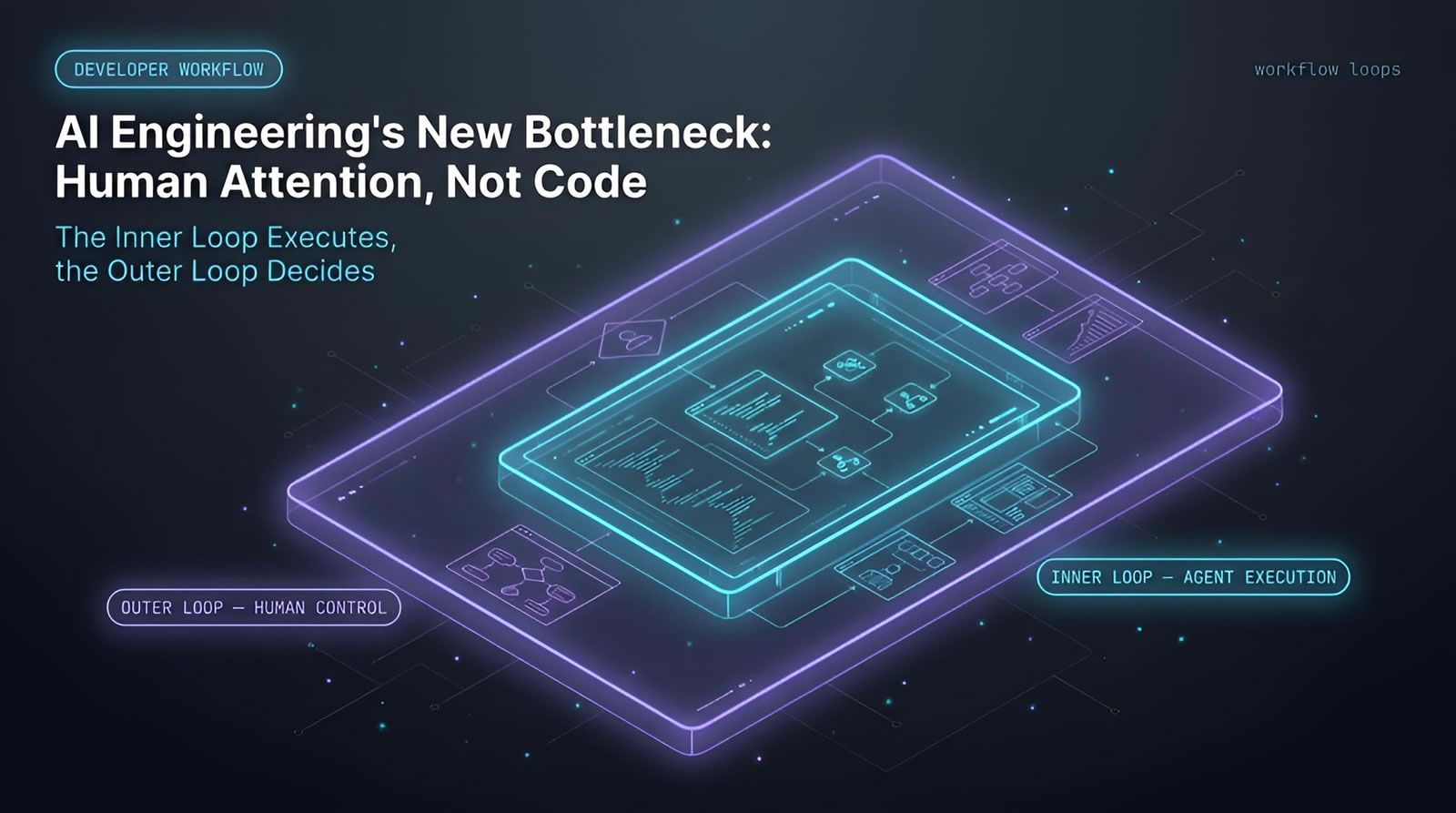
AI engineering is shifting from writing every line of code by hand to designing systems where coding agents can plan, build, test, and hand work back for review. That shift matters because modern agents are no longer limited to autocomplete. They can handle longer tasks, run tools, and operate across more of the software lifecycle. The real challenge is no longer “Can a model write code?” but “How do you structure reliable loops around it?” For teams building that way, agent-first platforms like Levr matter because they give agents shared context, verification steps, and clearer handoffs between humans and automated contributors.
At a Glance
AI engineering is becoming a discipline of loops, orchestration, and attention management.
- Big shift: Coding agents are moving beyond code suggestions into testing, review preparation, and long-running task execution.
- New bottleneck: Human attention is becoming more constrained than tokens or raw compute in many agent workflows.
- Product pattern: The most useful agent experiences combine conversational control with a deeper interface for inspection and steering.
- Infrastructure need: Long-running agents need persistent context, coordination, and triggers to stay useful over time.
- Team implication: The winning workflow is not full automation. It is better delegation, clearer loops, and stronger review boundaries.
Why does AI engineering feel like a new phase of software development?
AI engineering feels different because the unit of work has changed from isolated code edits to delegated outcomes. Engineers are no longer just prompting for snippets. They are shaping agent behavior across planning, implementation, testing, review, and deployment preparation.
The core idea is simple. Engineering was never only about typing code. It was always about solving problems with judgment, design, and technical leverage. Coding agents amplify that pattern because they can now take on longer goals and operate across more of the workflow.
That is why this moment feels larger than another productivity tool cycle. Model releases are speeding up, product surfaces are changing quickly, and teams are learning that useful automation depends on much more than a better completion engine.
The practical consequence is that AI engineering now includes at least four layers:
- Model capability: How well the model reasons, edits, tests, and persists on a task
- Tool execution: What systems it can access and what actions it can take
- Workflow design: How tasks are delegated, checked, resumed, and approved
- Human control: Where engineers inspect, steer, and make final decisions
This also aligns with broader industry movement. GitHub’s Octoverse has documented how AI-assisted development has become mainstream, while the Stack Overflow Developer Survey 2024 shows strong developer adoption alongside continuing concerns about trust, accuracy, and control.
What changed when coding agents learned to build and test their own work?
The biggest jump came when agents stopped being limited to proposing edits and started verifying them. Once a model can run code, test outcomes, and iterate, it becomes much more useful for real engineering work and much less dependent on blind trust.
That distinction matters. Earlier systems could make plausible changes, but they could not reliably confirm whether those changes actually worked. That left engineers in a fragile loop where a generated answer might look correct while hiding breakage underneath.
Once build and test entered the loop, the quality bar changed. Agents could try a fix, run verification, and keep pushing until the task converged. That makes longer goals feasible. It also changes where engineers spend time. Instead of checking every intermediate guess, they can increasingly review results after automated verification has already happened.
This is one reason agent workflows now feel less like enhanced autocomplete and more like delegated task execution.
How should useful coding agent products be designed?
The most effective pattern is not pure chat and not a code-first interface alone. It is a combination of conversational control and a hands-on workspace where you can inspect details, steer execution, and modify specific outputs when needed.
That design mirrors how teams actually work. Most collaboration does not happen by hovering over someone’s shoulder every minute. You describe the goal, clarify intent, and let work proceed. Then you step in when a decision, correction, or deeper inspection is required.
Applied to coding agents, that means two complementary modes:
- Conversation as the default: You assign goals, ask questions, redirect work, and maintain momentum through natural language
- Direct manipulation when needed: You inspect outputs, point at exact changes, compare alternatives, or intervene in technical details
This matters because code alone is no longer the whole center of the workflow. Engineers increasingly need to manage intent before implementation and review context after implementation. A purely terminal-based or IDE-first experience can be powerful, but it may not be the best surface for collaborative delegation.
One practical way to handle this in production is with an agent-first control plane. In Levr’s workflow model, teams define intent in natural language, let agents pick up scoped tasks, run automated verification, and then require human review before approval. That structure fits the same product philosophy: conversation first, inspection when needed, decisions at the right boundary.
Reducing Context-Switching: The Levr Dashboard
If attention is the real bottleneck, then every extra tool a lead has to check is a cost. The Levr Dashboard aggregates open issues, recent runs, and active cycles into a single pane of glass — one place to look instead of five.

The Levr Dashboard consolidates engineering activity into one view, reducing the attention cost of context-switching.
Why are agent loops more important than single prompts?
Single prompts can produce useful outputs, but durable engineering value comes from loops. A loop connects intent, execution, verification, escalation, and continuation so work can progress across time without forcing the engineer to manually restart the process at every step.
This is where many teams hit the real engineering problem. The model may be good, but the surrounding system is weak. Tasks lose context, long sessions drift, work gets trapped on one machine, and humans become the scheduler, memory system, and router.
A stronger loop usually needs three ingredients:
- Persistent context: Long-running work needs memory that survives beyond one short interaction
- Delegation and coordination: A manager-like thread or controller should be able to create and steer specialized work
- Triggers: The system should wake when an issue changes, a check fails, or a review note arrives
Once those exist, the workflow stops feeling like manual orchestration across many disconnected sessions. It starts feeling like directed management of ongoing work.
This is also where Levr becomes relevant for multi-agent teams. When agents need shared memory, a message bus, and intelligent routing, the bottleneck is no longer just model quality. It is the infrastructure that lets several agents coordinate without fragmenting context.
Build loops your agents can actually sustain
If your team is moving from prompts to long-running tasks, a shared control plane helps keep intent, task state, tests, and approvals in one place.
See how teams structure agent workflows
What becomes the bottleneck after models get much better?
Once models become reliable enough to handle longer tasks, the bottleneck shifts away from raw generation and toward human attention. Tokens, context, and compute still matter, but many teams now feel most constrained by how much work a person can meaningfully supervise.
Once attention becomes the bottleneck, the practical question is how teams actually manage it, and see how engineering teams prevent velocity sickness as AI accelerates code output.
This is an important mental shift. Many early workflows treated the engineer as a constant observer, watching code stream by and interrupting whenever the model seemed to drift. That made sense when systems were weaker and easy to derail.
As models improve, that pattern wastes time. If the agent can understand intent, run tests, and recover within a task, staring at every intermediate step stops being the best use of an engineer’s attention.
The better pattern is often:
- Agents handle the inner loop: investigate, edit, test, retry, and prepare output
- Humans handle the outer loop: set priorities, approve direction, resolve ambiguity, and make final calls
That distinction is useful for engineering managers as well. The question becomes less “How many tokens did this run consume?” and more “Where should limited human review time be spent for the highest leverage?”
How do long-running manager agents change the workflow?
Manager agents change the workflow by turning many short-lived sessions into a persistent operating layer. Instead of pairing with one worker at a time, you supervise a longer-lived coordinator that delegates tasks, tracks context, and returns when a decision is needed.
This pattern starts to resemble a small engineering organization. A manager thread receives the goal, evaluates incoming work, spins up workers, routes implementation, and gathers results. The engineer no longer acts as the scheduler for every task.
A practical example looks like this:
- An issue appears: the manager reviews it against project goals and scope.
- A worker is created: the worker investigates and implements the change.
- Verification runs: tests execute and failures are handled automatically where possible.
- Review support is prepared: a diff, status summary, or runnable build is returned.
- Human input happens at the edge: approve, reject, clarify, or redirect.
That structure reduces polling and scattered attention. It also highlights why agent systems need more than a single chat window. They need durable state, project memory, and a way to resume work based on events.
Why does open infrastructure matter for coding agent ecosystems?
Open infrastructure matters because agent workflows evolve too fast to be locked inside one vendor surface. Teams want shared primitives they can inspect, extend, and reuse across tools, apps, environments, and model choices.
The notable pattern here is building product layers on the same underlying developer stack that outside teams can access. When the same API primitives, harness components, and instruction formats are used internally and externally, developers can benefit directly from improvements instead of reverse engineering them.
That approach has several advantages:
- Inspectability: teams can understand how the loop works instead of guessing.
- Portability: harnesses can be adapted to other environments or models.
- Ecosystem growth: third parties can build monitors, plugins, extensions, and specialized surfaces.
- Faster feedback: edge cases discovered by developers improve the shared stack.
For engineering organizations, this reduces platform risk. It also makes it easier to adopt agent workflows incrementally rather than betting everything on a monolithic tool.
How do speed and cost change what teams can realistically automate?
Speed and cost matter because they determine whether agent workflows stay occasional or become operational. When frontier-level models get faster and cheaper, teams can run more iterations, explore more approaches, and parallelize more work without treating each run as precious.
Fast inference does more than reduce waiting. It changes the shape of the loop. If a model can produce high-quality output quickly, an agent can try several candidate solutions in parallel, compare results, and return the strongest one in roughly the time a slower system would spend producing just one path.
Lower cost has a similar strategic effect. It makes value-maxing possible. Teams can spend less time rationing each invocation and more time asking where higher intelligence creates real business value.
That said, cheaper tokens alone do not solve the workflow problem. Without clear review boundaries, persistent context, and good routing, faster output can simply create a larger pile of unstructured work for humans to sort through.
How do you stop treating your laptop like the center of the agent system?
Teams outgrow laptop-bound agent workflows when tasks become longer, parallel, or event-driven. At that point, agents need to run where the work makes sense, not where a single user session happens to be open at the moment.
Many developers have already felt the awkward interim phase. Multiple terminals stay open. Machines stay awake so tasks keep running. Local compute becomes noisy and brittle. Work is trapped inside the session that started it.
A better model is environment-aware execution:
- Cloud where isolation or scale is needed.
- Local where device-specific access is required.
- Automatic routing between the two.
The long-term goal is to remove the distinction from the user experience. You should be able to assign a task to an agent and let the system determine which environment is appropriate. That is especially important once manager agents coordinate several workers across different kinds of jobs.
Levr's routing and shared context layer points toward that model. The important idea is not the brand name. It is that multi-agent execution works better when routing, memory, and failover are part of the system rather than improvised by the user.
How do you build better agent loops inside a team workflow?
Better agent loops start with clearer intent and stronger boundaries. You need a way to define the goal, delegate scoped tasks, verify output automatically, and bring humans back only when judgment or approval is required.
For most teams, that means designing the workflow before chasing maximum autonomy. A practical framework looks like this:
1. Define the task in human language
Start with the outcome, constraints, and acceptance criteria. Ambiguity at the front of the loop creates wasted cycles later.
2. Scope what the agent can touch
Decide which repositories, files, tools, and systems are in bounds. Keep permissions narrow.
3. Add verification before human review
Require tests, checks, or deterministic validation before a person is asked to inspect the result.
4. Return decision-ready output
The review package should include the diff, status, failed checks if any, and a concise summary of what changed.
5. Resume from events, not from scratch
If a reviewer leaves notes or a check fails, wake the same loop with its existing context.
One way teams implement this is through a shared control plane. With Levr’s project, issue, test, and observability features, the loop can stay attached to real project state instead of floating across prompts and side chats. That is especially useful when several coding agents and humans contribute to the same initiative.
What mistakes do teams make when scaling coding agents?
The most common mistake is optimizing for raw output instead of operational clarity. Teams often add more agents, more tasks, and more open sessions before they have a reliable way to coordinate, verify, or review what those agents are doing.
Other frequent mistakes include:
- Watching every step: this wastes human attention that should be reserved for real decisions
- Treating prompts as memory: important context gets lost when the workflow spans time or tools
- Running everything locally: parallel work becomes fragile and resource-constrained
- Skipping task routing: the same agent ends up doing work that should be split or specialized
- Forgetting the outer loop: no one defines approval boundaries or escalation points
Another subtle mistake is tool fragmentation. A team may have a strong model, a terminal harness, a review flow, a test runner, and a ticket system, but no common thread connecting them. That forces engineers to become the integration layer.
The fix is rarely “add more AI.” It is usually “design the loop better.”
Technical Deep Dive FAQ
What is AI engineering?
AI engineering is the practice of building software systems that use models and agents to solve real tasks reliably. In this context, it goes beyond calling a model API. It includes tool access, workflow design, testing, review boundaries, memory, orchestration, and the interfaces humans use to direct and inspect agent work. The key difference from general software engineering is that part of the system behavior is probabilistic and needs structured loops around it.
What is a coding agent?
A coding agent is a software system that can take a goal related to software development and act on it with some autonomy. That may include reading code, editing files, running tests, using tools, and preparing outputs for review. The important distinction is that an agent is not just generating text. It participates in a workflow and can often iterate toward a result rather than stopping after one response.
What is an agent loop in software development?
An agent loop is the repeatable cycle that connects intent, execution, verification, feedback, and continuation. A simple loop might take a bug report, implement a fix, run tests, and return a pull request for approval. A more advanced loop can persist context, respond to events, wake itself after review comments, and coordinate several agents. The loop matters because reliable outcomes come from structured iteration, not from one isolated prompt.
Why is human attention the real bottleneck now?
As models improve, the limiting factor often becomes the number of outputs a human can meaningfully review and direct. Earlier systems needed constant supervision because they drifted easily. Stronger agents can handle more of the inner loop on their own. That shifts the scarce resource from generation to oversight. Teams that recognize this design better approval paths, clearer summaries, and stronger automated checks so humans spend time where judgment actually matters.
Do coding agents replace engineers?
No clear support exists for the idea that engineers become unnecessary simply because agents can code. The stronger pattern is that engineering shifts toward problem definition, system design, product judgment, review, and workflow control. Agents take on larger chunks of execution, but they still need direction, context, and constraints. In practice, the engineer’s role expands upward into orchestration and decision-making rather than disappearing.
Why do long-running tasks need compaction or context management?
Long-running tasks accumulate a large amount of history. Without context management, the session becomes expensive, fragile, or hard for the model to navigate. Compaction helps summarize prior work so the task can continue with preserved intent and relevant state. This is one of the enabling pieces for persistent manager-style agents, because they cannot stay useful if every resumed task has to rebuild its entire context manually from scratch.
What is the difference between managing one agent and managing a team of agents?
Managing one agent usually means assigning a task and interacting directly with its progress. Managing a team of agents introduces delegation. A higher-level manager or coordinator thread can decide which worker should investigate, implement, test, or review. That changes the operator’s job from direct execution supervision to system-level guidance. The advantage is scale. The challenge is that memory, routing, and triggers become much more important once work is distributed.
Why does local versus cloud execution matter for agent workflows?
It matters because execution environment affects scale, persistence, and reliability. Local execution is convenient for short tasks and device-specific access, but it becomes awkward when several long-running jobs need isolation or must continue after you close your machine. Cloud execution supports persistence and parallelism, but not every task belongs there. Mature agent systems should route work between local and remote environments based on the task, not force the user to choose every time.
What should a good review handoff from an agent include?
A good handoff should make the next human decision easy. That usually means a concise summary of the goal, the implementation diff, the status of tests or checks, and any unresolved risks or assumptions. In some workflows, a runnable build or visual artifact also helps. The point is not to expose every intermediate token. It is to return the smallest package of information that still lets a reviewer approve, reject, or redirect the work confidently.
How do agent-first platforms help without over-automating the team?
Agent-first platforms are useful when they structure coordination rather than trying to remove humans from the loop entirely. A shared control plane can attach tasks, tests, memory, and approvals to the same workflow so coding agents and people operate from common context. In practice, that means fewer lost handoffs, clearer state, and better observability. The goal is not blind autonomy. It is keeping agent work legible enough that humans can guide it without becoming the manual scheduler.
Key Takeaways
AI engineering is maturing from prompting into workflow design.
The teams that win will spend less time chasing output and more time shaping the loop around it.
- Capability shift: Coding agents are now useful across planning, implementation, testing, and review preparation.
- Workflow lesson: Durable value comes from persistent loops, not one-off prompts.
- Human role: Engineers should own direction, judgment, and approval in the outer loop.
- System requirement: Shared context, routing, verification, and triggers are becoming core infrastructure.
The future is not more terminals. It is better loops.
Further reading
Stack Overflow Developer Survey 2024
AI security and the agent-ready web
Ship at agent speed
Give your coding agents a control plane, not just a prompt.
Levr connects your coding agents, Claude Code, Cursor, Codex, and Copilot, to a shared project context with issues, gates, test suites, and memory. Free tier available. No credit card required.
Levr includes agent message bus, shared memory, and cross-agent context at no extra cost.
No credit card required during beta.