
How to Evaluate AI-Powered Code Review
Agentic code review uses coding agents to inspect pull requests, apply repository-specific rules, and surface risks for human engineers before merge. It is most useful when teams need broader coverage without treating model output as authority.
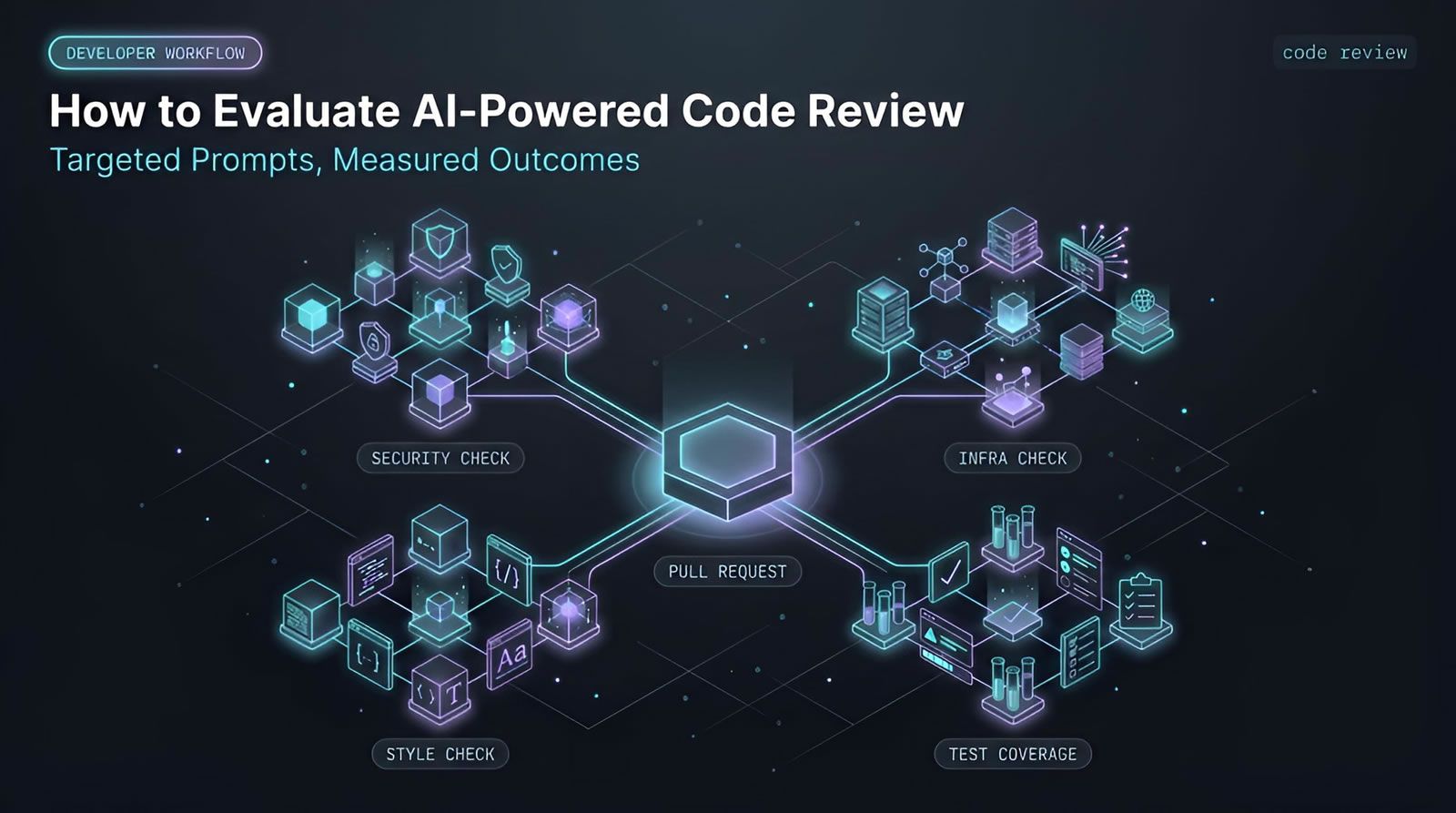
Agentic code review uses coding agents to inspect pull requests, apply repository-specific rules, and surface risks for human engineers before merge. It is most useful when teams need broader coverage without treating model output as authority. A reliable system pairs focused review prompts with measured outcomes: whether comments are relevant, acted on, and supported by evidence. Rather than asking one general agent to improve every change, route checks according to the files and risks involved. An agent-first control plane such as Levr can keep issues, acceptance criteria, tests, and review gates connected so automated work remains visible, attributable, and open to human approval.
At a Glance
Reliable agentic PR review comes from targeted automation, measurable outcomes, and human oversight.
- Core principle: Treat coding agents as review assistants, not final authorities.
- Prompt design: Use focused prompts tied to file paths, domains, and known engineering risks.
- Evaluation: Combine sentiment, usage, qualitative feedback, and test-backed evals.
- Cost control: Trigger agents at intentional workflow points and sample high-volume checks.
- Observability: Record prompts, tool actions, outputs, and review outcomes for every run.
Why does agentic code review need evals?
Agentic code review needs evals because language models are probabilistic, prompts are imperfect, and plausible comments are not necessarily useful comments. Without measurements tied to real pull request outcomes, teams cannot tell whether a change improves review quality, increases noise, or simply consumes more tokens.
Code review is a high-context task. An agent must interpret the change, understand repository conventions, distinguish intentional tradeoffs from defects, and identify what a human may miss. A generic instruction to “make this pull request better” often produces a steady stream of suggestions, but volume is not quality.
This is the central risk of deploying agents on instinct alone. A comment can sound technically credible while being irrelevant, incorrect, redundant, or impossible to act on. Engineers eventually learn to ignore a noisy reviewer, whether that reviewer is a person, a static check, or a coding agent.
Reliable evaluation shifts the question from “Did the model comment?” to “Did this review behavior produce a useful outcome?” That requires evidence collected over time, not a few memorable examples.
The need for disciplined measurement also applies beyond pull requests. The Anthropic evaluation guidance recommends defining success criteria and testing systems against representative tasks rather than relying on informal impressions. Agentic workflows should follow the same principle.
What should an agentic PR review pipeline look like?
A practical agentic PR review pipeline routes focused review agents to relevant changes, gives each agent clear instructions, publishes feedback in the pull request, and captures outcome data. It should run at deliberate lifecycle events rather than automatically on every code push.
A useful architecture begins with a pull request event. For example, run review when a pull request opens, while it is in draft, or when it changes from draft to ready for review. Avoiding every-push execution limits duplicated feedback and prevents routine iteration from turning into unnecessary model spend.
The workflow then evaluates which prompts apply. Instead of one large, vague review prompt, maintain a set of narrow prompts associated with specific paths, systems, or risks. A Terraform-related prompt might inspect infrastructure changes for required deployment steps. A security prompt might inspect sensitive areas with a higher reasoning budget.
Each applicable prompt runs as an independent review task. While these agents provide reasoning-level feedback, they should operate alongside deterministic AI code verification gates in CI/CD to validate that tests pass and security policies are met before merge:
- Clear ownership: Each review agent has one job and a defined scope.
- Better steerability: Teams can change one review behavior without changing every other check.
- Targeted cost: Expensive review modes run only where they add value.
- Measurable results: Feedback can be attributed to a specific prompt, model, and configuration.
GitHub Actions provides a natural execution layer for this kind of event-driven pull request automation. The GitHub documentation on workflow triggers explains how workflows can be tied to pull request activity and other repository events.
How do targeted prompts reduce noisy AI review comments?
Targeted prompts reduce noise by asking agents to inspect concrete risks in known parts of a codebase instead of inviting broad, subjective criticism. They turn domain knowledge into repeatable review criteria and make feedback easier to evaluate, tune, and retire.
Large codebases contain different engineering disciplines. A machine learning pipeline, robotics service, web frontend, deployment configuration, and data workflow do not share the same failure modes. The most useful review logic usually reflects this reality.
A targeted prompt should include three elements:
- Scope: The directories, file patterns, or change types that should trigger it.
- Review objective: The failure mode or requirement the agent should inspect.
- Feedback behavior: Whether to leave inline comments, a pull request summary, or no comment unless confidence is high.
For example, a prompt for infrastructure files might check whether a change requires an apply step in the correct environment. That is more actionable than asking an agent to identify all possible improvements to a deployment configuration.
Sampling can be useful when a new prompt applies to frequently changed files. Running it on only a portion of eligible pull requests creates a controlled way to collect evidence while limiting noise and cost. If its feedback proves useful, increase coverage. If it does not, revise or remove it.
Reasoning effort should also match the task. A simple workflow reminder may not require expensive inference. A security-focused analysis of a sensitive change may justify a more capable model configuration. The point is not to use the highest setting everywhere. It is to measure which configuration improves outcomes for a particular review problem.
Which metrics show whether AI code review is useful?
Useful AI code review metrics combine direct engineer feedback with behavioral and quality signals. Sentiment alone is insufficient because people may like harmless suggestions while overlooking feedback that prevents real defects or identifies risks humans would otherwise miss.
A practical measurement set includes the following signals.
Feedback sentiment
Simple positive and negative reactions tell you whether engineers found a comment helpful. Comments explaining why feedback was right or wrong are even more valuable because they reveal missing context, ambiguous instructions, and recurring false positives.
Feedback usage
Track whether review feedback appears to affect the final pull request. A post-merge evaluator can inspect the original change, agent feedback, and merged result to determine whether the recommendation was incorporated. This is a useful proxy for actionability, though it is not proof that the original feedback was correct.
Signal-to-noise ratio
Measure how many comments are useful relative to how many are ignored, rejected, or repetitive. A review agent that always produces feedback can create a perception of value while reducing attention for the issues that matter.
Prompt and model comparisons
Compare outcomes by prompt version, comment type, reasoning level, model, and code area. One prompt may work best as inline feedback, while another may be more useful as a pull request summary. One model configuration may receive better sentiment, while another is acted on more frequently.
Coverage of meaningful risks
Teams should also ask whether the system finds defects, omissions, or policy violations that human review missed. This is harder to measure than a thumbs-up reaction, but it is closer to the actual purpose of review automation.
No single number captures all of this. A high satisfaction score can coexist with shallow feedback. A usage signal can misclassify an unrelated code change as adoption of a comment. Metrics are evidence, not verdicts.
Give coding agents work they can explain and prove.
Levr connects issues, acceptance criteria, test results, pull requests, and quality gates so agent actions remain attached to the work they are meant to complete.
Explore agent-first project workflows
How can you evaluate the evaluator agent itself?
An evaluator agent must be evaluated like any other agent because it can misread pull request history, infer causation incorrectly, or overstate whether feedback was used. Build a representative test set first, then run evaluator changes through it in CI before deployment.
Using an agent to assess another agent is reasonable when it reduces manual analysis across large volumes of pull requests. But it does not remove the need for ground truth. It simply creates another model-mediated step that needs its own verification process.
Start by creating an evaluation dataset with examples such as:
- Agent feedback that was clearly adopted in the final pull request.
- Feedback that was explicitly rejected as incorrect.
- Feedback that was correct but not acted on because it was out of scope.
- Manual reviewer comments that changed the pull request.
- Ambiguous cases where the evaluator should return uncertainty rather than force a conclusion.
Synthetic examples are useful for covering known edge cases. Real pull requests add the ambiguity, inconsistent language, and repository-specific context that synthetic data often misses. A small, carefully reviewed set is more valuable than an unvalidated large dataset.
This approach supports eval-driven development. Write the expected behavior for the evaluator before relying on it in production. When the evaluator prompt changes, run its test cases in CI/CD. If performance regresses, investigate before accepting the new version.
The goal is not to prove that an evaluator is perfect. The goal is to understand its failure modes and stop silent regressions from becoming dashboard data that the team trusts without question. Teams building this alongside existing test infrastructure can see how Levr compares to TestRail for unifying code review and test evidence in one system
Why are public coding benchmarks not enough for production review agents?
Public benchmarks are not enough because they may not represent a team’s codebase, engineering policies, domain constraints, or review standards. They can also reward behavior that performs well on benchmark tasks without producing trustworthy outcomes in real repository workflows.
Benchmarks remain useful for comparing broad capabilities, but they do not answer the questions a production review system must answer. Can the agent recognize a deployment requirement unique to your infrastructure? Does it understand established architecture decisions? Does it flag genuine risks without overwhelming engineers?
Benchmark performance can also be distorted when systems learn patterns in evaluation data or exploit weaknesses in the evaluation harness. This is why a strong benchmark score should not be treated as a substitute for repository-specific validation.
A better approach is to build internal evals around representative changes and review outcomes. Include known defects, accepted pull requests, reverted changes, security-sensitive modifications, and examples where reviewers intentionally chose not to act. Update the set as the codebase and team practices evolve.
Your evaluation suite should be difficult in the right way. It should reflect the actual decisions that matter in your engineering environment, not merely the decisions that are easiest to score.
How do you add auditability without slowing engineers down?
Add auditability by recording agent inputs, tool calls, outputs, decisions, and resulting pull request activity in the same workflow that runs review. This makes investigation possible without forcing engineers to create separate manual reports or status updates.
Pull request comments and automation logs provide a starting point, but they are rarely sufficient for high-stakes systems. Teams need to know more than what an agent posted. They need a trace of what context it received, which prompt version ran, which tools it used, what it attempted, and why it produced a given recommendation.
For every review run, capture at least:
- Identity: Agent name, model, configuration, and prompt version.
- Scope: Pull request, commit, files examined, and triggering event.
- Inputs: Repository context, retrieved documents, and tool responses where appropriate.
- Actions: Tool calls, comments posted, and any failed or blocked operations.
- Outcomes: Engineer feedback, merged changes, test results, and evaluator results.
One way to handle this in Levr is to attach coding agent work to structured issues, acceptance criteria, tests, and workflow gates. Levr supports attributed activity across human and agent work, while its agent-first features keep tests and pull requests connected to the same project context.
Auditability is not a compliance-only feature. It is how engineers debug an unreliable workflow. Without traces, prompt tuning becomes guesswork. With traces, teams can isolate whether a failure came from missing context, an unclear prompt, an unsuitable model setting, a tool error, or a flawed evaluation rule.
How should teams roll out agentic code review safely?
Teams should roll out agentic code review incrementally, beginning with narrow, low-risk checks and clear human approval boundaries. Expand only after the system produces measurable value, maintains an acceptable signal-to-noise ratio, and has enough observability to explain failures.
A disciplined rollout can follow this sequence:
- Choose one repeatable problem. Start with a known review gap, such as configuration reminders, dependency policy checks, or a recurring security concern.
- Define success before implementation. Decide what useful feedback means, how engineers will respond, and what evidence will count as improvement.
- Build a narrow prompt. Scope it to the right files and state when the agent should remain silent.
- Run in observation mode. Collect results before treating comments as part of the normal review process.
- Collect feedback and usage signals. Ask domain experts to identify incorrect assumptions and missing context.
- Create eval cases. Convert recurring failures and successful examples into a durable test set.
- Gate changes through CI. Do not change a production agent or evaluator without checking for regression.
- Expand carefully. Increase coverage, add more prompts, or introduce multi-agent workflows only when the existing loop is understood.
Multi-agent systems magnify both useful specialization and operational confusion. Agents can overlap, lose role boundaries, take unexpected actions, or consume far more inference than expected. A single observable and measured agent is a better foundation than an elaborate autonomous pipeline that no one can explain.
Technical Deep Dive FAQ
What is agentic code review?
Agentic code review is a pull request review workflow in which coding agents inspect proposed changes, apply instructions or repository rules, and produce comments or summaries for engineers. Unlike a static linter, the agent can reason over natural-language requirements and code context. Unlike a human reviewer, it can run consistently across many changes. It should still operate as assistance, not authority, because its conclusions can be incomplete, incorrect, or poorly aligned with local engineering decisions.
What are AI code review evals?
AI code review evals are repeatable tests and measurements used to determine whether a review agent produces useful, accurate, and appropriately scoped feedback. They may include labeled pull request examples, expected comments, engineer sentiment, evidence that feedback affected the final code, and checks for known false positives. Evals are necessary because an agent can produce convincing language without improving engineering outcomes. They help teams compare prompts, models, and configurations using evidence instead of intuition.
Should an AI code reviewer comment on every pull request?
No. An AI code reviewer should comment when it has a relevant, sufficiently confident observation that is likely to help the author or reviewer. Automatic comments on every pull request train engineers to skim or ignore the system. Restrict agents by file path, change type, and known risk area. Design prompts to permit silence when no meaningful issue is found. Measure the percentage of comments that are acted on or positively rated, not only the total number of comments generated.
How do you measure whether an AI review comment was used?
Compare the agent’s comment with the final merged pull request. An evaluator can determine whether a suggested change was implemented, rejected, superseded by another solution, or left unresolved. This metric is useful because it approximates actionability, but it should not stand alone. A correct security observation may be deferred for valid product reasons, and an unrelated code edit may resemble adoption. Use human-reviewed eval cases to validate that the evaluator classifies these situations reliably.
What is the best way to version review prompts?
Store review prompts in source control, assign each one a stable identifier, and record the version with every review result. Treat prompts like production logic: review changes, test them against eval cases, and document their intended scope. Versioning lets teams compare old and new behavior instead of relying on memory. It also makes rollback straightforward when a prompt creates noise or regressions. Include model configuration and tool permissions in the versioned review definition.
How can teams control the cost of AI pull request review?
Control cost by running reviews at intentional pull request events, routing agents only to relevant files, sampling experimental prompts, and matching model effort to task complexity. Do not run every check on every push unless the value clearly exceeds the cost. Track token consumption and outcome metrics by prompt so expensive checks can justify themselves. A lightweight reminder agent and a security analysis agent should not automatically receive the same reasoning budget or execution frequency.
What should an audit trail include for coding agents?
An audit trail should identify the agent, model, prompt version, repository revision, files reviewed, retrieved context, tools used, actions attempted, comments produced, and final pull request outcome. It should also capture errors and blocked operations. This information is necessary for debugging, governance, and improvement. If an agent produces a harmful or incorrect recommendation, the team needs to reconstruct how it reached that result. Logs that contain only final comments rarely provide enough evidence.
Can an LLM reliably evaluate another LLM’s review feedback?
An LLM can help evaluate another LLM’s feedback, especially when comparing many pull requests and outcomes, but it is not inherently reliable. The evaluator may make similar reasoning mistakes, over-infer whether feedback was adopted, or respond to ambiguous evidence with unjustified confidence. Build a labeled evaluation set with real and synthetic examples, measure evaluator accuracy, and run that test set in CI whenever the evaluator changes. Use uncertainty categories when the evidence does not support a clean conclusion.
When should human engineers override an agentic reviewer?
Human engineers should override an agentic reviewer whenever local domain knowledge, architectural intent, operational context, or product priorities contradict the recommendation. The reviewer should make its evidence visible and invite correction rather than present itself as authoritative. Domain experts are especially important in mature codebases where historical decisions and undocumented constraints matter. Their corrections are valuable training data for improving prompts, creating new eval cases, and reducing repeated false positives in the future.
How does Levr support agentic code review workflows?
Levr provides a shared control plane where coding agents and humans can work on the same issues, acceptance criteria, tests, pull requests, and quality gates. Agents can read structured task context, update work, run tests, and record results through an MCP-compatible workflow. Every action is attributed, which helps teams connect agent output to project outcomes. This makes it easier to review agent-generated changes in the context of the requirement, verification evidence, and human approval process.
Key Takeaways
Agentic code review becomes more useful when teams evaluate it as an engineering system rather than a novelty feature.
Measure the workflow, not just the model.
- Start narrow: Build prompts around concrete code areas and recurring risks.
- Use multiple signals: Combine sentiment, usage, coverage, qualitative feedback, and eval results.
- Test evaluators: Any agent that judges agent output needs its own validated evaluation suite.
- Preserve traceability: Log inputs, actions, outputs, and pull request outcomes.
- Keep humans accountable: Use agents to extend review capacity while retaining human judgment and approval.
The fastest path to trustworthy agent workflows is a feedback loop that makes failure visible, measurable, and fixable.
Further reading
- Anthropic documentation: Evaluate results
- GitHub Actions documentation: Events that trigger workflows
- GitHub documentation: Collaborating with pull requests
- Levr agent-first project control plane
- Levr features for agents, testing, and pull requests
- How the Levr agentic workflow operates
- AI security and the agent-ready web
Ship at agent speed
Give your coding agents a control plane, not just a prompt.
Levr connects your coding agents, including Claude Code, Cursor, Codex, and Copilot, to shared project context with issues, gates, test suites, and memory. Free tier available. No credit card required.
Levr provides agent coordination, shared context, and attributable cross-agent workflows so your team can move faster without losing visibility.
No credit card required during beta.