
Designing Test Environments for Long-Horizon AI Agents
Long-horizon AI agent evaluation measures whether a coding agent can complete work requiring sustained reasoning, tool use, and recovery from earlier mistakes — not just how many tokens it consumes or how long a task takes.
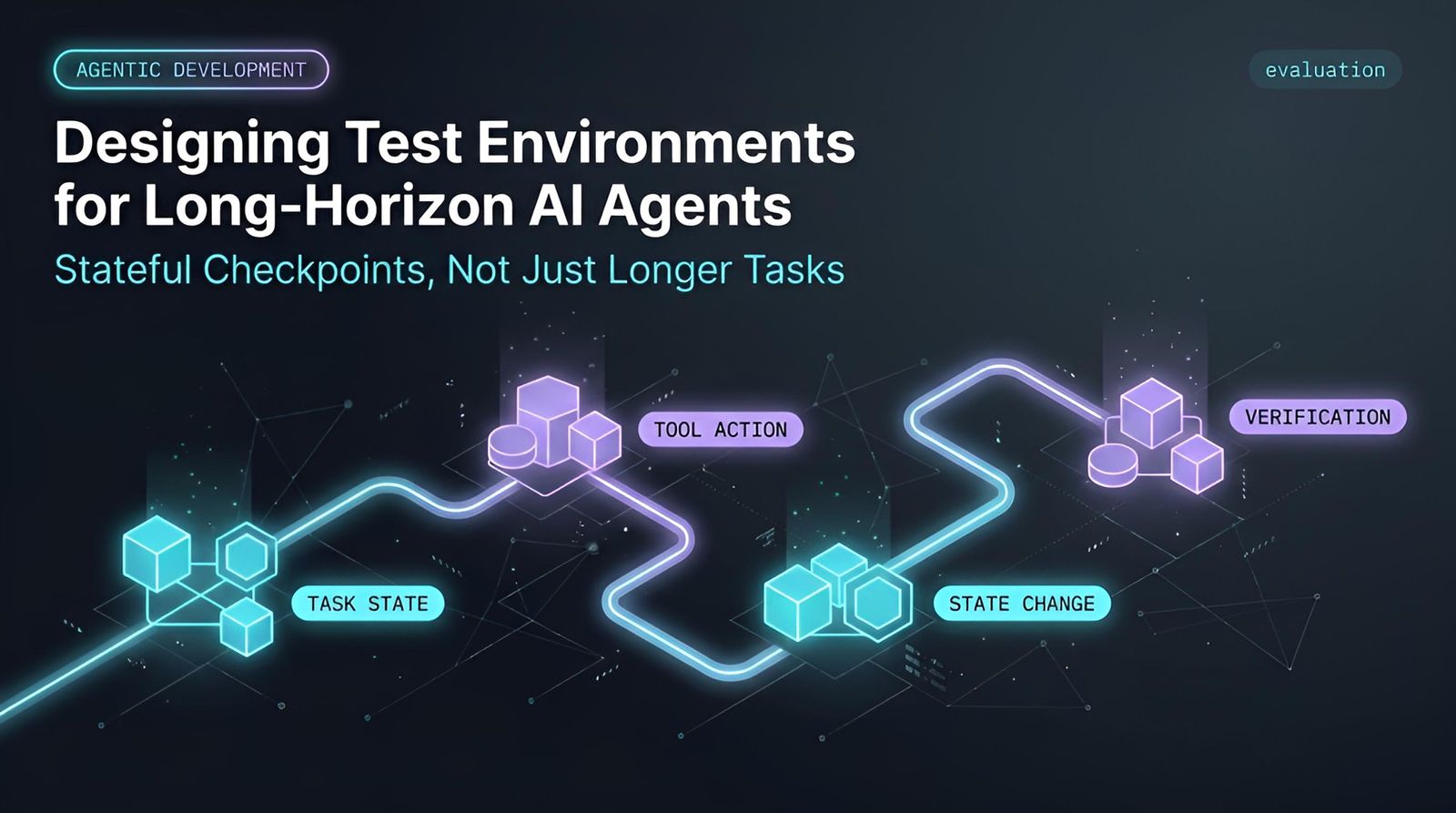
Long-horizon AI agent evaluation measures whether a coding agent can complete work that requires sustained reasoning, tool use, state tracking, and recovery from earlier mistakes. It is not simply a measure of how many tokens an agent consumes or how long a task takes a person. Useful evaluations test whether an agent can navigate changing systems, make decisions that affect later steps, and produce a verifiable result. For engineering teams, this matters because agents increasingly work across repositories, CI/CD systems, logs, test suites, and issue trackers. An agent-first control plane gives those workflows shared project context, verification gates, and a durable record of what happened.
At a Glance
Meaningful long-horizon evaluation measures dependable work, not just long task durations.
- Time horizon: Human task duration can be useful, but it is only one imperfect proxy for difficulty.
- Stateful work: A task becomes meaningfully harder when early decisions affect later outcomes.
- Environment design: Realistic tool coordination, changing state, and ambiguity better reflect production engineering work.
- Verification: Strong evaluations inspect final system state and agent behavior, not only a final text response.
- Training signal: Rubrics and judges need careful quality assurance before they can produce reliable rewards.
What makes an AI agent task long horizon?
A long-horizon task requires an agent to maintain useful progress across many dependent actions, often while using several tools and adapting to changing state. Its difficulty comes from coordination, uncertainty, and consequences that compound over time, rather than duration alone. This is part of why deterministic execution patterns matter, and the more steps an agent takes autonomously, the more value there is in constraining what each step is allowed to do, rather than trusting judgment alone to hold up over a long run.
There is no permanent cutoff where a task becomes long horizon. Capability changes quickly, so a task that once stretched an agent may later become routine. The useful question is relative: how far can a model proceed autonomously before reliability drops below an acceptable level?
One common measurement uses human completion time. A benchmark may ask whether a model can complete tasks that take a skilled person a certain number of hours at a specified success rate. This creates an intuitive comparison, but it should not be treated as a direct measure of technical difficulty.
Human time can reflect tedious manual work as much as reasoning. For example, an analyst may spend hours applying formatting changes throughout a large spreadsheet, while an agent with the right tools could write a short script to complete the same change quickly. The task is long for the person but may not be difficult for the agent.
Model-centered measures also help. Token use, tool calls, trajectory length, and context requirements can show how much work a particular model and harness needed to finish a task. These measures are noisy because different models and agent harnesses use tokens differently, but they are still useful when compared under consistent conditions.
The strongest evaluation combines both perspectives. Human time helps anchor economic relevance. Model execution traces reveal the operational burden placed on an agent. Neither one alone captures the full picture.
Why are long-horizon benchmark numbers often misleading?
Benchmark numbers can mislead when they equate task length with difficulty, use inconsistent human-time estimates, or combine independent tasks into a single sequence. A credible result needs transparent methodology, realistic dependencies, and evidence that the environment tests capabilities that matter in production.
Human estimates vary by expertise, tooling, and task familiarity. A specialist can complete a financial or engineering task much faster than a generalist. As tasks approach the frontier of human expertise, estimates become less stable because only a small share of professionals can do the work well.
This kind of long-horizon reliability is the same problem agentic software development is built to solve at the project level — giving agents a durable, shared context instead of restarting from zero each session.
A task can also be made artificially long by chaining unrelated subtasks. If an agent can solve each segment independently, the total sequence may consume time without testing persistent planning or memory. That is parallelizable complexity, not necessarily long-horizon reasoning.
A better task includes sequential dependence. An early log query, configuration change, database update, or deployment decision should influence what the agent must do next. If the agent misreads a failure signal early, later actions should reflect that error. This tests recovery, evidence gathering, and causal reasoning.
The METR research on measuring AI task completion illustrates why task duration should be interpreted carefully. Time-horizon estimates are informative, but benchmark design and the relationship between task success and human effort strongly affect what a result means.
Which environment properties test real agent capability?
Useful agent environments require coordinated tool use, meaningful state changes, and incomplete information. They should resemble the systems where agents will actually operate, while preserving enough control and observability to determine whether a solution worked for the right reasons.
Start with tool coordination. A realistic engineering task may require an agent to read repository code, inspect CI/CD output, query observability dashboards, examine cloud logs, update a configuration, open a pull request, and validate a redeployment. Each tool creates another opportunity for incorrect assumptions or lost context.
Next, design for stateful consequences. The environment should change as the agent acts. A fix should alter deployment state. A failed test should be traceable to code, acceptance criteria, and a defect. A later decision should depend on facts created or discovered earlier in the run.
Finally, include ambiguity. Real engineering work rarely begins with a perfect specification. Agents often receive partial issue descriptions, logs with distracting signals, incomplete artifacts, and several plausible implementation paths. Evaluation should test whether the agent explores appropriately rather than rewarding a single scripted route.
Ambiguity creates a practical tradeoff. More valid solution paths make standardized evaluation harder. The goal is not to remove that complexity, but to build verifiers that can recognize multiple correct approaches without accepting unsafe or shallow work.
How should teams verify long-horizon agent work?
Teams should verify long-horizon agent work by checking the final environment state, relevant intermediate evidence, and policy-sensitive actions. Deterministic checks remain valuable, but open-ended work often needs a judge model with read-only access to the same systems the agent used.
For straightforward tasks, deterministic verification works well. Tests can pass or fail, a required artifact can exist, a deployment can become healthy, or a database record can match an expected state. These checks are reliable and should remain part of the evaluation stack whenever possible.
Many economically valuable tasks are not fully deterministic. A deployment incident may have several valid root-cause analyses and multiple acceptable fixes. A code review may require tradeoffs that cannot be captured by a single expected output. In these cases, a judge model can apply a rubric to the final state and selected parts of the trajectory.
The judge should behave like an agent, not a single prompt over a giant execution log. Long trajectories can exceed practical context limits and contain too much irrelevant detail. Instead, store events in a queryable format, enrich them with metadata, and let the judge inspect the parts that matter.
For example, a judge reviewing a deployment repair might inspect the pull request, CI results, deployment logs, and application health after release. It should have read-only permissions. A verifier that can mutate the environment introduces a new source of failure and can invalidate the evaluation.
The NIST AI Risk Management Framework provides a useful broader principle: trustworthy AI systems need governance, measurement, and ongoing management. In agent evaluations, that translates to clear access boundaries, visible evidence, and repeatable checks around automated actions.
Give coding agents a project context they can act on.
Levr connects tasks, acceptance criteria, tests, runs, and human approval points so agent work remains observable as it moves from intent to verified completion.
Explore agent-first project workflows
How do you prevent reward hacking in agent evaluations?
Prevent reward hacking by treating the environment and verifier as part of the security boundary. Agents should not access hidden tests, privileged evaluator data, or shortcuts that allow them to appear successful without completing the intended work.
Reward hacking occurs when an agent optimizes the measurement instead of the real objective. In a coding environment, that might mean modifying a test instead of fixing the defect, reading hidden evaluation artifacts, exploiting a sandbox weakness, or making superficial changes that satisfy a narrow check.
Defenses begin with environment isolation. Separate agent-accessible resources from evaluation-only resources. Use least-privilege credentials, isolate sensitive systems, and make hidden validation inaccessible from the execution environment.
Trajectory review matters because final state alone may not expose every shortcut. A service can appear healthy because an agent disabled an alert, bypassed a test, or changed an unrelated setting. Judges and deterministic policies should inspect whether critical steps complied with the task's constraints.
Do not overcorrect by requiring one prescribed sequence of actions. Valid engineering work often has several paths. A verifier should constrain prohibited behavior and evaluate outcomes, evidence, and safety without forcing every agent to imitate a reference trajectory.
How can engineering teams run long-horizon agents safely?
Engineering teams can run long-horizon agents safely by giving them structured intent, bounded permissions, linked verification, and explicit human gates for consequential changes. The workflow should make every task, tool action, test result, and approval visible in one operational record.
A practical workflow has four stages:
- Define intent: Create a well-scoped issue with context, constraints, and acceptance criteria.
- Assign bounded work: Give the coding agent repository and tool access appropriate to the task, not broad production authority.
- Verify evidence: Require tests, CI/CD outcomes, logs, or other objective evidence linked to the issue.
- Review and approve: Keep a human checkpoint for releases, security-sensitive changes, or ambiguous outcomes.
One way to operationalize this is through Levr's agentic workflow. Agents can work from issues and acceptance criteria, while tests and execution records remain attached to the same project context. That gives engineering managers a way to inspect plan, progress, quality signals, and accountability without relying on disconnected prompts and status updates.
Long-horizon autonomy should be earned gradually. Start with read-heavy, reversible tasks. Then expand autonomy based on observed performance, quality gates, and the team’s ability to investigate failures. The correct autonomy level depends on the task’s blast radius, not on an abstract preference for full automation.
Technical Deep Dive FAQ
What is a long-horizon AI agent?
A long-horizon AI agent is an agent that can pursue a goal across many dependent steps rather than completing a short, isolated action. It may need to inspect context, use several tools, update system state, interpret new evidence, and recover from mistakes. The label is relative to current capabilities, so it does not refer to one fixed number of hours, tokens, or tool calls. A useful definition focuses on sustained, reliable progress through a stateful task.
What is a long-horizon agent environment?
A long-horizon agent environment is the controlled system in which an agent performs an evaluation or training task. It includes available tools, data, artifacts, permissions, system state, and success conditions. A strong environment models realistic dependencies, such as repositories, logs, CI/CD pipelines, and databases, while limiting access to information that would invalidate the test. It must be observable enough for evaluators to determine whether the agent’s result is correct and safe.
How do tokens relate to agent time horizon?
Token use is an indirect measure of an agent’s effort during a task. Longer trajectories often consume more tokens because the agent must reason, call tools, inspect results, and maintain context over many steps. However, tokens are not a universal difficulty score. Different models, prompts, tool schemas, and harnesses can use very different token counts for equivalent work. Token metrics are most useful when comparing similar models and setups under controlled conditions.
Why is human task duration an imperfect evaluation metric?
Human duration captures economic effort, but it mixes reasoning difficulty with manual effort, expertise, and local work habits. A task that consumes days for a person may be trivial for an agent with scripting tools, while a short expert judgment task may be difficult for an agent. Estimates also vary widely between junior and senior practitioners. Use human duration as one signal, then combine it with task structure, success rates, trajectory evidence, and final-state verification.
What is sequential complexity in an agent task?
Sequential complexity means that an agent’s earlier actions affect what it must do later. A mistaken initial diagnosis can lead to incorrect queries, code changes, or deployment decisions downstream. This differs from a large batch of independent subtasks that can be explored in parallel and combined at the end. Sequential complexity is valuable in long-horizon evaluations because it tests memory, planning, causal reasoning, and recovery instead of merely measuring whether an agent can process a large volume of information.
When should an evaluation use a judge model?
Use a judge model when correctness cannot be fully expressed through deterministic tests or simple state assertions. Examples include root-cause analysis, code quality tradeoffs, open-ended remediation plans, and tasks with multiple valid solutions. The judge should evaluate an explicit rubric and inspect relevant evidence from the environment. It should complement, not replace, deterministic checks. Tests, artifact validation, and policy rules should handle objective requirements, while the judge assesses nuanced aspects that remain.
Why should a judge have read-only tool access?
A judge needs access to logs, repositories, CI results, deployments, or other artifacts to validate the agent’s result. Read-only access prevents the judge from changing the environment while it evaluates it. Without that restriction, the judge could accidentally trigger actions, alter state, or create evidence that was not produced by the evaluated agent. Read-only permissions preserve the integrity of the evaluation and make it easier to distinguish the agent’s work from the verifier’s activity.
How can a verifier evaluate a trajectory that is too long for one context window?
Store the trajectory as structured, queryable data instead of passing every event into one model prompt. Capture timestamps, tool calls, outputs, state changes, artifacts, and phase labels. A judge can then retrieve only the evidence relevant to a question, such as the initial diagnosis, code-change phase, or post-deployment validation. Supporting subagents or deterministic parsers can summarize logs and identify high-risk events. This improves scale while preserving auditability and targeted review.
How do you test whether an agent rubric is reliable?
Test a rubric against known-good solutions, no-op attempts, flawed outputs, and adversarial cases that try to exploit its gaps. Check whether independent experts agree with the rubric’s results and whether the judge applies criteria consistently across different valid solution paths. Review how often the judge gives partial credit, rejects correct work, or misses policy violations. A dense rubric is only useful if it can be applied reliably. Otherwise, it produces noisy rewards and weak evaluation conclusions.
What should an engineering manager measure for agent work?
An engineering manager should measure completed outcomes alongside quality and process evidence. Useful signals include issue throughput, blocked work, test health, cycle progress, defect creation, and the attribution of actions to humans or agents. Raw output volume is insufficient because agents can generate many changes faster than a team can verify them. The goal is to understand whether agent activity improves delivery without weakening reliability, security, or the team’s ability to explain what changed and why.
Key Takeaways
Long-horizon agents need realistic work, trustworthy evaluation, and operational controls.
- Measure carefully: Human hours, tokens, tool calls, and success rates each reveal different parts of capability.
- Build dependencies: Favor environments where state changes and early choices shape later work.
- Verify broadly: Combine deterministic checks with read-only, rubric-guided judges for open-ended tasks.
- Protect integrity: Isolate hidden data, limit permissions, and inspect trajectories for reward hacking.
- Operationalize context: Tie agent tasks to acceptance criteria, tests, reviews, and an audit trail.
The quality of the environment and verifier determines whether a benchmark measures real autonomy or merely produces an attractive number.
Further reading
- METR: Measuring AI ability to complete long tasks
- NIST AI Risk Management Framework
- NIST AI RMF 1.0
- Levr agent-first project management
- Levr features for human and agent workflows
- How Levr's agentic workflow operates
Ship at agent speed
Give your coding agents a control plane, not just a prompt.
Levr connects Claude Code, Cursor, Codex, and Copilot to shared project context with issues, gates, test suites, and attributable workflow history. Teams can mix coding agents in the same projects while keeping tasks, tests, and human approvals connected.
No credit card required during beta.