
How Engineering Managers Measure AI Coding ROI
Software factory is a practical term for a development system where agents do more than assist with code completion. They pick up scoped work, generate changes, review output, file follow-up tasks, and push delivery forward with limited human intervention.
Software factory is a practical term for a development system where agents do more than assist with code completion. They pick up scoped work, generate changes, review output, file follow-up tasks, and push delivery forward with limited human intervention. Instead of treating coding help as a one-off prompt, teams structure work as a flow that can be routed, inspected, and improved over time. That usually means issues, pull requests, automated checks, review loops, and some shared memory around project context. For teams building this way, Levr represents the same shift in tooling: a control plane where work, tests, agents, and human approval live together.
At a Glance
Software factories turn agent output into a managed delivery system.
- Definition: A software factory is a workflow where code-generating agents operate inside a repeatable system for planning, implementation, review, and verification.
- Core idea: Work becomes the main thing you manage, not individual prompts.
- Why it matters: Once multiple agents run in parallel, humans become bottlenecks unless the workflow itself is redesigned.
- Main risk: Teams can overspend tokens, lose track of work, or build brittle orchestration if they automate too much too early.
- Best starting point: Begin with one repeated workflow, then add checks, reviews, and routing as patterns emerge.
What makes something a software factory instead of just using a coding agent?
A software factory starts when you stop treating the agent as a one-off assistant and start writing systems that direct agents through work. The key difference is orchestration. You are no longer pair programming with one model. You are managing how work gets created, routed, checked, retried, and completed.
That shift matters because a single coding session does not create the same operational problems as a multi-agent workflow. Once you have agents generating issues, opening pull requests, reviewing code, or scanning a codebase for defects, you need a way to track what exists, what is in progress, and what has already been accepted.
In practice, software factories usually have a few traits:
- Work is explicitly represented as issues, tasks, tickets, or specs.
- Agents can act in parallel across multiple pieces of work.
- Review is layered, often with agents reviewing agents before humans step in.
- Verification is automated with tests, linting, or targeted checks.
- The system is maintained over time instead of being rebuilt from scratch for every prompt.
If you are writing code that makes agents do things in a repeatable flow, you are in software factory territory.
Why does work become the center of the system?
In a software factory, work becomes the main unit of control because agents can create, duplicate, lose, or transform it faster than humans can manage manually. Once tasks move through multiple stages, you need a durable representation of what exists and where it is in the lifecycle.
This is one of the biggest conceptual changes in AI-native development. Traditional development tools often assume people are the main actors and tickets are lightweight coordination objects. In a factory model, the tickets, specs, bug reports, and review comments are the raw material moving through the system.
That means work often needs at least three views:
- Future work: public, claimable, discussable, and easy to reprioritize.
- In-progress work: expanded into substeps, partial outputs, and intermediate reasoning.
- Finished work: compressed into a result that can be reviewed, merged, and remembered.
Without that structure, parallel agents create confusion fast. Two agents may solve the same problem differently. One may generate follow-up bugs while another is already patching the original issue. A review agent may file findings that never get routed back into implementation.
This is also where agent-first control planes become useful. Platforms like Levr’s shared project and testing system are built around the idea that issues, tests, approvals, and agent activity need to live in one operational layer, not across disconnected prompts and markdown files.
Leadership-Level ROI Visibility: The Levr Dashboard
Measuring AI coding ROI requires seeing velocity, output quality, and pipeline health in one place — not stitched together from separate tools. The Levr Dashboard gives engineering managers exactly that leadership-level view across the full team.

The Levr Dashboard gives engineering managers a real-time view of agent velocity and output quality alongside human-led work.
How do software factories actually process work?
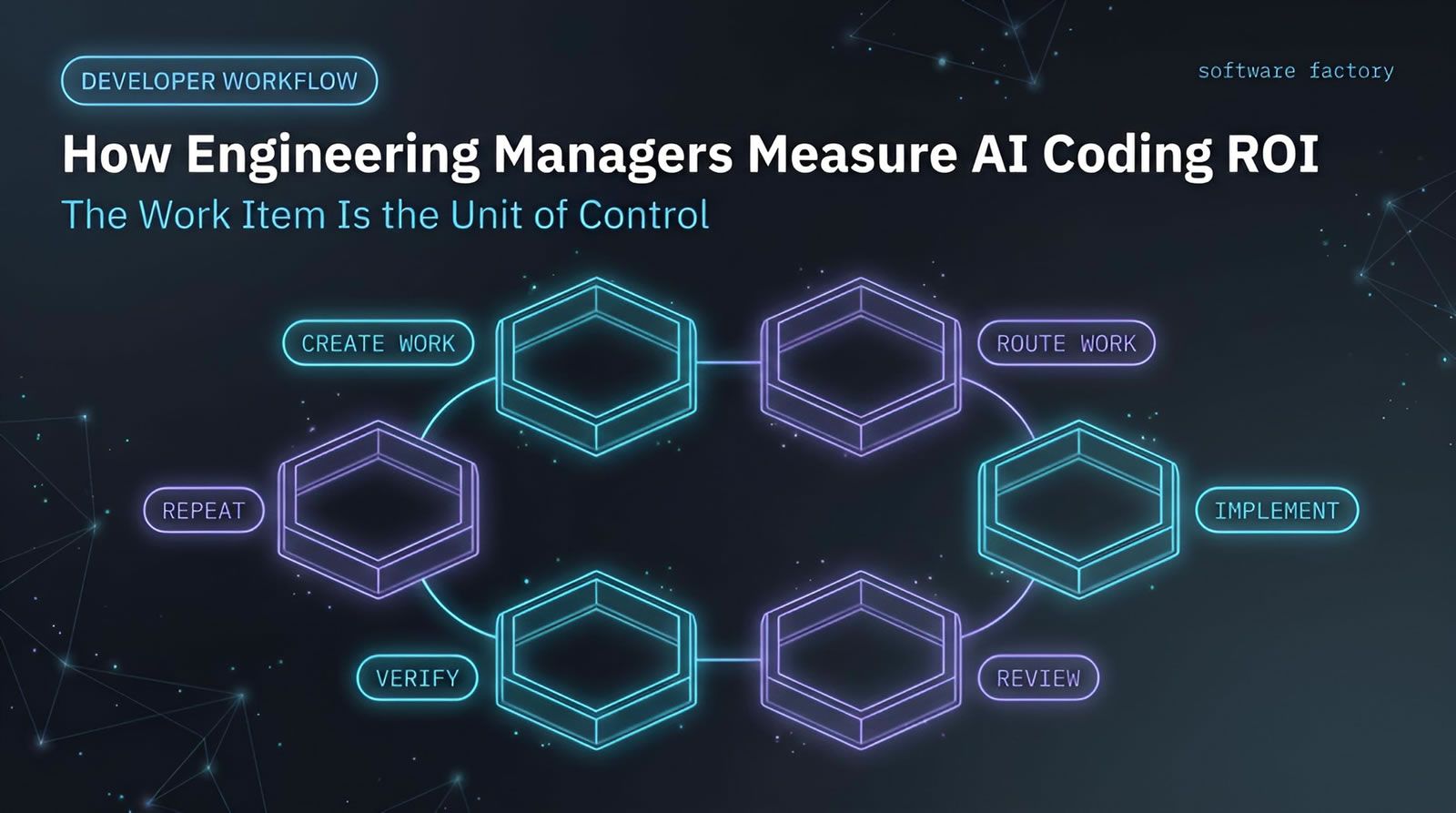
Most software factories follow a repeating loop: generate or ingest work, implement it with agents, review the output, then create new work from what the review uncovers. The specific tools vary, but the rhythm is consistent.
A common pattern looks like this:
- Create work: issues, audits, bug reports, refactors, or design tasks.
- Route work: send tasks to one or more agents based on complexity or scope.
- Implement: agents modify code, tests, docs, or configs.
- Review: separate agents inspect the result and file defects or improvements.
- Verify: run automated checks such as tests, linters, or targeted quality scans.
- Repeat: unresolved findings become new work items.
This can feel expensive because every pass consumes tokens. But the point of the factory is not a perfect first try. It is throughput plus controlled iteration.
That mindset is closer to manufacturing than handcrafted coding. You do not assume one pass gets everything right. You assume the system needs multiple passes, with different roles handling different parts of the lifecycle.
For teams using a control plane, the workflow can become even more explicit. One practical pattern is the four-step flow described in Levr’s agentic workflow: define intent in natural language, let agents pick up scoped tasks, run automated verification, and require human review before merge.
What are the common building blocks of a software factory?
Most factories are bespoke, but the same components keep showing up. Teams repeatedly need a place to track work, a way to run agents, a review layer, and some form of verification and memory.
Even if no two teams build the same exact system, the recurring parts are familiar:
- An issue tracker or task store for defining and routing work.
- Source control integration so agents can create branches, commits, and pull requests.
- Execution environments for long-running or parallel agent tasks.
- Automated review that checks code before humans spend time on it.
- Verification layers such as tests, linting, and policy checks.
- Shared project memory so context survives across runs.
Some teams also build a “brain” for each project. That can be a structured knowledge base, a graph of work, or a repository of specs and decisions. The exact format matters less than the function. Agents need access to project memory that is more durable than a single context window.
When multi-agent coordination becomes important, infrastructure matters too. This is where Levr fits naturally. Its message bus, shared memory, and routing model line up with the exact problems factory builders run into once they outgrow isolated agent sessions.
How much orchestration should you build yourself?
The safest answer is less than you think at first. Teams often begin with heavy, deterministic orchestration, then remove pieces when the workflow becomes brittle. Too much plumbing can become harder to maintain than the agent behavior it was supposed to control.
This is a common trap. A team sees a repeated pattern and immediately tries to formalize every step. But software factories live in an environment where tasks vary, models improve, and workflows keep changing. Rigid orchestration breaks when real work does not follow the template.
A better pattern is:
- Be explicit about work states.
- Be strict at the edges, especially before merge or release.
- Be flexible in the middle, where agents need room to adapt.
In practical terms, that means using deterministic checks for things like:
- Did tests run?
- Was the work committed?
- Was a pull request opened?
- Did required verifications pass?
But inside the implementation loop, many teams get better results by giving agents enough tooling to handle the flow directly rather than forcing every task through a fragile orchestrator.
This also explains why bottom-up adoption tends to work better than top-down grand designs. It is easier to automate one recurring task well than to define the perfect end-to-end factory before you have operational evidence.
Want a control plane for agent work instead of stitched-together prompts?
Teams building software factories need shared context, task state, tests, and review gates in one place. See how Levr structures agent workflows.
Why do review and verification matter more in a factory model?
Review and verification matter more because software factories amplify both output and mistakes. Once agents can generate work continuously, a small recurring failure can spread across dozens of tasks before a human notices.
That is why successful factories treat review as a system, not a meeting. Human review still matters, but the first line of defense often becomes agent review plus automated verification.
Useful review layers include:
- General code review: broad checks for correctness, style, and obvious defects.
- Targeted review: focused rules for architectural boundaries or known failure patterns.
- Automated verification: unit tests, linting, CI/CD, and other hard gates.
- Periodic sweeps: whole-codebase scans for architecture drift, weak tests, or duplication.
One especially practical technique is mutation testing. Instead of just measuring whether code was executed during tests, mutation testing changes the code in ways that should break behavior, then checks whether tests actually catch it. This can reveal coverage that looks fine on paper but misses real edge cases.
That matters because coverage numbers alone can be misleading. Mutation testing often exposes boundary assumptions and weak assertions that ordinary coverage metrics miss.
For broader context, the quality problem is not theoretical. The Stack Overflow Developer Survey 2024 shows continued developer use of AI tools alongside concerns about reliability and trust. A factory multiplies output, so those trust concerns need operational answers, not optimism.
What mistakes do teams make when building software factories?
The most common mistakes are spending too many tokens too early, overengineering orchestration, and failing to maintain the factory itself. A software factory is not a one-time build. It behaves more like a workshop that constantly needs cleanup, repair, and adaptation.
Here are the big failure modes to watch:
- Token maxing without discipline: parallel agents can create a shocking amount of work and cost.
- Assuming one-pass perfection: trying to force flawless output instead of designing multi-pass review.
- Keeping obsolete rules forever: old prompts, checks, and workarounds pile up after model improvements.
- No maintenance role: every factory needs ongoing hygiene, not just new features.
- Weak work tracking: if tasks can be duplicated or lost, throughput turns into noise.
- Training too late: organizations talk about advanced automation before teams know how to use agents productively.
The maintenance point is easy to underestimate. Every time a team uses a factory, they discover a little bit of drift. Skills age. Documentation goes stale. Routing assumptions break. Model behavior improves and makes old instructions unnecessary.
That means your system needs to remember and forget. Keeping every workaround forever makes the factory slower and worse over time.
This dynamic mirrors larger industry patterns. The GitHub Octoverse reporting has documented how quickly AI-assisted development has become mainstream. As adoption rises, the question stops being whether teams use agents and becomes whether they can operate them sanely at scale.
How is the software engineering job changing in a factory world?
Software engineering shifts upward in abstraction when factories work well. Less time goes into typing every implementation detail, and more time goes into shaping work, maintaining systems, reviewing outcomes, and deciding what should happen next.
That does not mean engineering disappears. It means the center of gravity moves.
Skills that become more important include:
- Task shaping: breaking work into units agents can execute.
- System design: defining the flow between planning, implementation, review, and release.
- Quality engineering: deciding what must be verified and how.
- Model routing: choosing where high-intelligence models are worth the cost.
- Factory maintenance: improving prompts, rules, memory, and tooling as the environment changes.
There is also a cultural shift. Teams that once prized individual implementation speed may start valuing throughput design, quality loops, and operational judgment more heavily.
Some specialist roles may blur together. Design, product thinking, architecture, test quality, and engineering management can all move closer because the implementation bottleneck changes shape.
For engineering managers, this also creates a visibility problem. If agents are doing a meaningful portion of delivery work, you need a way to observe velocity, output quality, and review load across both human and machine contributors. That is one reason agent-first platforms focus on observability, not just execution.
How should a team start building a software factory without overcomplicating it?
The best way to start is with one repeated workflow that already costs your team time. Automate that unit first, then add review, testing, and routing only after you see where failures actually happen.
A practical starting sequence looks like this:
- Pick one recurring task such as bug triage, code review, test improvement, or routine implementation work.
- Represent it as explicit work in issues, tickets, or specs.
- Let one agent execute the task end to end in a controlled environment.
- Add hard edge checks like tests, linting, or PR requirements.
- Review the failures and turn repeated problems into targeted checks.
- Add a sweep for whole-codebase quality or architecture drift.
- Only then add more orchestration if the evidence says it is needed.
One way to do this in Levr is to define the intent in natural language, let connected coding agents pick up the work, run native verification against the result, and keep merge approval with a human lead. That maps closely to how many teams are already converging on software factory patterns, just with less glue code and less context loss.
If your team expects multiple agents to collaborate across runs, that is also the point where infrastructure like shared memory and routing stops being optional. The more parallel your system gets, the more expensive disconnected context becomes.
Technical Deep Dive FAQ
What is a software factory in plain English?
A software factory is a repeatable development system where agents help move work from idea to merged result with less human intervention than a normal coding workflow. Instead of one person prompting one model in one session, the team manages tasks, reviews, checks, and routing as an ongoing process. The important shift is that the workflow itself becomes a product you maintain, not just a collection of prompts you reuse occasionally.
How is a software factory different from pair programming with AI?
Pair programming with AI usually means a human is actively steering one coding agent in real time. A software factory goes further by having systems that create, assign, verify, and review work across multiple agents or repeated workflows. The human is still involved, but more as a designer, reviewer, and operator of the system. The difference is not the model. It is the move from direct assistance to orchestrated delivery.
Do software factories require multiple agents?
No, but the pattern becomes much clearer once you have more than one active agent or more than one automated workflow. A single agent can still be part of a factory if it picks up explicit tasks, creates pull requests, runs through verification, and participates in a managed lifecycle. Multi-agent systems simply make the need for routing, memory, and work tracking more obvious because parallelism creates more coordination overhead.
What does “work as a first-class entity” mean?
It means tasks, issues, specs, bug reports, and review findings are treated as durable objects with lifecycle states, not as side effects of chat sessions. The system knows what work exists, who or what is handling it, what blocked it, and what completed it. This matters because agents can produce work much faster than humans can track manually. If work is not structured, the team ends up with duplicated effort, lost output, or unreviewed changes.
Why do software factories need maintenance?
They need maintenance because the environment keeps moving. Models improve, project architectures change, test suites drift, prompts age, and brittle checks pile up. A factory that worked well three weeks ago may be carrying obsolete assumptions today. Maintenance includes updating skills, removing rules that no longer matter, improving routing, and fixing low-grade friction in the workflow. Without that hygiene, the factory becomes expensive, noisy, and harder to trust.
Should teams build deterministic orchestration or rely on agents more?
Most teams need a mix, but usually less deterministic orchestration than they expect. Hard requirements at the edges are valuable, especially for testing, pull request creation, merge gates, and release checks. Inside the workflow, rigid orchestration often becomes brittle because real tasks vary. A strong pattern is to let agents handle flexible middle steps, then enforce strict verification at checkpoints. That gives you adaptability without losing control over quality-critical boundaries.
How does mutation testing fit into a software factory?
Mutation testing is a way to verify that your tests catch real failures, not just that they execute code. The system intentionally makes small breaking changes, then checks whether tests fail as they should. In a software factory, that helps because agent-generated tests can look thorough while still missing boundary conditions or weak assumptions. Mutation testing is especially useful as a sweep or review layer because it reveals false confidence that ordinary coverage metrics often hide.
Can software factories reduce human code review safely?
They can reduce the amount of human review needed per change, but only if agent review and automated verification become much stronger first. Safe reduction does not come from skipping review. It comes from moving early review left into the system itself. Agent review, targeted policy checks, CI/CD gates, and periodic codebase sweeps should catch a large class of recurring issues before a human sees the pull request. Humans then focus on judgment, tradeoffs, and release decisions.
How do you keep token costs under control in a software factory?
You control token costs by treating quality and intelligence as routing decisions instead of defaulting every task to the most expensive model. Start by boxing recurring workflows so you can measure them. Then decide which parts need premium models for planning or design and which parts can use cheaper models for implementation or review. Multi-pass systems often cost less than naive one-pass attempts because they let you spend high-end tokens only where they actually change the outcome.
What role does shared memory play in multi-agent development?
Shared memory helps agents retain project context across runs and across contributors. Without it, each agent session starts too close to zero, which causes repeated mistakes, redundant analysis, and fragile handoffs. In a software factory, memory is not just chat history. It includes task state, prior decisions, tests, review findings, and accepted outcomes. That is why infrastructure layers focused on message passing and persistent context become more valuable as factories scale beyond isolated agent sessions.
How do you train a team to work this way?
Teams need practical immersion more than abstract theory. The first goal is basic AI literacy: enough hands-on time with real work that people stop treating agents as either magic or a threat. After that, training should focus on repeated workflows, quality controls, and cost awareness. The main failure is trying to discuss advanced software factory design before people can use one agent productively. Literacy comes first, then workflow design, then organizational rollout.
Is a software factory a replacement for project management tools?
Not exactly. It changes what project management tools need to do. In an agent-heavy workflow, traditional human-only tracking is not enough because agents need structured context, test expectations, and visibility into the same work system as humans. That is why agent-first tools matter. They are not replacing project management as a concept. They are adapting the control plane so humans and coding agents can both operate from shared tasks, gates, and memory.
Key Takeaways
Software factories are less about one magical model and more about designing a managed workflow for agent-driven delivery.
The teams that benefit most are the ones that treat work, review, and maintenance as system design problems.
- Threshold: You enter factory territory when you start building systems that direct agents through work, not just prompting them interactively.
- Core shift: Work becomes a tracked asset that moves through states, reviews, and verification loops.
- Operational truth: Multi-pass review and sweeps are more realistic than expecting perfect one-shot output.
- Adoption path: Start with one repeated workflow, then improve routing, checks, and memory based on actual failures.
The biggest advantage is not writing less code by hand. It is raising the ceiling on how much useful work a team can reliably ship.
Further reading
Stack Overflow Developer Survey 2024
AI security and the agent-ready web
Ship at agent speed
Give your coding agents a control plane, not just a prompt.
Levr connects your coding agents, Claude Code, Cursor, Codex, to a shared project context with issues, gates, test suites, and memory. Free tier available. No credit card required.
Levr includes agent message bus, shared memory, and cross-agent context at no extra cost
No credit card required during beta.