
Reinventing the Dev Team for Agentic Software
Agentic software development is changing how engineering teams plan, build, and ship software. Instead of treating code generation as a small productivity boost, teams now face a bigger operational shift: development can move faster than product decisions, testing, and release processes can keep up.
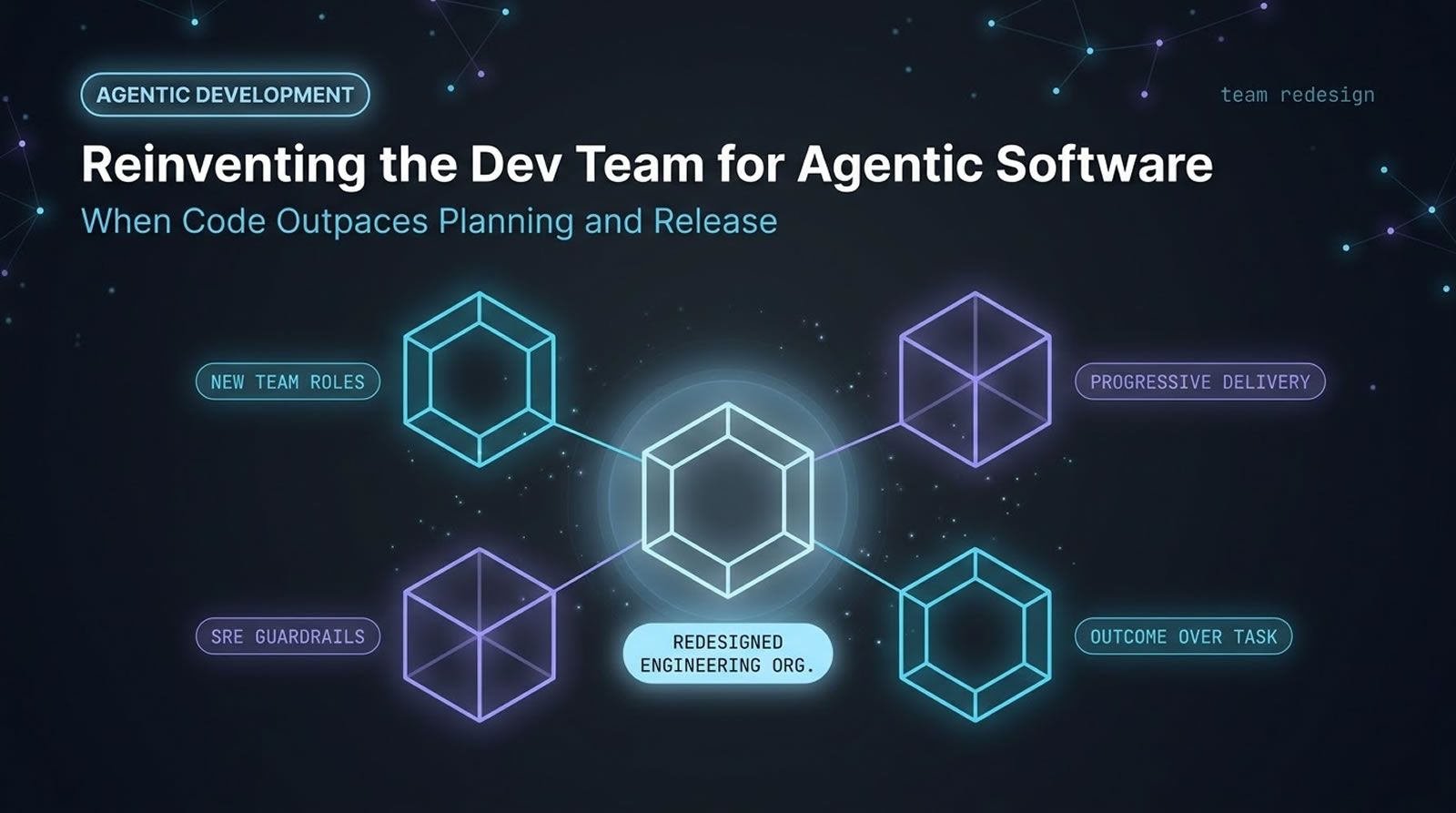
Agentic software development is changing how engineering teams plan, build, and ship software. Instead of treating code generation as a small productivity boost, teams now face a bigger operational shift: development can move faster than product decisions, testing, and release processes can keep up. That changes team design, backlog management, and the role of platform and reliability work. Tools are only part of the story. The deeper question is how humans and coding agents should work together without losing focus, safety, or job quality. Platforms like Levr matter here because they help teams manage shared context, workflow gates, and agent output across a real delivery process.
At a Glance
Agentic development creates a team design problem, not just a tooling upgrade.
- Main shift: Coding velocity is rising faster than many teams can make product decisions or safely ship changes.
- Primary bottleneck: Product analysis, testing, code review, and release workflows often lag behind implementation speed.
- Team impact: Traditional team ratios and planning rituals may no longer fit agent-assisted delivery.
- Safety requirement: Faster coding only helps if pipelines, automated testing, progressive delivery, and SRE practices are strong.
- People implication: Sustainable on-call, meaningful review work, and career development still matter, even as agents take on more implementation.
Why does agentic software development change team design?
Agentic software development changes team design because implementation is no longer the slowest step in the system. Once coding speeds up, bottlenecks move upstream into product decisions and downstream into testing, release, and operational safety.
For years, software teams were organized around a familiar assumption: writing and shipping code was expensive enough that most structure existed to ration engineering time. Product managers filtered requests, roadmaps prioritized trade-offs, and developers worked through a queue that rarely ran dry.
That assumption is weakening. When coding agents can produce working implementations quickly, teams can reach the end of a backlog sooner than expected. The result is not automatic success. It is a mismatch between old operating models and new delivery speed.
The practical change is this: a team can now generate software faster than it can confidently decide what should exist, how it should be validated, and whether it is safe to run in production. That means the organization itself becomes the limiting factor. Teams weighing whether to adapt their existing tracker or switch platforms can see a direct breakdown of Levr versus Linear for agent-first team structures.
What stays true even as coding agents get better?
Three ideas still hold: build something worth building, move fast without losing safety, and design work around people. Those principles become more important, not less, when implementation gets cheaper and faster.
The first principle is outcome over task. Code is still a means to solve a problem, not the product goal by itself. Faster implementation can tempt teams into building too much, saying yes too often, or shipping every request without enough judgment.
The second principle is that speed requires safety. Faster change increases the need for strong release systems, reliable testing, and operational guardrails.
The third principle is that people matter. If a new process creates miserable review work, unsustainable on-call rotations, or shallow career paths, the process is broken even if output metrics improve.
How does faster coding create back pressure in product management?
Faster coding creates back pressure in product because teams can implement ideas faster than product functions can evaluate, prioritize, and validate them. The bottleneck moves from building software to deciding what deserves to be built.
This is one of the biggest organizational consequences of agentic development. In a traditional setup, product management filtered demand because engineering capacity was scarce. That logic changes when prototypes and early implementations are cheap.
Cheap prototyping means product teams no longer need to rely only on abstract requirements, mockups, or long debates. They can validate ideas with real working software much earlier. That makes product judgment more valuable, not less. The goal is not to build everything. The goal is to test more ideas and reject weak ones faster.
A common failure mode is treating new velocity as permission to flood the product with features. That usually hurts usability. It also increases product sprawl and makes prioritization worse, not better.
According to the Stack Overflow Developer Survey 2024, AI tooling is already widely used by developers, but concerns about accuracy, trust, and correctness remain. That matters here because more output does not automatically mean more value. Teams still need disciplined product choices.
What new team patterns are emerging around product and engineering?
Several patterns are emerging: product managers who prototype directly, engineers who work closer to users, and smaller teams with different ratios between product and engineering. All of them aim to reduce the delay between user need and product response.
One pattern is the product manager who builds prototypes independently. If the product role can validate ideas before handing work off, engineering time gets focused on production-grade work instead of vague exploration.
Another pattern is the forward-deployed engineer. This is not a sales engineer or solution architect. It is an engineer working closely with users who can identify product gaps and fix them quickly. That shortens the loop between user pain and shipped improvement.
A third pattern is the product engineer, especially in developer tools companies. When engineers deeply understand the user because they are building for peers like themselves, they may not need a heavy permission structure to improve the product.
These models all point to the same underlying shift: teams are testing ways to reduce friction between users, product decisions, and delivery.
Do traditional dev team ratios still make sense?
Traditional team ratios may no longer fit every environment because development output can now outpace product decision-making. Some teams are experimenting with more product capacity per developer, rather than the other way around.
The old default of one product manager supporting a larger cluster of engineers assumed engineering throughput was the primary constraint. In agentic workflows, that assumption can break down. If one developer can now move through work that once required a broader team, then product analysis, user research, and prioritization may need more capacity.
That does not mean there is one correct ratio. It does mean teams should challenge inherited norms like six to eight engineers plus one PM as a universal default.
Smaller teams are part of this conversation too. If a team can reach meaningful outcomes with fewer people, the right question becomes whether the remaining work is actually well-qualified and high-value, not whether headcount matches old expectations.
Why is the path to production now a bigger competitive advantage?
The path to production matters more because faster code generation exposes every manual bottleneck after implementation. If review, testing, or release steps are slow, agentic development simply piles work up faster at those choke points.
Many teams discover that writing code is no longer the slowest part of the system. The trouble starts after that. Manual reviews, weak test coverage, slow pipelines, and fragile release processes become obvious constraints.
That makes platform engineering more strategic. Teams need reliable automation from intent to merge to deployment. Manual work is not always bad, but manual work on the critical path becomes expensive fast.
Official guidance from AWS has also emphasized rethinking software delivery practices in response to AI-assisted development, especially as code volume increases and confidence has to come from stronger automation rather than slower handoffs. See the AWS engineering perspective on generative AI and software delivery at AWS Builders' Library.
For teams using coding agents, one way to structure this is with a shared control plane. In Levr’s workflow model, teams define intent, let agents pick up scoped tasks, run automated verification, then require human review and approval. That structure helps absorb higher implementation speed without turning delivery into chaos.
Give faster coding a safer system around it.
If your agents can implement work faster than your team can validate and ship it, a shared control plane helps keep context, tests, and approvals in one place.
See how teams structure agent workflows
How should teams rethink testing in an agentic workflow?
Teams should push harder on automated testing because high-confidence delivery depends on it. If implementation is cheap, testing coverage and verification quality become some of the highest-leverage investments available.
A useful shift here is treating AI-assisted test creation as an operational advantage, not a side experiment. If manual testing or slow test authoring is holding back releases, this is one of the clearest places to apply coding agents.
Better test coverage matters for two reasons. First, it lets you ship more changes with confidence. Second, it reduces the need to rely on humans to manually inspect every implementation detail.
That is especially important when code volume rises. JPMorgan has publicly discussed using AI to support software testing and engineering workflows, including broader automation around validation. The core lesson is straightforward: when change volume increases, verification has to scale too. See JPMorgan Technology for its official engineering and AI initiatives.
In practice, some teams may get more value by reassigning part of their engineering capacity toward test coverage, pipeline health, and release confidence instead of pure feature work.This technical enforcement layer is what makes organizational redesign possible in the first place — see how agent harnesses give teams the primitives to build on.
What release practices help teams ship more safely?
Progressive delivery practices help teams ship more safely by limiting blast radius and separating deployment from full exposure. Feature flags, staged rollouts, and blue-green style approaches reduce the risk of frequent change.
This matters because users do not reward raw feature count. They care whether the product works reliably and safely. High-velocity teams need ways to release incomplete or risky changes without exposing all users at once.
Feature flags are one of the most practical tools here. They let you deploy code without instantly turning it on for everyone. That gives you room to test in production-like conditions while keeping control.
Staged rollouts serve the same goal. If only a subset of users sees a change at first, teams can detect issues earlier and recover with less damage.
The wider point is simple: frequent change is only tolerable when the system can contain mistakes.
Why do platform engineering and SRE become more important, not less?
Platform engineering and site reliability engineering become more important because they turn raw coding speed into safe, repeatable delivery. They are the disciplines that keep agent-driven output from overwhelming the rest of the organization.
In many organizations, feature teams still outnumber platform, security, and reliability groups by a wide margin. Agentic development may push that balance toward a stronger internal platform function.
Platform teams reduce friction on the path to production. SRE teams provide operating discipline around reliability, measurement, and controlled change. Together, they help teams ship quickly without wrecking availability or creating constant fire drills.
Service level indicators, service level objectives, and error budgets remain useful because they give teams a common language for deciding when to keep shipping and when to slow down. That matters more when software can be produced at a higher rate. The same logic applies below the SRE layer — the recurring engineering toil that eats into that budget is exactly what benefits from turning into governed automation. See how AI workflow automation turns dependency upgrades and CI triage into playbooks that free up capacity for the judgment calls SRE actually requires.
In agent-first environments, this is also where observability helps. Platforms like Levr are built to give teams visibility into project state, testing, and agent activity, with shared memory, routing, and an agent message bus built in for when multiple coding agents need to coordinate work.
What should happen to code review when AI writes much more code?
Mandatory review of every large AI-generated change may become unsustainable. Teams still need quality control, but they may need to shift review earlier into specs, scope, tests, and acceptance criteria instead of relying on end-stage inspection alone.
This is one of the hardest workflow questions. Reviewing thousands of lines of machine-authored code is not high-quality work by default. It is tiring, easy to do poorly, and likely to create frustration.
That does not mean peer review disappears. It means the discipline probably changes. Teams may move review left by investing more in specification quality, problem framing, test design, and automated verification.
Instead of making the pull request the only quality gate, the better pattern may be multiple smaller gates earlier in the workflow. That is one reason structured agent workflows matter. If the spec, task boundaries, tests, and merge criteria are all explicit, humans can review the right things at the right stage.
How small can a team get before operational reality pushes back?
Teams can get smaller for implementation work, but operational ownership still imposes a floor. Sustainable on-call, production support, and service accountability require enough humans to share responsibility without burning people out.
This is an important counterweight to aggressive automation talk. A coding agent cannot own the pager. A production service still needs human accountability, especially when things break outside happy-path conditions.
That means the minimum viable team is not defined only by how fast software gets written. It is also defined by how the system is run. Primary and secondary support, incident response, and a humane rotation schedule still matter.
Even if implementation becomes highly compressed, production ownership keeps a human constraint in place. Teams that ignore this usually end up with fragile systems and exhausted engineers.
How should engineering managers rethink careers and team development?
Engineering managers should focus less on narrow specialization alone and more on broader capability with multiple areas of depth. Teams need people who can move between product understanding, implementation, reliability, and operational judgment.
A purely task-fed engineer becomes a bottleneck in agentic workflows. If someone needs highly detailed instructions for every assignment, the organization loses the benefit of faster implementation. User empathy and independent problem framing become more valuable.
That also changes coaching. Career development should not assume the most valuable engineer is simply deeper in one narrow technical lane. Teams increasingly need people who can sit with users, reason about product value, shape specs, and still contribute technically.
This is especially relevant when working with coding agents. The highest-value human work often shifts toward problem selection, system design, judgment, and operational trade-offs.
How do you give coding agents a real project control plane?
Coding agents work better when they operate inside a structured workflow with clear intent, scoped tasks, tests, and approval gates. A control plane turns isolated prompting into coordinated software delivery.
One practical way to handle agentic development is to stop treating each coding task as a standalone chat. Instead, give agents shared project context, explicit issues, and observable state changes.
In Levr’s four-step workflow, that looks like this:
- Define intent in natural language: Turn outcomes into projects, issues, and acceptance criteria.
- Agents pick up tasks: Connected coding agents such as Claude Code, Cursor, Codex, and Copilot can work from scoped context.
- Automated verification: Test suites run against the work so quality is checked before a human has to inspect everything manually.
- Human review and approval: People make the final decision with more context and less guesswork.
When multiple agents are involved, Levr becomes relevant because it adds shared memory, routing, and a message bus across agent runs. That is useful when the challenge is coordination rather than single-agent output.
One View for a Reinvented Team: The Levr Dashboard
A dev team built around agentic software needs a shared view that includes both human and agent contributors. The Levr Dashboard aggregates open issues, recent runs, and active cycles into a single pane of glass — the team's real shape, in one place.

The Levr Dashboard reflects a reinvented team structure, with human and agent work visible together
Technical Deep Dive FAQ
What is agentic software development?
Agentic software development is a way of building software where coding agents take on more complete units of work than simple autocomplete or snippet generation. Instead of only suggesting lines of code, they can implement scoped tasks, work from requirements, produce tests, and participate in broader delivery workflows. The organizational challenge is that faster implementation changes where bottlenecks appear. Product decisions, verification, and operational safety become more central once coding itself is less scarce.
How is agentic development different from AI code completion?
AI code completion helps with local editing inside a file or IDE. Agentic development operates at a larger level of abstraction. It can take a task, reason across context, generate multiple files, and move toward a working feature or prototype. That difference matters because team structure, testing, review, and release processes are affected only once the unit of work becomes larger than a single coding assist. At that point, the issue is no longer productivity inside the editor. It is workflow design across the whole team.
Why do product bottlenecks show up before engineering bottlenecks now?
Product bottlenecks show up earlier because it is easier and cheaper to build or prototype ideas than it used to be. When implementation is no longer the limiting step, teams can run out of well-prioritized, well-qualified work. That exposes slow decision-making, weak validation, and backlog processes built for a slower era. The solution is not to lower the quality bar. It is to improve how ideas are tested, how user needs are understood, and how product judgment keeps pace with implementation capability.
Should teams reduce headcount because coding agents increase output?
There is no universal rule that higher coding output should lead directly to lower headcount. The more useful question is whether people are working in the right places. As implementation gets cheaper, more value may come from product discovery, platform engineering, testing, security, and reliability. Some teams may decide they were overstaffed in one area, but many will simply rebalance rather than shrink. Operational work, user understanding, and release safety do not disappear just because code can be generated faster.
What happens to sprint planning in a high-velocity agentic team?
Long planning cadences can become a drag if they do not match the pace of delivery. A two-week sprint cycle may be too slow for teams that can implement and validate ideas much faster. That does not mean all planning disappears. It means teams should examine which ceremonies still add value and which only preserve habit. Faster loops may require lighter planning, more continuous prioritization, and tighter connection between product signals and engineering execution. The point is responsiveness, not chaos.
Why is automated testing one of the best uses of AI in software delivery?
Automated testing is a strong AI use case because it directly supports safe speed. If coding agents raise the rate of code production, then test creation, maintenance, and coverage become leverage points. Better tests reduce manual effort, improve confidence, and keep higher change volume from overwhelming human reviewers. This is especially important when teams want to avoid making pull request inspection the only quality gate. Automated verification works best when it is part of a release system, not just an isolated test-generation experiment.
Do mandatory code reviews still make sense for AI-generated code?
Mandatory review on every change may become less effective when AI substantially increases code volume. The issue is not that review stops mattering. The issue is that end-stage code inspection alone may not scale as a quality strategy. Teams may need to review specs, task scope, tests, and acceptance criteria earlier in the workflow, then use automation to validate implementation details. Human review still matters, but it should focus on judgment-heavy decisions rather than acting as a last-minute filter for everything.
Why do SRE practices matter more in an agentic environment?
Site reliability engineering matters more because frequent change increases the risk of instability unless teams measure and manage reliability deliberately. Service level indicators, objectives, and error budgets give teams a shared language for balancing feature throughput against operational risk. Without that language, delivery discussions often become reactive and subjective. In an agentic environment, where code can be produced faster, SRE practices help organizations decide when they can keep accelerating and when they need to slow down to protect user trust.
What is the role of a forward-deployed engineer?
A forward-deployed engineer works closely with users and can directly identify and fix product gaps. This is different from a purely internal feature team or a sales-support role. The value comes from shrinking the loop between real user friction and product improvement. In a world where implementation is faster, the limiting factor often becomes how quickly the organization can understand and act on real needs. Embedding engineering capacity closer to users is one way to solve that without adding more process layers.
How can a team coordinate multiple coding agents without losing control?
Multiple coding agents need more than prompts. They need shared context, routing, and observability. Otherwise, teams end up with disconnected work, duplicated effort, and weak accountability. One way to solve that is with an agent-first control plane. In Levr, projects, issues, tests, and approvals provide shared state for humans and agents — plus a message bus, shared memory, and routing layer that help agents coordinate across runs. That turns isolated automation into a managed delivery system.
What should engineering managers coach for now?
Engineering managers should coach for broader judgment, user empathy, and multiple areas of depth. Teams still need specialists, but they also need people who can understand users, shape problems, work with coding agents, and contribute to reliability and delivery quality. A developer who can only execute pre-written tasks may struggle in an environment where implementation is abundant but product judgment is scarce. Coaching should reflect the skills the team needs next, not just the ones that were rewarded in a slower delivery model.
Key Takeaways
Agentic software development does not remove the need for product judgment, safety, or humane team design. It raises the stakes on all three.
The biggest gains come from redesigning the system around faster implementation.
- Reframe the bottleneck: The problem is often no longer coding speed. It is decision-making, validation, and release confidence.
- Invest in safety: Pipelines, testing, progressive delivery, platform engineering, and SRE now carry more strategic weight.
- Rethink structure: Team ratios, planning cadence, and review practices should be challenged rather than inherited.
- Protect the humans: Sustainable on-call, meaningful review work, and modern career paths still define healthy engineering teams.
The teams that adapt best will treat agentic development as an organizational redesign, not just a new editor feature.
Further reading
Stack Overflow Developer Survey 2024
Levr blog: AI security and the agent-ready web
Ship at agent speed
Give your coding agents a control plane, not just a prompt.
Levr connects your coding agents, Claude Code, Cursor, Codex, to a shared project context with issues, gates, test suites, and memory. Free tier available. No credit card required.
Levr includes agent message bus, shared memory, and cross-agent context at no extra cost.
No credit card required.