
Scaling Coding Agents: What Agent Enablement Actually Means
Agent enablement is the set of team, platform, and governance practices that help coding agents work reliably across an engineering organization, not just on one developer’s laptop. It covers reusable context, clearer task definitions, evaluation, observability, access control, and ...
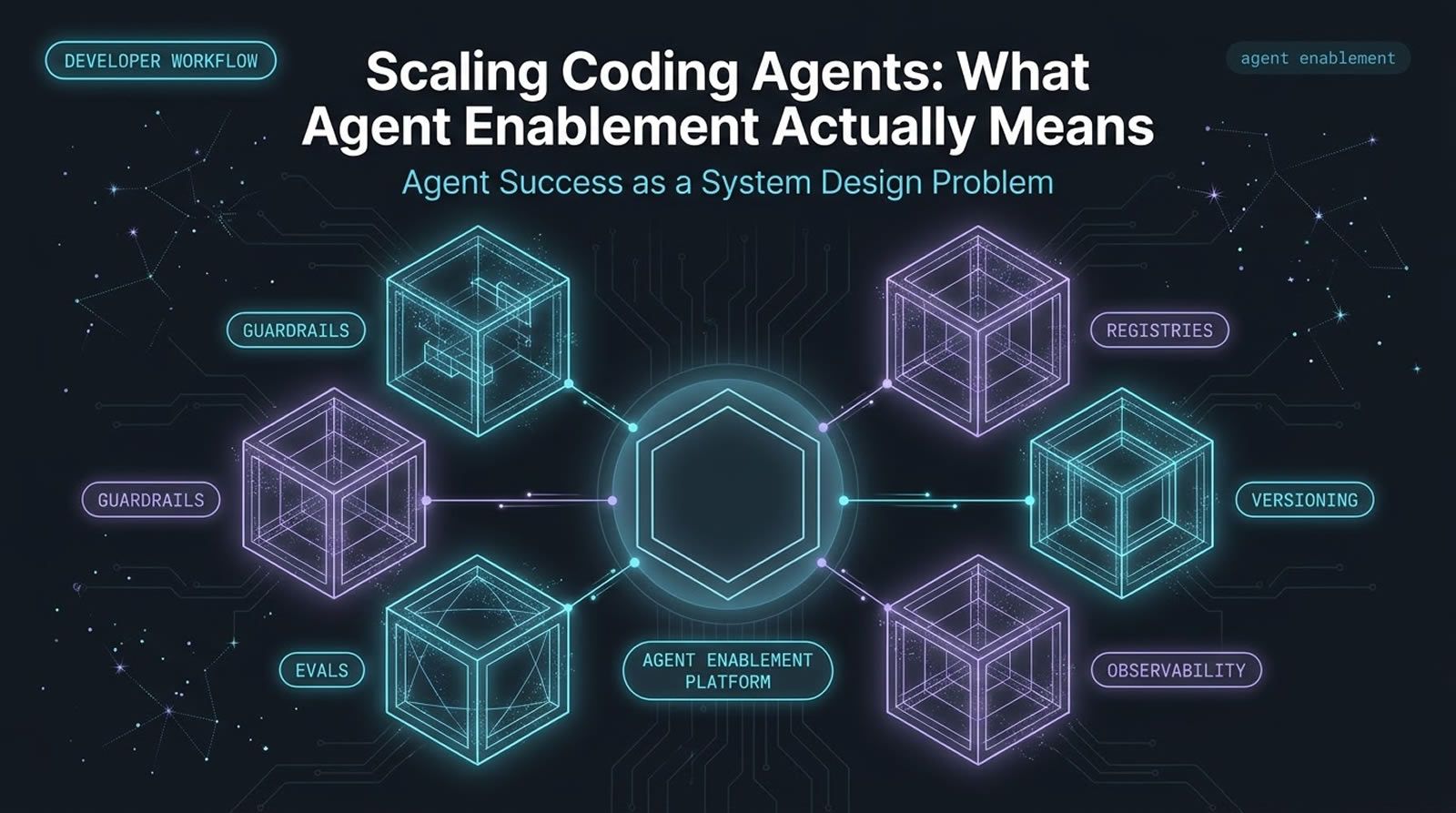
Agent enablement is the set of team, platform, and governance practices that help coding agents work reliably across an engineering organization, not just on one developer’s laptop. It covers reusable context, clearer task definitions, evaluation, observability, access control, and shared infrastructure. The core idea is simple: if agents are now part of software delivery, they need the same operational support humans do. Teams that scale well stop treating agent success as individual prompt craft and start treating it as a system design problem. An agent-first control plane fits naturally into that shift by centralizing context, tasks, tests, and review boundaries.
At a Glance
Agent enablement turns isolated coding-agent wins into repeatable engineering practice.
- Definition: Agent enablement is the function that helps teams use coding agents with reusable context, shared tooling, and clear operating standards.
- Main problem: Ad hoc prompts, one-off harnesses, and unclear ownership do not scale across teams or repositories.
- Maturity shift: Strong teams stop fixing each agent mistake manually and instead improve the system that produced it.
- Platform need: Shared registries, observability, evals, and access controls become necessary once multiple teams depend on agents.
- Leadership angle: Engineering managers and VPs need KPIs for agent quality, cost, and rework, not just output volume.
What is agent enablement, really?
Agent enablement is the organizational function that helps coding agents operate consistently, safely, and productively across teams. It moves agent use from personal experimentation to shared engineering practice by standardizing context, workflows, metrics, and guardrails.
Most teams start with individuals trying tools, prompts, and local conventions. That phase is useful for learning, but it creates fragmentation fast. One developer has a custom context file, another has a private harness, and a third has a workflow nobody else can reuse.
Agent enablement exists to reduce that sprawl. It plays a role similar to earlier developer enablement and platform engineering efforts. The difference is that the unit being enabled is no longer just a person. It is also the coding agent working alongside that person.
That means the job is not simply “teach people to prompt better.” It is to make good agent work repeatable.
Why do coding agents fail to scale on their own?
Coding agents do not scale on their own because raw model capability is only one layer of the system. Without reusable context, structured workflows, and shared oversight, teams end up recreating the same fixes, costs, and mistakes in parallel.
A common failure pattern is manual rescue. An agent gets something wrong, a developer jumps in, cleans it up, and moves on. The immediate problem is solved, but the underlying system remains unchanged.
That is the wrong optimization target. The better question is not, “How do you fix this output?” It is, “How do you improve the setup so this class of mistake happens less often?”
This is close to the old automation mindset from DevOps. If something must be corrected repeatedly, the real work is to make the process repeatable and less fragile. The same principle now applies to coding-agent workflows.
What mindset change matters most for teams using agents?
The biggest mindset shift is moving from fixing code to fixing the system that generates the code. Teams that scale agents well treat repeated mistakes as workflow design problems, not isolated execution failures.
This matters because coding agents can create the illusion of speed while quietly increasing rework. A team may think it is going faster because more code appears quickly, but if the same flaws keep returning, the system is not improving.
Good teams respond by tightening planning, writing clearer specs, improving tests, and making context reusable. Those practices help humans too. They just become more visible when agents expose the cost of ambiguity.
That is why agent enablement is not a rejection of solid engineering basics. It is usually a rediscovery of them.
What engineering practices help both humans and agents?
Clear planning, smaller tasks, strong testing, reusable documentation, and observability help both humans and agents. These practices reduce ambiguity, make failures easier to detect, and improve how work can be repeated across projects and teams.
Several patterns keep showing up:
- Planning before implementation: Agents perform better when the task shape is clear before execution starts.
- Smaller units of work: Large, vague requests lead to drift and unnecessary turns.
- Documentation as working context: Specs, conventions, and decision records improve consistency.
- Testing and evals: Teams need a way to catch silent regressions and unintended behavior changes.
- Observability: If you cannot see how agents operate, you cannot improve them systematically.
This lines up with broader industry evidence. The Stack Overflow Developer Survey 2024 shows widespread use of AI tools, while trust, correctness, and quality remain open concerns. That gap is exactly where enablement work lives.
How should individual developers work differently with coding agents?
Individual developers should focus less on one-off prompt success and more on making context, specs, and workflows reusable. The goal is not to get one good run. The goal is to avoid solving the same problem manually again next week.
In practice, that means turning tribal knowledge into shared assets. If a prompt pattern works, convert it into a reusable spec. If a common review issue appears, add a check. If a task repeatedly needs clarification, tighten the input structure.
It also means paying attention to signals from production and operations, not just local output. If an agent-generated change causes instability or unwanted behavior, that signal should feed back into the system design.
One way teams structure this in Levr’s workflow model is simple: define intent in natural language, let agents pick up scoped tasks, run automated verification, and then require human review before approval.
Visibility at Scale: The Levr Dashboard
Enabling agents across a growing team means knowing what's running where, without checking a dozen individual sessions. The Levr Dashboard aggregates open issues, active runs, and in-progress plans into a single pane of glass as agent usage scales

How do engineering managers lead teams that include coding agents?
Engineering managers need to treat coding agents as part of the delivery system they are responsible for. That means defining goals, measuring output quality, reducing rework, and improving how agents collaborate with the human team.
The management challenge changes in a few important ways. Traditional oversight focused on developer output, quality, and velocity. Now managers also need visibility into how well the team’s agents perform under real constraints.
Useful questions include:
- How many turns does an agent need to complete a task correctly?
- How often does agent output require rework?
- Which tasks consistently drift or fail?
- Where is context unclear or incomplete?
- Which teams need education, better tooling, or tighter review gates?
That “turns to success” idea is especially practical. It helps teams measure whether their context and harnesses are actually improving. More output is not automatically better output.
What new team practices are emerging around agent work?
Teams are adding new practices around context writing, agent retrospectives, and definitions of done that include agent behavior. These rituals make agent performance visible and give teams a way to improve shared workflows instead of relying on individual heroics.
Examples of these practices include:
- Context writing as a team skill: Teams compare how they describe work, constraints, and expected outcomes.
- Agent-focused retrospectives: In addition to discussing human collaboration, teams review how their agents performed.
- Definition of done updates: “Done” may now include successful evaluation, acceptable turn count, or verified task completion.
- Shared libraries: Teams create common stores of reusable specs, patterns, and harness components.
This is not far from how platform practices evolved before. The new part is that context itself becomes an operational asset.
Why do organizations need a dedicated agent enablement function?
Organizations need a dedicated agent enablement function because experimentation naturally creates duplication. Without a shared team to consolidate patterns, every group builds its own harnesses, context conventions, and controls, which increases maintenance cost and reduces learning across the org.
Early on, duplication is normal. Teams are learning quickly, trying different workflows, and discovering what helps. But that phase should not become permanent architecture.
At scale, a dedicated function can do the consolidation work. It can decide which shared patterns survive, which should be versioned, how teams discover them, and how maintenance happens over time.
This is where agent enablement starts to resemble platform engineering. The mission becomes building for the teams that build with agents, not just building for one repo or one experiment.
What should an agent platform provide at scale?
At scale, an agent platform should provide self-service access to reusable context, shared evaluation and monitoring, discoverable components, and governance controls. Teams should be able to adopt good defaults quickly without rebuilding the same infrastructure repeatedly.
Core platform capabilities often include:
- Registries: Central places for skills, harnesses, pipelines, or other reusable agent components.
- Versioning: Teams need to know which component they are using and when it changed.
- Observability: A central view of agent behavior across teams helps uncover common failure modes.
- Evals: Shared infrastructure for validating outputs and maintaining quality over time.
- Guardrails: Security scanning, approved dependencies, and access boundaries.
This is also where an agent-first platform can help materially. Levr’s shared project, testing, and observability model aligns with the need for centralized issues, test gates, and visibility, with shared memory, routing, and an agent message bus built in.
Make agent work observable before it turns into rework.
Teams scaling coding agents need shared context, verification, and visibility, not another pile of isolated prompts.
See how Levr structures agent workflows
How do shared registries and reusable components change agent adoption?
Shared registries make agent adoption more reliable by turning private tricks into managed assets. Instead of copying prompt files or duplicating harnesses across repositories, teams can discover, reuse, version, and maintain common building blocks centrally.
This matters because one-off customization tends to fork quickly. Someone adopts a shared pattern, changes 1 percent of it, and now a separate variant exists. Over time, those variants become expensive to maintain.
A registry helps, but it is not enough by itself. Teams also need:
- Ownership: Somebody must maintain the shared component.
- Testing: Changes need validation as models, APIs, or surrounding systems evolve.
- Contribution paths: Teams need a clean way to extend shared assets without creating chaos.
This is the same pattern engineering organizations have already seen with CI templates, shared services, package repositories, and internal developer platforms.
What governance issues show up once agents touch real systems?
Once agents use ticketing systems, customer data, reviews, or internal tools, governance becomes unavoidable. The biggest issues are access control, approved components, security checks, and accountability for maintaining shared agent infrastructure.
Many systems were not designed with coding agents in mind. Access boundaries may be too broad, audit trails may be incomplete, and ownership may be ambiguous. That creates risk quickly.
Useful governance questions include:
- Who can approve agent-accessible tools or skills?
- Which components are vetted and which are experimental?
- How are shared agent assets scanned, versioned, and maintained?
- Who owns a broken or insecure shared harness?
- How is blast radius limited when agents interact with sensitive systems?
The need for governance also tracks with agent security concerns more broadly. Teams working through these questions may find this analysis of AI security and agent-ready systems useful as a companion read.
How should VPs of engineering think about agent enablement?
VPs of engineering should treat agent enablement as an organizational capability, not just a tooling purchase. The job is to align teams, remove access bottlenecks, fund shared infrastructure, and define KPIs that capture quality, cost, and operational learning.
Licenses alone do not create maturity. Leaders still need to invest in education, monitoring, governance, and platform support. Otherwise the org gets scattered experimentation with little compounding benefit.
There is also a coordination role. One team may need access that another team controls. Platform improvements may require cross-functional approval. Shared standards may need executive backing before they become real defaults.
That is why agent enablement belongs on the org chart as much as in the editor.
Which KPIs actually matter for scaling coding agents?
Useful KPIs for coding agents measure quality, rework, efficiency, and maintainability, not just raw output or spend. The right metrics help teams find where context is weak, where shared components fail, and where investment should go next.
Practical KPI candidates from the source material include:
- Turns to correct completion: A signal of context and harness efficiency.
- Rework rate: How often agent output needs significant manual correction.
- Quality outcomes: Whether delivered changes behave as intended after testing and review.
- Cost awareness: Token spend matters, but only alongside value and correctness.
- Adoption maturity: Which teams are improving and which remain blocked.
That focus on measurable delivery is consistent with broader software trends. GitHub’s Octoverse reporting shows how quickly AI-assisted development is moving into the mainstream, which makes operational measurement more important, not less.
How do you introduce agent enablement without creating more chaos?
Introduce agent enablement in layers. Start with clear ownership and reusable patterns, then add observability, evals, and stronger governance. Trying to automate everything before you have basic controls usually magnifies weak points instead of solving them.
A practical rollout sequence looks like this:
- Map current experimentation: Identify which teams, tools, and local conventions already exist.
- Capture common patterns: Turn successful context, specs, and workflows into reusable shared assets.
- Assign ownership: Every shared component needs a maintainer.
- Add observability: Create a central view of agent runs, rework, and failure patterns.
- Standardize evaluation: Make validation easy enough that teams actually use it.
- Strengthen governance: Add approval paths, security checks, and access controls where needed.
This layered approach follows a simple truth. The whole system only scales as far as its weakest operational piece allows.
How can teams apply agent enablement with Levr?
Teams can apply agent enablement with Levr by moving work from prompt-only interactions into a shared control plane with issues, context, tests, and review gates. That makes agent work easier to observe, standardize, and improve across multiple contributors.
One practical way to do it:
- Define intent clearly: Create the work in natural language with explicit acceptance criteria using Levr’s workflow approach.
- Let agents pick up scoped tasks: Connected coding agents work from the same project context rather than isolated local notes.
- Run verification automatically: Use shared test management and gates so output is checked consistently.
- Review before approval: Keep human oversight where it matters, especially on risky or cross-cutting changes.
- Learn across runs: Shared observability and memory help teams see what worked and what needs refinement.
When the problem extends into multi-agent coordination, Levr's shared memory, routing, and message bus map directly to the need for a common backbone across runs and contributors."
Technical Deep Dive FAQ
What is agent enablement in software engineering?
Agent enablement is the practice of helping coding agents work effectively across a team or organization through shared context, reusable workflows, testing, observability, and governance. It is broader than prompt engineering. The goal is to make agent performance repeatable and maintainable, rather than relying on isolated developer tricks. In mature teams, agent enablement usually becomes a function connected to platform engineering, developer enablement, or engineering operations.
How is agent enablement different from prompt engineering?
Prompt engineering focuses on shaping a single interaction or task so a model responds better. Agent enablement is larger in scope. It covers how teams create reusable context, measure quality, manage shared components, apply guardrails, and improve outcomes over time. Prompt quality still matters, but agent enablement assumes the real challenge is operational scale. It asks how multiple teams can use agents reliably without each inventing separate workflows, standards, and infrastructure.
Why do coding agents need smaller tasks?
Smaller tasks reduce ambiguity and help agents stay aligned with the intended outcome. When work is too broad, agents can drift, make unwanted changes, or spend extra turns exploring the wrong path. Breaking work into smaller units also improves testing and review because each step is easier to validate. This does not guarantee correctness, but it makes failures more visible and helps teams understand whether problems come from poor context, poor planning, or weak evaluation.
What does “fix the system, not the code” mean for coding agents?
It means that when an agent repeatedly makes the same kind of mistake, the best response is usually to improve the workflow around it instead of manually patching output every time. That might mean writing a clearer spec, adding a reusable rule, tightening the task scope, or creating a test that catches the issue. The point is to stop treating each mistake as a standalone event. Sustainable scaling comes from improving the production system behind the output.
What metrics should engineering managers track for agent performance?
Managers should track metrics that reflect efficiency and quality together. The most practical examples here are turns to successful completion, rework rate, and delivered quality after testing and review. Raw token spend or activity volume can be misleading if they are not tied to useful outcomes. Managers also need to know which teams are blocked by unclear context, missing infrastructure, or lack of education. Good metrics help direct investment instead of simply reporting usage.
Why do teams need shared registries for agent skills or harnesses?
Shared registries reduce duplication and improve discoverability. Without them, useful patterns remain buried in local repos or private notes, and every team reinvents the same setup. A registry creates one place to find, version, and maintain reusable agent components. That matters even more as models, APIs, and toolchains change over time. A shared component that is unowned or untested becomes a liability quickly, so the registry model only works when ownership and maintenance are explicit.
How do evals fit into agent enablement?
Evals are the mechanism that helps teams test whether agent outputs are still acceptable as surrounding conditions change. A model can change, an external API can shift, or a shared harness can be updated, and the visible failure may appear much later. Evals make those regressions easier to catch systematically. They also help teams compare whether a new workflow is actually better than an older one. Without evals, most improvement claims remain anecdotal and hard to trust.
What governance problems appear when coding agents access internal systems?
The biggest governance problems are access control, approved component policies, auditability, and unclear ownership. Many enterprise systems were set up for human access patterns, not persistent agent use across tools like ticketing systems, customer databases, and review flows. Once agents start interacting with those systems, teams need stronger boundaries and clearer accountability. They also need a process for approving external components and maintaining shared internal ones, or risk grows faster than operational maturity.
Do you need a separate team for agent enablement?
Not always at the start, but many organizations eventually benefit from one. Early experimentation can live inside product or platform teams, especially while teams are still learning basic patterns. A separate function becomes more useful once duplication, maintenance, governance, and observability turn into shared organizational problems. At that point, somebody needs to consolidate what works, manage shared infrastructure, and support other teams. Otherwise every group keeps paying the same learning and maintenance cost alone.
How does an agent-first control plane help with agent enablement?
An agent-first control plane helps by moving work out of scattered prompts and into a shared operational system. Instead of leaving tasks, tests, and context fragmented across laptops and tools, the control plane gives agents and humans a common place to coordinate. That makes ownership, verification, and observability much easier to manage. In practice, teams use this kind of structure to define intent, scope tasks, run checks, and maintain review boundaries without depending on private local setups.
Key Takeaways
Agent enablement is how engineering organizations turn coding agents from local experiments into a manageable delivery capability.
The job is to improve the system around the agent, not just the agent’s last answer.
- Mindset: Replace manual rescue loops with repeatable improvements to context, workflow, and validation.
- Team practice: Managers should measure agent quality, rework, and turns to success, not just usage or cost.
- Platform need: Shared registries, observability, evals, and ownership are necessary once multiple teams depend on agents.
- Leadership role: VPs need to fund education, infrastructure, and governance if they want agent adoption to compound.
Coding agents do not remove the need for engineering discipline. They make the cost of missing discipline easier to see.
Further reading
Stack Overflow Developer Survey 2024
AI security and the agent-ready web
Ship at agent speed
Give your coding agents a control plane, not just a prompt.
Levr connects your coding agents, Claude Code, Cursor, Codex, to a shared project context with issues, gates, test suites, and memory. Free tier available. No credit card required.
Qinetic is included free with every Levr account, agent message bus, shared memory, and Q-Mesh MCP network at no extra cost.
No credit card required during beta.