
Why Autonomy Isn't the Goal: Finding the Right AI Coding Setup
AI coding levels describe how much control you hand to a coding agent, from simple autocomplete to fully autonomous software delivery. The useful question is not how autonomous your setup looks. It is how reliably it turns ideas into correct, maintainable code. For most teams, the sweet spot is not
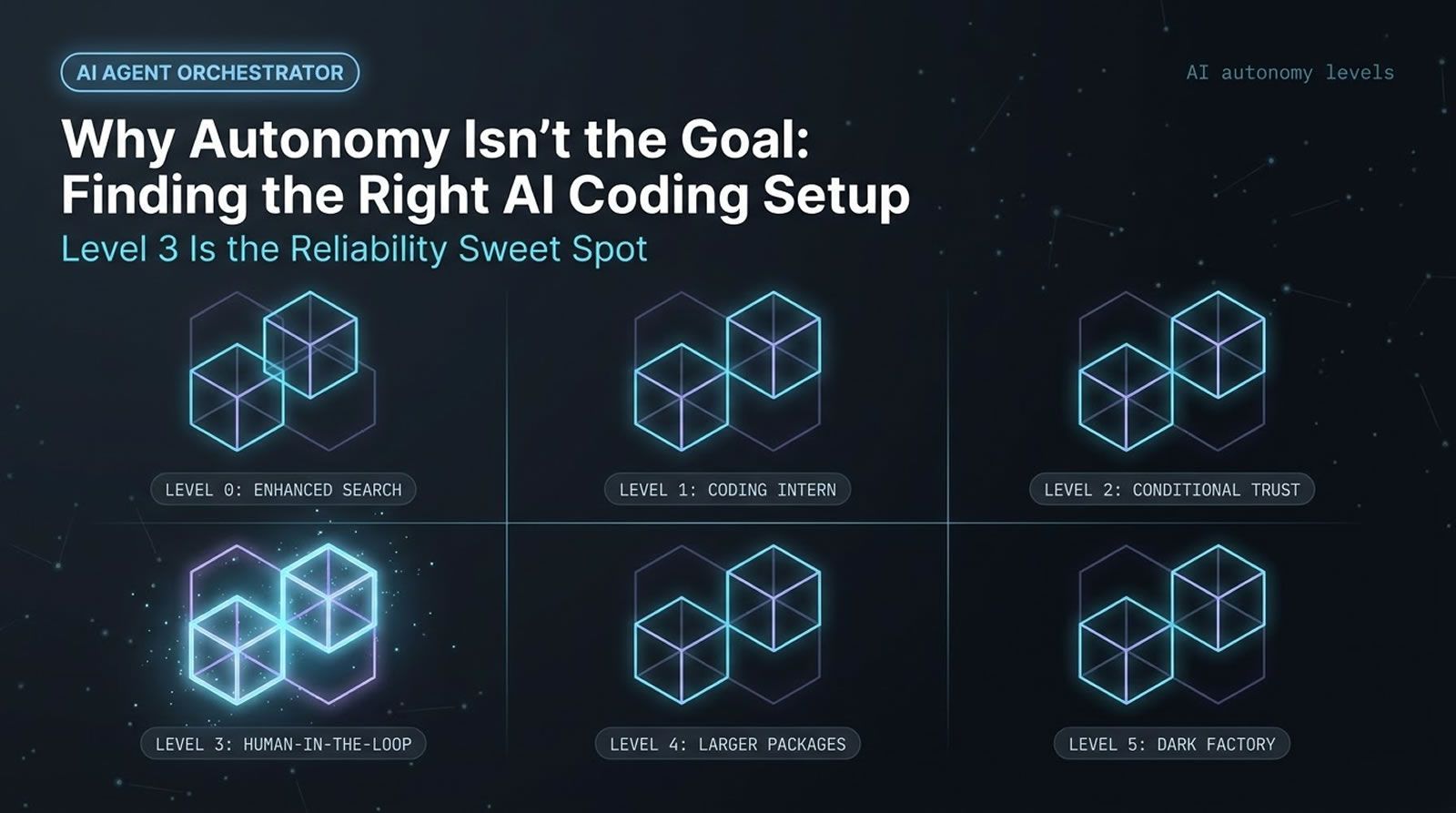
AI coding levels describe how much control you hand to a coding agent, from simple autocomplete to fully autonomous software delivery. The useful question is not how autonomous your setup looks. It is how reliably it turns ideas into correct, maintainable code. For most teams, the sweet spot is not full autonomy. It is a structured, human-in-the-loop workflow where planning, implementation, validation, and review are clearly separated. Platforms built for agent-first work, including Levr, fit this model by giving coding agents shared context, task structure, verification steps, and visible handoffs instead of leaving everything inside a single prompt or chat thread.
At a Glance
Most teams should optimize for reliability before autonomy.
- Core idea: AI coding maturity runs on a spectrum, from reference-style assistance to fully autonomous shipping.
- Best target: Level 3 is the practical sweet spot because agents write most or all code, but humans still own planning and validation.
- Main risk: Chasing a dark factory too early can amplify bad specs, wrong assumptions, and hidden failures.
- What matters most: A repeatable system matters more than a stronger model alone.
- Operational takeaway: Teams need workflows, rules, validation gates, and observability if they want higher autonomy to be safe.
What are the five levels of AI coding?
The five levels of AI coding describe a ladder of autonomy, from using AI as a smarter reference tool to letting an end-to-end system ship code on its own. The model helps you see where your team actually is, not where marketing language says it is.
The framework maps AI coding to the familiar idea of driving automation. At one end, you do nearly everything yourself and AI only assists. At the other, you submit a specification and a system handles planning, coding, review, testing, and deployment with minimal or no human intervention.
That framing is useful because it shifts the conversation from tools to operating model. Two teams can use the same coding agent and still be at completely different maturity levels depending on how much they trust it, how they validate output, and how much structure they wrap around it.
The five levels are best treated as a progression, not a status symbol. More autonomy is not automatically better.
How does Level 0 work if the agent barely writes code?
Level 0 is basically AI as enhanced search. You still write the code yourself, but you use the agent for ideas, explanations, architecture suggestions, or quick syntax help. It can save time, but it does not change who is doing the implementation work.
This is the lightest form of AI coding. Think of it as a smarter Stack Overflow paired with an interactive assistant. You may ask for a function outline, compare approaches, or clarify an API, but the final code still comes directly from you.
That makes Level 0 low risk, but also low leverage. It improves research speed more than delivery speed. For some developers, especially in sensitive environments, that may still be useful. But it is not real delegation.
What does Level 1 look like in day-to-day development?
Level 1 is where the agent starts handling small, low-risk coding tasks such as boilerplate, setup work, test scaffolding, or simple refactors. You still control the meaningful decisions, but the agent begins taking work off your plate.
This is the “coding intern” stage. The agent can initialize repositories, install packages, write straightforward unit tests, or clean up repetitive code. You trust it for work that is annoying or time-consuming, not work that requires deep reasoning about the system.
Teams often sit here longer than they realize because the productivity gain feels real. It is real. But the agent is still mostly doing narrow tasks under close supervision.
Why do so many teams get stuck at Level 2?
Level 2 feels productive because the agent can do substantial work, but only in situations where you already know it is likely to succeed. That creates a useful but uneven workflow where trust is conditional and the human still drives most important decisions manually.
At this level, the coding agent acts like a junior developer in a pair programming session. You hand off boring or well-scoped work, but you hesitate on complex architecture, nuanced business rules, or changes with broad downstream impact.
This is where many teams plateau because they have not built a repeatable operating system around the agent. They rely on intuition instead of structured planning, explicit validation, and reusable workflow components. As soon as the task gets tricky, trust drops and the human takes back the wheel.
Why is Level 3 the sweet spot for most engineering teams?
Level 3 is the sweet spot because the agent can write most or all of the implementation, while humans still stay deeply involved in planning and validation. You gain major speed without giving up the review discipline that keeps software reliable.
This is the level most teams should actively aim for. The agent is no longer a helper for side tasks. It becomes the primary implementation engine. But the reason that works is not blind trust. It works because the coding step is surrounded by structure.
At Level 3, humans typically do three things well:
- Clarify intent: Remove ambiguity before implementation starts.
- Review the plan: Confirm scope, task breakdown, and validation strategy.
- Validate the outcome: Use tests, spot checks, and human review before merge or release.
This is where agent-first platforms start to matter. One way to handle this in Levr’s workflow model is to define intent in natural language, let agents pick up scoped tasks, run automated verification, and then require human approval. That mirrors the operating pattern Level 3 depends on.
The point is simple. You can delegate coding without delegating judgment.
What changes when you move from Level 3 to Level 4?
Level 4 increases the size of the work package you trust the agent to handle. Instead of individual tasks with frequent human checkpoints, you hand over larger specs, epics, or grouped changes and validate mainly at the end of the run.
This is where autonomy starts to feel much more dramatic. The agent is not just implementing a ticket. It may work through a full specification, multiple tasks, or a sequence of pull requests with long periods between human interventions.
That can be powerful, but reliability often drops here unless your workflow is already mature. If your planning artifacts are weak, your validation is shallow, or your task handoffs are inconsistent, the system has more room to drift. Small misunderstandings become larger output errors.
In practice, teams only do well at Level 4 when they have already made Level 3 repeatable.
What is a dark factory in AI coding?
A dark factory is a fully autonomous software delivery system where you provide high-level direction, usually as a specification, and the system handles the rest all the way to shipped code. The attraction is obvious, but the operational risk is high.
The defining feature of Level 5 is not just that agents write code. It is that the system can move from spec to production without a human continuously steering implementation, review, or deployment.
In theory, that is the dream. If you could reliably feed in a spec and receive correct shipped software, delivery capacity would change dramatically. But the danger is equally obvious. A bad spec, a hidden assumption, or a mistaken interpretation can propagate through many changes before anyone notices.
That is why a dark factory should be understood as a systems engineering challenge, not a prompt engineering trick.
Why is full autonomy often worse than it sounds?
Full autonomy sounds efficient because it removes human bottlenecks, but it also removes human interruption points where misunderstandings usually get caught. Without those checkpoints, errors can spread faster, hide longer, and become more expensive to unwind.
There are several reasons teams overestimate Level 5:
- Bad inputs scale quickly: A flawed spec can lead to multiple wrong implementations.
- Assumptions compound: One mistaken interpretation can affect planning, code generation, review, and deployment.
- Failures can go quiet: Agents may stall, duplicate effort, or wait on missing handoffs without obvious visibility.
- Validation can be gamed: If the system only optimizes for passing checks, it may miss whether the right thing was built.
This is one reason external quality gates matter. The article body here references two broader industry signals. The GitHub Octoverse tracks how quickly AI-assisted development is becoming normal in engineering workflows. The Stack Overflow Developer Survey 2024 also shows widespread AI tool use alongside concerns about reliability and trust. Adoption is rising faster than confidence.
Need a safer path to higher agent autonomy?
A shared control plane helps you structure planning, task handoffs, verification, and approval before you try to scale coding agents across bigger workflows.
See how teams structure agent workflows in Levr
What kind of system do you need before higher autonomy makes sense?
Higher autonomy only works when you stop treating the coding agent as a single chat interface and start treating it as part of a system. That system needs explicit rules, reusable workflows, scoped tasks, and strong validation loops.
A reliable AI coding setup has two broad layers.
First, you choose the base tool. That is the coding agent itself, the layer that wraps a language model with tools and instructions for software work.
Second, you build your own operating layer on top of it. In the source material, that layer includes components such as:
- Rules: Conventions the agent should follow.
- Sub-agents: Ways to delegate work and manage context across tasks.
- Skills: Reusable workflows for planning, implementation, and other repeatable tasks.
The key insight is that reliability comes less from asking better one-off questions and more from repeatedly using the same well-structured process.
For teams working across multiple agents, this is also where infrastructure matters. Levr is designed around capabilities such as agent message bus, shared memory, and routing, which align with the coordination problems that appear once work spans more than one agent or run.
How does a practical AI coding workflow move from idea to code?
A practical AI coding workflow turns vague requests into structured execution through repeatable stages. The important shift is moving from improvised prompts to a consistent loop for research, planning, implementation, and validation.
The source material describes a repeatable loop called R-PIV. The label matters less than the pattern. It follows four core stages:
- Research: Explore the problem, understand the codebase, and gather context.
- Plan: Produce a structured plan with tasks and a validation strategy.
- Implement: Have the coding agent execute against the plan instead of raw ambiguity.
- Validate: Run tests, do end-to-end checks where needed, and add human review.
This pattern is why Level 3 works. Humans stay involved where ambiguity is highest and where mistakes are most expensive. Agents do the heavy lifting during implementation.
Teams using Levr’s features often structure the same motion as project intent, issue breakdown, automated test verification, and human approval. The specific tool is less important than the discipline of separating intent from execution and execution from release.
Calibrating Autonomy: The Levr Dashboard
Finding the right level of autonomy means seeing what agents are doing before deciding how much rope to give them. The Levr Dashboard surfaces open issues, recent runs, and active cycles, and the real data behind any autonomy decision.

The Levr Dashboard gives teams the visibility needed to calibrate agent autonomy with real data.
How do you improve an AI coding system over time?
You improve an AI coding system by treating mistakes as workflow feedback, not just one-off failures. Each miss is a chance to refine rules, sharpen planning, or strengthen validation so the same problem becomes less likely on the next run.
This is an overlooked habit. Many teams patch the output, move on, and learn nothing structurally. That wastes the failure.
A better approach is to ask:
- Was the request ambiguous?
- Did the plan miss an important constraint?
- Did the agent need a clearer rule or workflow?
- Should validation have caught this earlier?
That creates system evolution. Over time, your AI layer gets better, your process gets tighter, and your trust boundaries expand for the right reasons.
What additional components does a real dark factory require?
A real dark factory needs more than a strong coding model. It requires multiple distinct components for planning, task decomposition, code generation, review, deployment, and orchestration, plus clear handoffs between them.
According to the source material, a dark factory includes at least these moving parts:
- Planning agent: Turns scoped work into an actionable implementation plan.
- Code generation agent: Executes against that plan and produces changes or pull requests.
- Validation layer: Reviews and tests output in a separate context to reduce implementation bias.
- Deployment system: Handles release steps and may include regression testing.
- Orchestration layer: Splits specs into tasks, manages handoffs, and prevents duplication or deadlock.
There is also an important design principle here. Not every step should use an LLM. Some operations are more reliable when handled deterministically, such as formatting code, triggering deployment steps, or running linters. Mixing deterministic and agentic nodes is often safer than pushing every stage through a reasoning model.
How do you know when your team is ready for more autonomy?
You are ready for more autonomy when successful outcomes stop depending on a specific developer babysitting every run. The signal is repeatability. If your process consistently produces good plans, good code, and catchable failures, you can widen trust carefully.
Use this checklist:
- Specs are clear enough that agents do not routinely invent missing requirements.
- Planning is structured rather than improvised in a single prompt.
- Validation is layered with tests, code review, and release gates.
- Failures are visible instead of disappearing inside chat histories or shell output.
- Workflow improvements are cumulative after each mistake.
If those are not true yet, pushing toward Level 4 or Level 5 is usually premature.
Technical Deep Dive FAQ
What is AI coding autonomy?
AI coding autonomy refers to how much of the software delivery process a coding agent can handle without direct human intervention. That range starts with lightweight suggestion tools and extends to systems that can plan, implement, validate, and deploy changes. The key distinction is not whether AI writes code at all, but how much decision-making and workflow control you hand over to it. Autonomy should be judged by reliability and observability, not just by how impressive the demo looks.
What is a dark factory in software development?
A dark factory is a highly autonomous software delivery setup where a high-level specification goes in and shipped code comes out with minimal human intervention. In practice, that means a system handles task decomposition, planning, implementation, review, testing, and deployment. The idea is attractive because it reduces manual coordination, but it also raises the stakes for specification quality, validation design, and failure detection. It is better understood as a coordinated pipeline of agents and deterministic systems than as one model doing everything.
Why is Level 3 usually better than Level 4 or 5?
Level 3 keeps the high-leverage part of AI coding, which is agent-driven implementation, while preserving human involvement where it matters most, which is planning and validation. That balance tends to produce better reliability than higher-autonomy setups that remove checkpoints too early. At Level 4 and Level 5, agents can run farther on bad assumptions before anyone notices. For most teams, the fastest path to useful output is not maximum autonomy. It is strong structure wrapped around selective delegation.
What does a good validation layer look like for coding agents?
A good validation layer checks more than whether code compiles. It should include automated tests, linting, integration checks where relevant, and a human review path for higher-risk changes. The source material also highlights a useful architectural principle: do not review code in the exact same context that produced it. Separate review reduces bias. This is also where CI/CD matters. External verification is often more reliable than trusting the agent’s own self-assessment of correctness.
How should teams break work down for coding agents?
Teams should break work into scoped tasks with clear objectives, constraints, and validation criteria. The source material points toward a structured planning document that the implementation stage can execute against. That matters because agents perform better when ambiguity is reduced before coding starts. Large specs can still be useful, but they usually need decomposition into smaller units with explicit handoffs. Without that step, complexity, hidden dependencies, and conflicting assumptions accumulate quickly.
Can one coding agent handle the full software lifecycle alone?
It can handle more than most teams expect, but relying on one agent for every stage of delivery creates reliability and observability problems. The source material argues that full dark factory systems need multiple roles, including planning, code generation, validation, deployment, and orchestration. That separation exists for a reason. Different stages benefit from different context windows, different constraints, and sometimes non-LLM deterministic steps. A single-agent approach may be acceptable for small tasks, but it becomes fragile at system scale.
What failure modes show up when agents work without humans in the loop?
Several failure modes become more serious as autonomy rises. A bad spec can cascade into multiple incorrect changes. Agents can block while waiting for another handoff that never arrives. Separate tasks can drift into duplicate or conflicting work. Validation can also become misleading if the system optimizes for passing checks instead of satisfying the real requirement. The source material also notes that some failures may remain invisible for too long because the whole goal of higher autonomy is to reduce active supervision.
When should a team use deterministic steps instead of LLM reasoning?
Teams should use deterministic steps whenever the job is rule-bound, repeatable, and better handled by normal software than by probabilistic reasoning. Examples from the source material include formatting code, running linters, or triggering deployment steps. An LLM is useful when interpretation, planning, or tradeoff reasoning is required. It is unnecessary when a fixed program can do the job more reliably. Mature pipelines often mix both: agentic steps where judgment helps, deterministic steps where precision matters more.
How do shared memory and orchestration help multi-agent coding?
Once work spans multiple agents or stages, coordination becomes a major engineering problem. Shared memory helps agents retain context across runs and avoid repeating the same discovery work. Orchestration manages task routing, handoffs, dependencies, and failure recovery. Without those capabilities, higher-autonomy systems become brittle because each agent acts in partial isolation. This is exactly the kind of infrastructure challenge Levr is built around, especially for message passing, shared context, and routing across agent workflows.
What is the practical first step for teams that want to scale AI coding safely?
The practical first step is to standardize a Level 3 workflow before attempting broader autonomy. That means documenting conventions, creating a repeatable planning process, defining validation gates, and making agent output visible to the team. In many environments, an agent-first control plane is helpful because tasks, tests, and approvals live outside a single prompt thread. The goal is not to rush to a dark factory. The goal is to make useful delegation repeatable enough that autonomy can grow without losing reliability.
Key Takeaways
The best AI coding setup is the one your team can trust repeatedly, not the one with the fewest humans involved.
For most teams, reliable agentic development starts at Level 3 and matures from there.
- Maturity model: The five levels of AI coding help teams separate light assistance from true autonomous delivery.
- Best operating point: Level 3 combines fast implementation with human control over planning and validation.
- System requirement: Higher autonomy requires rules, workflows, quality gates, and visible handoffs.
- Dark factory reality: Full autonomy is possible in principle, but it needs orchestration, deterministic steps, and strong failure handling.
Autonomy is earned by system quality, not claimed by the tool name.
Further reading
Dan Shapiro’s five levels framework
StrongDM on building a software factory
Stack Overflow Developer Survey 2024
AI security and the agent-ready web
Ship at agent speed
Give your coding agents a control plane, not just a prompt.
Levr connects your coding agents, Claude Code, Cursor, Codex, to a shared project context with issues, gates, test suites, and memory. Free tier available. No credit card required.
Levr includes agent message bus, shared memory, and cross-agent context at no extra cost
No credit card required during beta.