
The Product Brain: How PMs Can Orchestrate AI Coding Agents
Product brain refers to a structured system that continuously gathers product context, synthesizes it into usable knowledge, and helps agents act with better judgment. Instead of relying on scattered docs, tickets, and chat history...
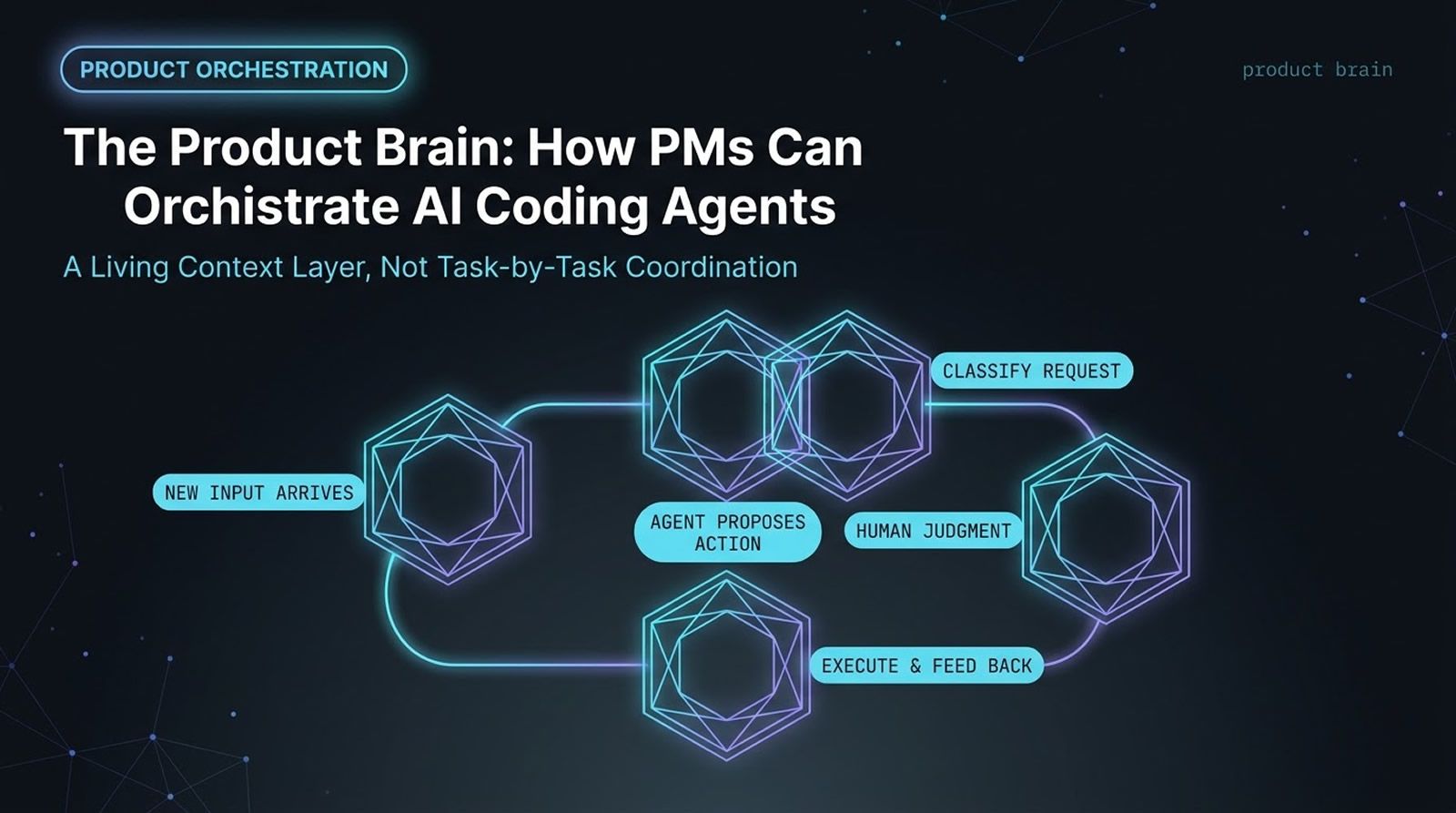
Product brain refers to a structured system that continuously gathers product context, synthesizes it into usable knowledge, and helps agents act with better judgment. Instead of relying on scattered docs, tickets, and chat history, a product brain turns that raw input into a living model of product strategy, feature context, customer feedback, and technical reality. For teams working with coding agents, this changes product management from manual coordination into orchestration. Platforms such as Levr fit naturally into this shift by giving humans and agents a shared control plane for tasks, reviews, tests, and context, rather than leaving execution trapped inside disconnected prompts and tools.
At a Glance
A product brain helps PMs turn judgment into repeatable agent workflows.
- Core idea: Centralize product context so agents can reason from current reality, not stale documents.
- Main inputs: Customer meetings, tickets, GitHub changes, email, chat, and manual notes all feed the system.
- Primary goal: Automate the parts of product work that are repetitive, while keeping strategy and approvals with humans.
- Key requirement: The system needs reinforcement from human feedback so it learns product taste and limits over time.
- Operational challenge: Privacy, workflow design, and approval boundaries matter as much as the model itself.
What is a product brain?
A product brain is a continuously updated knowledge system that captures how your product works, what customers are asking for, what changed in the codebase, and how your team makes decisions. Its purpose is to give agents enough grounded context to take useful action without guessing.
Most teams already have the raw material for this. The problem is that it lives everywhere. Meeting notes sit in one tool, tickets in another, product docs in a third, and technical truth in GitHub. When coding agents speed up implementation, this fragmentation becomes a bottleneck for product work.
A product brain fixes that by ingesting these sources and turning them into structured context. That context can include:
- Customer insights.
- Feature definitions.
- Product principles.
- Technical and front-end flow context.
- Open and resolved ticket history.
The result is not just a searchable wiki. It is a working memory layer that agents can use to classify requests, draft requirements, recommend actions, and in some cases trigger implementation work.
Why does product management need this now?
Product management needs a product brain now because coding agents have accelerated engineering faster than most PM workflows have evolved. When implementation gets cheaper and faster, the pressure shifts upstream to deciding what to build, how to scope it, and where human judgment still matters.
This is the core role change. Product managers are no longer only writing tickets or breaking down requirements. They are increasingly defining automation boundaries, training systems on company taste, and deciding which workflows can run with partial or full autonomy.
That trend also aligns with broader industry adoption of AI in software work. GitHub's Octoverse has documented the rapid rise of AI-assisted development across the industry, which makes upstream coordination and context quality more important, not less. See GitHub Octoverse. The Stack Overflow Developer Survey 2024 also shows widespread developer use of AI tools alongside ongoing concerns about trust, accuracy, and reliability. Those concerns apply directly to product workflows too.
If engineering can move at agent speed, product cannot stay trapped in static docs and manual triage.
What does a product brain actually need to ingest?
A useful product brain needs live inputs from the systems where product reality changes. That usually means customer conversations, issue trackers, GitHub activity, email, chat, and occasional manual uploads. If ingestion is stale or incomplete, autonomous workflows break down quickly.
The most important principle is freshness. A product brain that is one week out of date is often worse than no product brain at all, because it gives agents confidence based on old assumptions.
Key input categories include:
- Customer meetings: Notes from tools such as Granola or similar meeting capture systems
- Ticketing systems: Linear, Jira, or equivalent issue history and state changes
- GitHub diffs: What the product actually does today
- Email and chat: Feedback, internal decisions, unresolved ambiguity
- Manual entries: High-signal notes that someone wants the system to consider explicitly
One detail that matters is not keeping every raw input forever inside the active agent context. Raw data can overwhelm models. A better pattern is to preserve source references while synthesizing the parts agents need most.
How does the knowledge layer turn raw input into product judgment?
The knowledge layer turns raw inputs into product judgment by organizing them into linked concepts such as features, principles, customer needs, and technical flows. Agents do not need every transcript or ticket. They need a compact, current representation of what matters and how those facts relate.
This is where the idea moves beyond document storage. A product brain is doing synthesis. It connects a changed GitHub flow to an existing feature description. It notices that a support issue maps to a known onboarding problem. It recognizes that a strategic feature request overlaps with work already underway.
A practical structure often includes:
- Inputs: queued or newly arrived source material
- Sources: retained raw data or references to it
- Wiki or knowledge graph: synthesized understanding of the product
- Feature context: what exists and how it behaves
- Product principles: the taste layer that shapes decisions
- Technical context: flows, dependencies, and implementation realities
The product principles piece is especially important. It is how the system starts to represent coherence, not just information.
Which agents should sit on top of a product brain?
Most product brain setups need multiple specialized agents rather than one general agent. A common split is input processing, knowledge reorganization, workflow execution, and organizational maintenance. This separation helps the system stay current without mixing ingestion, reasoning, and action into one fragile process.
A practical model includes four roles:
- Input agent: Processes new tickets, meeting notes, diffs, and other incoming material
- Brain agent: Synthesizes and rewrites the knowledge base so agents can use it efficiently
- Action agent: Executes workflows such as clarification, recommendation, PRD drafting, or implementation kickoff
- Organizational agent: Reorganizes the wiki and context structure as teams and systems change
This kind of decomposition also fits teams using Levr, where agent-to-agent coordination, shared memory, and routing are useful once workflows stop being linear and start requiring handoffs between specialized agent roles.
How do you decide what should be automated and what should stay human?
You decide automation boundaries by separating repetitive execution from strategic judgment. Agents are well suited to triage, drafting, synthesis, and routing. Humans should still own taste, prioritization, risk acceptance, and approval in areas where mistakes are expensive or hard to reverse.
This is less about ideology and more about workflow design. Not every request should go straight to implementation. Two inputs may both look like feature requests, yet deserve different handling.
For example, a narrow issue with clear context may be specific enough for an agent to recommend a quick fix and create an implementation task. A broader request, like task complexity estimation or story-pointing logic, may overlap with strategy and require a PRD first.
Good automation questions include:
- Is the request clear enough to act on?
- Does it touch active strategic work?
- Would a wrong decision be cheap to reverse?
- Does this require company-specific taste or policy?
- Should a human approve before coding starts?
In an agent-first workflow, the PM becomes the designer of these boundaries.
Need a shared control plane for human and agent work?
One way to operationalize a product brain is to connect product context, issues, tests, and approvals in a single workflow instead of spreading them across prompts and disconnected tools.
See how Levr structures agent workflows
What does an end-to-end product brain workflow look like?
An end-to-end workflow starts when new information arrives and ends when the outcome feeds back into the knowledge system. The product brain ingests the signal, interprets it using current context, asks for human guidance when needed, and then either drafts documentation or initiates execution.
A practical flow looks like this:
- New input arrives through a ticket, meeting note, GitHub change, or manual entry.
- The system classifies the request based on current product context and related work.
- The agent proposes an action such as asking for clarification, drafting a PRD, or suggesting a scoped fix.
- A human provides judgment when strategy, overlap, or ambiguity requires it.
- The system creates the next artifact such as a task, PRD, or implementation job.
- Execution happens through coding agents, usually followed by human review.
- The result feeds back into the brain so future decisions improve.
This feedback loop is what makes the system learn product instincts instead of repeating a static template forever.
How can developers actually use a product brain backed by GitHub?
Developers can use a GitHub-backed product brain as a normal repository, which makes product context easier to consume with the same tools they already use. That means product artifacts become accessible to coding agents, engineers, and reviewers without forcing everyone into separate document systems.
This matters because a lot of useful product context still lives in places that are awkward for coding agents to consume. When feature definitions, principles, front-end flows, and updated context live in GitHub, engineers can pull them locally, inspect changes, reference them in issues, and ground their agent runs more directly.
Benefits of using GitHub as the backing layer include:
- Shared access model for PMs and engineers.
- Version history for evolving product context.
- Natural fit with agent-based coding workflows.
- Manual contribution path for engineers who want to add or correct context.
That does not mean every team must abandon all other tools immediately. It means the context that needs to guide execution should exist somewhere agents and engineers can actually work with.
How do you keep the system aligned with product taste over time?
You keep the system aligned by making human feedback part of the workflow, not an afterthought. Product taste is not only about facts. It is about choosing between valid options, recognizing overlap, and knowing when a narrow fix is better than a broader initiative.
Without reinforcement, the product brain becomes a smart filing system. With reinforcement, it starts to model judgment.
Important feedback mechanisms include:
- Approving or rejecting recommendations.
- Correcting how requests are classified.
- Editing PRDs the system drafted.
- Teaching principles explicitly through product guidelines and examples.
- Feeding completed work back into the knowledge layer.
Over time, this teaches the system what your company considers strategically coherent, well-scoped, or ready for execution.
What are the biggest privacy and compliance issues to plan for?
Privacy and compliance issues usually come from where the data lives, what gets sent to third-party models, and how approvals are recorded. If customer-sensitive material or regulated decisions pass through the system, you need explicit controls for storage, anonymization, and human signoff.
A few practical safeguards stand out:
- Keep the core repository inside the customer or company domain.
- Anonymize sensitive conversation data before model processing where needed.
- Maintain internal mappings separately if re-identification is required by the team.
- Record approval steps for PRDs, implementations, and release gates.
- Configure stricter workflows in regulated environments so code never starts without documented review.
This maps well to an agent-first control plane. For example, teams using Levr's workflow model can place human review after automated verification and before merge, which is especially useful when the organization needs a clear approval boundary.
How should larger companies roll this out without blowing up cost?
Larger companies should start with a team-level rollout, not a company-wide ingest of every document and every line of code. The goal is to learn how a specific team works, what data changes most often, and which workflows create enough value to justify ongoing indexing cost.
This is where many teams go wrong. They try to build a universal knowledge layer before they know which questions the system actually needs to answer.
A more practical rollout looks like this:
- Start with one team that has frequent product and engineering interaction.
- Ingest high-change, high-value sources first such as tickets, GitHub diffs, and customer meetings.
- Define 2 to 4 workflows where autonomy would save real time.
- Tune update frequency around the team's actual rate of change.
- Expand only after feedback loops and cost are understood.
The right product brain for a fast-moving startup will not look identical to one for a large, regulated enterprise.
The PM's Control Center: The Levr Dashboard
Orchestrating coding agents as a PM means seeing the plan before the code lands. The Levr Dashboard gives product leads a leadership-level view of open issues, active cycles, and in-progress plans and the orchestration layer made visible.

The Levr Dashboard gives PMs a real-time view of agent-driven plans as they move through execution
How do you give coding agents a real project control plane?
Coding agents need more than a prompt. They need scoped tasks, acceptance criteria, shared history, verification gates, and human review paths. A control plane makes those pieces explicit so agents can contribute inside a managed delivery workflow instead of improvising across disconnected tools.
This is where the product brain and execution layer meet. Once a request is classified and shaped into the right artifact, you still need a way to hand it to Claude Code, Cursor, Codex, or Copilot with enough surrounding context to act safely.
One way to handle this in Levr's feature set is to connect projects, issues, test suites, and observability in the same system. That supports a four-step pattern that maps cleanly to product brain workflows:
- Define intent in natural language.
- Agents pick up scoped tasks.
- Automated verification runs.
- Human review approves the result.
That structure is useful whether your product brain is simple or advanced.
Technical Deep Dive FAQ
What is the difference between a product brain and a normal product wiki?
A normal product wiki stores information for human lookup. A product brain is designed for continuous ingestion, synthesis, and action. It does not just preserve notes. It updates its internal understanding based on tickets, customer conversations, GitHub changes, and other live inputs, then makes that context usable for agents. The difference is operational. A wiki is documentation. A product brain is a context layer that supports decisions, recommendations, and workflow execution.
What does it mean for a PM to become an agent orchestrator?
Becoming an agent orchestrator means the PM spends less time manually moving work between tools and more time deciding what the system should automate, when it should ask for input, and how it should reflect product strategy. The PM still owns judgment, but now expresses it through workflow rules, product principles, approval boundaries, and reinforcement. The role shifts from direct task execution toward designing a system that can execute well with supervision.
What are the minimum data sources needed to make a product brain useful?
The minimum useful set is usually a ticketing source, GitHub, and some record of customer feedback. Tickets show what work exists, GitHub shows what the product actually does, and customer feedback explains why requests matter. Chat, email, and meeting notes add depth, but those first three sources often provide the fastest path to value. The key is not ingesting everything at once. It is ingesting enough current, high-signal data to support one or two real workflows.
How often should a product brain update?
The right cadence depends on how quickly product reality changes, but daily processing is a practical starting point for many teams. If inputs change very quickly, some sources may need more frequent refreshes. The important part is consistency. Agents should not act on stale feature definitions or outdated ticket states. Teams can also separate urgent event-driven workflows from slower background reindexing, which helps control cost while keeping critical decisions timely.
Should raw customer data be stored inside the active knowledge base?
Usually, no. It is better to keep references to raw sources and synthesize the parts that matter for ongoing decision-making. Large volumes of raw notes can overwhelm models, increase privacy exposure, and reduce signal quality. A cleaner pattern is to ingest the source, extract structured insights, and preserve traceability back to the original material. In regulated or privacy-sensitive environments, anonymization before model processing can further reduce risk while retaining the value of the input.
How do you stop agents from pushing every request straight into implementation?
You stop that by encoding decision gates before execution starts. Not every feature request is equally clear, strategic, or safe to act on. The system should be able to route some requests toward clarification, some toward PRD drafting, and only some toward implementation. That requires explicit workflow logic, not just better prompting. Teams that use a control plane for issues, tests, and approvals have a much easier time enforcing those distinctions than teams relying on ad hoc chat-based automation.
Why use GitHub as the backbone instead of keeping product docs in standard document tools?
GitHub makes product context easier for engineers and coding agents to consume because it supports versioning, local access, repository workflows, and direct use inside agent-based development tools. Standard document tools still have value, but they are often awkward as the primary source of execution context. If the goal is to help developers and agents act on product understanding, placing the most important artifacts in a system they already operate in reduces friction and improves traceability.
How do you handle compliance when agents draft PRDs or start coding tasks?
Compliance depends on workflow design more than on a single model setting. In stricter environments, teams may require a documented PRD before any implementation starts, mandatory human approval before task execution, and recorded signoff before merge. The product brain can still help by drafting documents, surfacing related work, and organizing context, but the final authority stays with humans. Approval history matters. So do clear boundaries around what an agent can create automatically versus what it can only propose.
What is the biggest mistake teams make when building a product brain?
The biggest mistake is trying to build a giant universal knowledge system before identifying a few workflows where better context would immediately improve outcomes. Teams often over-focus on ingestion and under-focus on action design. A product brain only becomes valuable when it helps route, clarify, scope, or execute real work. Start with a narrow loop, teach the system with feedback, and then expand. Otherwise you risk building a costly archive instead of an operational decision layer.
Where does Levr fit if a team starts running many specialized agents?
Levr becomes relevant once your workflows involve multiple agents with distinct responsibilities, shared context, and repeated handoffs. In that setup, agent coordination matters almost as much as model quality. A shared message bus, persistent memory, and routing layer can help the input agent, knowledge agent, and action agent operate as a coherent network rather than as isolated scripts. That is especially useful when product decisions, execution tasks, and verification steps need to reference the same evolving state.
Key Takeaways
A product brain is not just another knowledge base. It is the context layer that makes agentic product workflows possible.
The PM role is shifting from manual coordination to workflow orchestration.
- Context first: Agents cannot make useful product decisions without live, structured product context.
- Judgment matters: The goal is not full automation everywhere. It is smart delegation with clear human boundaries.
- GitHub helps: Backing the system with GitHub can make product context easier for engineers and coding agents to use.
- Feedback compounds: Human reinforcement is what turns a static knowledge base into a system that learns product taste.
The teams that move fastest will not be the ones with the most agents. They will be the ones with the clearest context and the best control over how agents act.
Further reading
Stack Overflow Developer Survey 2024
AI security and the agent-ready web
Ship at agent speed
Give your coding agents a control plane, not just a prompt.
Levr connects your coding agents to a shared project context with issues, gates, test suites, and memory. Free tier available. No credit card required.
Levr includes agent message bus, shared memory, and cross-agent context at no extra cost.
No credit card required during beta.