
Adaptive engineering beyond fixed AI harnesses
Adaptive engineering is the idea that an AI system’s operating structure should not always be fixed before work begins. Instead, the harness, meaning the prompts, roles, tools, sequencing, and memory around a model, can reorganize during execution as the problem changes. This matters most when codin
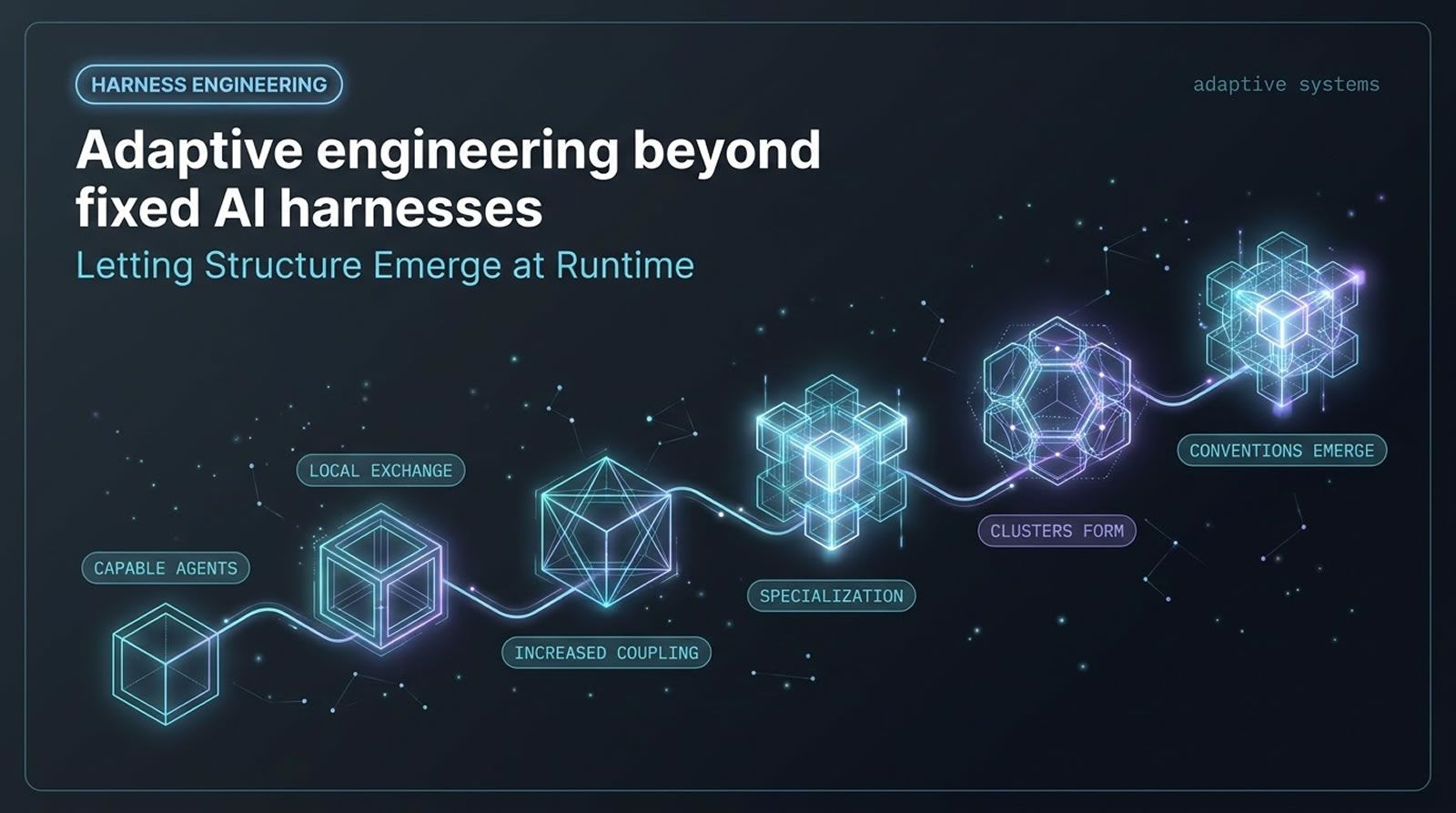
Adaptive engineering is the idea that an AI system’s operating structure should not always be fixed before work begins. Instead, the harness, meaning the prompts, roles, tools, sequencing, and memory around a model, can reorganize during execution as the problem changes. This matters most when coding agents move beyond tidy software tasks into messy, real-world coordination across people, institutions, and environments. A fixed harness is often reliable, but it can become brittle when conditions shift. Teams exploring agent-first development platforms are increasingly running into this exact boundary as coding agents take on broader, more dynamic work.
At a Glance
Fixed harnesses work well for stable tasks, but adaptive engineering is built for moving targets.
- Core idea: A traditional AI harness is predesigned before runtime, while adaptive engineering allows structure to emerge and change during execution.
- Best use case: Fixed systems fit complicated, predictable tasks. Adaptive systems fit complex, changing environments.
- Main trade-off: Reliability and auditability usually improve with fixed harnesses, while flexibility and novelty improve with adaptive ones.
- Key mechanism: Multi-agent coordination, local interaction, feedback, and emergent specialization drive runtime adaptation.
- Main risk: Greater adaptability can reduce legibility, predictability, and centralized control.
What is an AI harness, and why does it matter?
An AI harness is the layer around a model that turns raw model capability into usable behavior. It usually defines prompts, tools, memory, roles, and execution flow, which is why the harness often matters as much as the model itself for real engineering work.
A simple way to think about it is this: the model is the engine, and the harness is everything built around that engine so it can actually do useful work. In practice, that includes system prompts, project instructions, agent definition files, tool access, role boundaries, handoff logic, and loops that keep work moving toward an outcome.
Most modern agent workflows depend on some version of this structure. CLI coding tools, IDE-based coding agents, and multi-agent orchestration frameworks all rely on a harness, even if they use different terms.
What makes these systems useful is not just access to a powerful model. It is the surrounding structure that shapes the model into something repeatable, scoped, and productive.
How do fixed harnesses work today?
Most current AI engineering systems rely on a fixed harness that is designed ahead of runtime. You can customize it, but the key roles, sequencing, and control logic are usually established before the actual work begins.
This is the dominant pattern because it works. You decide what agents exist, what each one can do, how memory is handled, which tools are available, and how outputs flow from one step to the next. Once the run starts, the structure is mostly stable.
That predictability creates three clear benefits:
- Reliability: similar inputs tend to produce similar outputs
- Auditability: changes and failures are easier to trace
- Linear causality: if something breaks, you can usually locate the source
This is why fixed harnesses remain a strong fit for many coding workflows. If you already know the task shape, the output format, and the likely failure modes, predefining the structure is often the right call.
Why are fixed harnesses so effective for software work?
Fixed harnesses perform well because many software tasks are structured enough to benefit from predefined roles and orderly execution. For bounded engineering problems, a stable workflow usually beats improvisation.
This resembles a factory line. Each agent gets a defined job, a place in the sequence, and a handoff to the next step. That arrangement can be extremely effective in closed systems where the product, constraints, and desired outcomes are already clear.
For example, if you need a coding agent to implement a feature, write tests, summarize changes, and hand off for review, a fixed process can work very well. Platforms like Levr’s four-step workflow follow this logic by structuring intent, task pickup, automated verification, and human approval into a repeatable path.
The broader industry trend supports why structured workflows matter. The Stack Overflow Developer Survey 2024 shows widespread use of AI tools among developers, but also ongoing concerns about trust, correctness, and quality. Structured harnesses are one response to that concern.
Where do fixed harnesses start to break down?
Fixed harnesses start to fail when the environment changes faster than the predefined structure can handle. The more dynamic the problem, the more brittle a preplanned workflow becomes.
The core issue is not that fixed systems are bad. It is that their reliability often comes from suppressing variance. That same suppression can also limit novelty, adaptation, and context-sensitive behavior.
Two pressures make this more important over time:
- Model acceleration: a carefully designed scaffold can become outdated quickly as models improve
- Real-world exposure: work increasingly involves changing environments, multiple actors, and coordination across boundaries
As more agent systems move from isolated coding tasks into broader operational or institutional settings, every unanticipated situation requires patching. Eventually the harness can become more complicated than the problem it was meant to solve.
The GitHub Octoverse reporting on AI-assisted development also reflects the speed of change in engineering practice. Faster adoption means more teams are hitting the limits of static workflows sooner.
What is the difference between a complicated problem and a complex problem?
Complicated problems can be decomposed, analyzed, and planned in advance. Complex problems cannot be fully understood that way because their parts continuously interact, adapt, and change each other.
This distinction is central to adaptive engineering.
A complicated system is difficult, but still largely knowable. Think of something like a machine with many parts. Experts can inspect the components, document the dependencies, and predict outcomes with enough analysis.
A complex system behaves differently. The important behavior comes from interactions, feedback loops, and adaptation over time. Human organizations, markets, and cross-functional operational systems fit this pattern much better than a simple machine does.
That is why applying a factory-style harness to a complex environment often creates avoidable failure. The mistake is not poor execution. The mistake is treating the wrong class of problem as if it were predictable from the start.
Why does complexity science matter for AI engineering?
Complexity science matters because it explains why stable behavior can emerge from local interactions without central design. That is the conceptual foundation for adaptive multi-agent systems that reorganize while they run.
In a relational or systems view, the world is not mainly a collection of static parts. It is a set of ongoing relationships and processes. Stable entities are often just slower-moving patterns inside that flow.
That perspective changes how you think about AI systems. Instead of assuming you must define every useful structure up front, you can ask whether some structure should emerge from interactions among agents, the environment, and constraints.
Common examples from complexity thinking make the point clearly:
- Water: wetness is not found in hydrogen or oxygen alone, but in their relation.
- Flocking birds: no single bird contains the flock, yet coordinated order emerges.
- Organizations: the actual system often lives in live relationships, not org charts.
For AI engineering, this suggests that coordination patterns may matter more than preassigned roles once systems operate in changing environments.
What is adaptive engineering?
Adaptive engineering is the practice of designing constraints so that the harness can emerge, stabilize, and change during runtime. In this model, the harness becomes an output of the system, not just an input.
This is the core shift. In a fixed approach, you decide the structure first and run it later. In an adaptive approach, you create rules of play, allow capable agents to interact, and let coordination patterns form in response to goals and environmental pressure.
That does not mean removing structure. It means relocating structure.
The engineer still matters, but the role changes. Instead of prescribing every role, sequence, and boundary in advance, the engineer shapes the conditions under which useful order can appear. Then the system is monitored, sensed, and nudged rather than rigidly rewritten at every change.
How does a harness emerge at runtime?
A runtime harness emerges when agents interact locally, begin differentiating, form stable coordination patterns, and develop conventions that support the current environment. The structure is discovered through interaction rather than imposed all at once.
The proposed path looks something like this:
- Start with capable agents: agents can interact, learn, and change.
- Allow local exchange: early interactions are sparse and loosely connected.
- Increase coupling: more interaction creates system-level organization.
- Specialization appears: redundant roles split into useful niches.
- Clusters form: agents begin coordinating with some partners more than others.
- Conventions emerge: norms, boundaries, and protocols arise from repeated coordination.
The key claim is that an agent’s role is not always something assigned from above. It can become a position the agent takes relative to other agents and the environment. That is a very different model from predefining a planner, coder, tester, and reviewer before the task even starts.
Give agents enough structure to move, and enough context to adapt.
Teams experimenting with coding agents often need a middle ground between rigid workflows and total autonomy. A shared control plane helps make those runtime adaptations visible and governable.
See how agent-first teams structure that control plane
What is the engineer’s role in an adaptive system?
The engineer does not disappear in adaptive engineering. The role shifts from fully specifying the workflow to shaping constraints, observing emergent behavior, and adjusting conditions without rebuilding the whole system from scratch.
That means thinking less like a factory planner and more like a designer of conditions.
Useful control points include:
- Enablement versus constraint: how much freedom agents get.
- Reward and penalty design: what behavior is encouraged or discouraged.
- Rate of coupling: how quickly and how broadly agents interact.
- Memory and persistence: what the system can retain across adaptations.
In practice, this also creates a strong need for observability. If the system can reorganize itself during runtime, you need to see how and why. One way teams approach that is through agent-first platforms with shared tasks, tests, and run visibility. For example, Levr’s features emphasize shared context, test management, and observability rather than relying on prompts alone.
Watching Adaptive Systems Work: The Levr Dashboard
Adaptive engineering means agents that shift approach mid-task — which makes visibility even more important, not less. The Levr Dashboard tracks active runs and in-progress plans in real time, so adaptive behavior stays observable, not opaque.

The Levr Dashboard keeps adaptive agent behavior visible and traceable as it unfolds.
What is the difference between vertical intelligence and horizontal intelligence?
Vertical intelligence makes individual agents smarter. Horizontal intelligence improves how groups of agents coordinate. Adaptive engineering focuses more on horizontal intelligence because runtime adaptation depends on collective organization, not just stronger individual agents.
This distinction helps clarify a common misunderstanding. A system can be highly adaptive at the level of a single agent’s skill acquisition while still using a mostly fixed coordination model.
Adaptive engineering, as framed here, is less about one agent becoming better at a task and more about how multiple agents arrange themselves, divide work, form norms, and respond to changing conditions together.
That is why multi-agent infrastructure becomes important. When the real challenge is coordination, message flow, shared context, and routing matter a lot. That is also where Levr's agent message bus and shared memory layer become relevant to teams exploring decentralized workflows
How do you know when to use fixed engineering versus adaptive engineering?
Use fixed engineering when the task is bounded, repeatable, and auditable. Use adaptive engineering when the environment is moving, the actors are many, and the right workflow cannot be fully known in advance.
This is a spectrum, not a binary. Very few systems are purely fixed or purely adaptive.
A practical decision framework looks like this:
- Choose a fixed-heavy approach when: outputs are known, compliance matters, and the process must be repeatable.
- Choose an adaptive-heavy approach when: the context changes during execution, coordination is decentralized, and local conditions matter more than a global script.
- Choose a hybrid approach when: core governance must stay stable, but task allocation and coordination need runtime flexibility.
Many engineering organizations will likely land in that hybrid middle. They will keep fixed gates around testing, approval, and access while allowing more adaptive behavior in planning, delegation, and coordination.
What are the main risks and failure modes of adaptive engineering?
Adaptive systems can become hard to explain, hard to predict, and vulnerable to drift. The same flexibility that makes them useful in complex environments can also reduce legibility and make governance more difficult.
Several risks stand out:
- Attractor traps: the system can settle into a stable pattern that is merely convenient, not optimal.
- Weak selection pressure: without meaningful environmental feedback, the system may drift instead of improving.
- Monoculture: agents trained on similar data may converge too easily and lose diversity.
- Legibility loss: increased emergence can make explanations and audits much harder.
- Reduced predictability: runtime reorganization limits advance certainty.
These are not minor footnotes. They are design-defining concerns. Any serious move toward adaptive engineering has to include stronger observability, scoped permissions, and explicit boundaries for what may change during runtime and what must remain fixed.
How do you experiment with adaptive engineering without losing control?
Start by keeping governance fixed while allowing limited runtime adaptation in planning, delegation, or coordination. That gives you room to test adaptive behavior without removing the safeguards that protect quality, access, and release decisions.
A practical rollout path can look like this:
- Keep fixed gates: preserve human approval, test requirements, and permission boundaries
- Allow adaptive task formation: let agents decide how to split or sequence work inside those gates
- Instrument interactions: log agent handoffs, role changes, and coordination patterns
- Measure outcomes: compare speed, quality, and failure rates against fixed workflows
- Increase scope gradually: expand runtime adaptation only where it clearly improves performance
One way to operationalize that is by treating the control plane as fixed and the coordination layer as adaptive. In that setup, the project context, issues, tests, and approvals stay visible and stable, while the agents inside that boundary have more freedom to self-organize.
Technical Deep Dive FAQ
What is adaptive engineering in AI?
Adaptive engineering is an approach where the structure around AI models can change during runtime instead of being fully defined beforehand. Rather than locking in roles, sequencing, and coordination logic at the start, you design constraints that let the system reorganize as conditions change. The goal is not less engineering. It is a different kind of engineering that focuses on interaction rules, environmental feedback, and emergent coordination in dynamic problem spaces.
What is a fixed harness in agentic systems?
A fixed harness is a predesigned execution structure wrapped around a model or set of agents. It typically includes prompts, tools, role definitions, memory rules, and execution order. You can customize it before the run starts, but its main shape stays stable during execution. Fixed harnesses are useful because they improve repeatability, traceability, and control, especially for bounded software tasks where the desired process is already well understood.
How is adaptive engineering different from simply customizing prompts?
Prompt customization usually happens before runtime and mainly affects what a model is asked to do. Adaptive engineering is broader. It concerns how the overall agent system reorganizes while work is happening. That includes changing coordination patterns, specialization, clustering, or conventions among agents in response to environmental change. In other words, prompt tuning edits instructions, while adaptive engineering changes the system’s operating structure under live conditions.
Why do multi-agent systems matter more in adaptive engineering?
Adaptive engineering depends on coordination, not only raw model capability. Multi-agent systems create the possibility for local interaction, redundancy reduction, specialization, and emergent structure. Those are the building blocks of runtime adaptation. A single strong agent may improve vertically by becoming better at individual tasks, but adaptive engineering is more concerned with horizontal intelligence, meaning how a group of agents divides work and reorganizes as the surrounding problem changes.
Can adaptive engineering still be audited?
Yes, but it is harder than auditing a fixed harness. In a fixed workflow, causality is more linear and easier to inspect. In an adaptive system, you need better instrumentation because the structure itself can change during execution. That means tracking handoffs, role emergence, clustering behavior, state transitions, and decision history. A shared control plane can help by making agent tasks, test gates, and approval boundaries visible even when the coordination pattern inside the system is changing.
What kinds of problems are best suited to adaptive engineering?
Adaptive engineering is best suited to complex problems rather than merely complicated ones. That means environments with many interacting actors, shifting conditions, incomplete information, and outcomes that cannot be fully planned in advance. Cross-team coordination, multi-institutional workflows, and operational settings that touch the physical or social world fit this pattern better than a narrow, deterministic software task. For bounded implementation work, a fixed harness often remains the better option.
Does adaptive engineering mean removing human oversight?
No. The approach changes the role of the human engineer, but it does not remove it. Humans still decide constraints, permission boundaries, reward logic, and escalation paths. They also monitor the emergent harness and respond when it drifts or settles into poor patterns. In many practical setups, human oversight becomes more important, not less, because the system can no longer be understood only through the static configuration defined before execution began.
What are attractors in adaptive systems?
Attractors are relatively stable states that a changing system tends to settle into. In adaptive engineering, they matter because an agent network may find a coordination pattern that feels stable and keeps returning to it. That pattern may be useful, but it is not automatically the best one. Without strong selection pressure or meaningful feedback from the environment, the system can stabilize around convenience, habit, or drift rather than true performance.
How do you prevent monoculture in a multi-agent network?
Monoculture happens when agents become too similar in behavior, perspective, or training influence, which reduces diversity and weakens adaptation. Preventing it usually means introducing differentiated constraints, varied capabilities, or different feedback channels so the system does not collapse into one mode too early. The underlying concern is that emergent behavior needs variation to improve. If every agent thinks the same way, the system may look orderly while actually becoming fragile.
How could Levr fit into an adaptive engineering workflow?
One practical use for Levr is keeping the project control plane stable while allowing more adaptation inside the agent network. Teams can define intent, track issues, run test suites, and preserve human approval gates through a structured workflow, while using coding agents to self-organize task execution within those boundaries.If coordination across agents becomes the bottleneck, Levr adds shared memory, routing, and agent-to-agent communication without requiring the entire engineering process to be scripted up front.
Key Takeaways
Adaptive engineering is not a replacement for fixed harnesses. It is a better fit for a different class of problem.
The real design question is whether your problem is stable enough to predefine, or dynamic enough to require runtime reorganization.
- Fixed harnesses: Best for predictable, auditable, bounded engineering tasks.
- Adaptive systems: Better for complex environments where coordination must change during execution.
- Engineer’s role: Move from prescribing every step to shaping constraints and observing emergent structure.
- Practical path: Keep governance fixed, and let coordination become adaptive in measured stages.
The next bottleneck may not be model strength. It may be whether the harness can adapt fast enough to the world around it.
Further reading
Stack Overflow Developer Survey 2024
AI security and the agent-ready web
Ship at agent speed
Give your coding agents a control plane, not just a prompt.
Levr connects your coding agents, Claude Code, Cursor, Codex, to a shared project context with issues, gates, test suites, and memory. Free tier available. No credit card required.
Levr includes agent message bus, shared memory, and cross-agent context at no extra cost..
No credit card required during beta.