
Why AI Coding Agent Context Rots and How to Fix It
AI coding agent context is the instructions, repository guidance, skills, and tool information supplied to a coding agent beyond its base model knowledge. It can help an agent follow local conventions, find platform-specific workflows, and use the right commands.
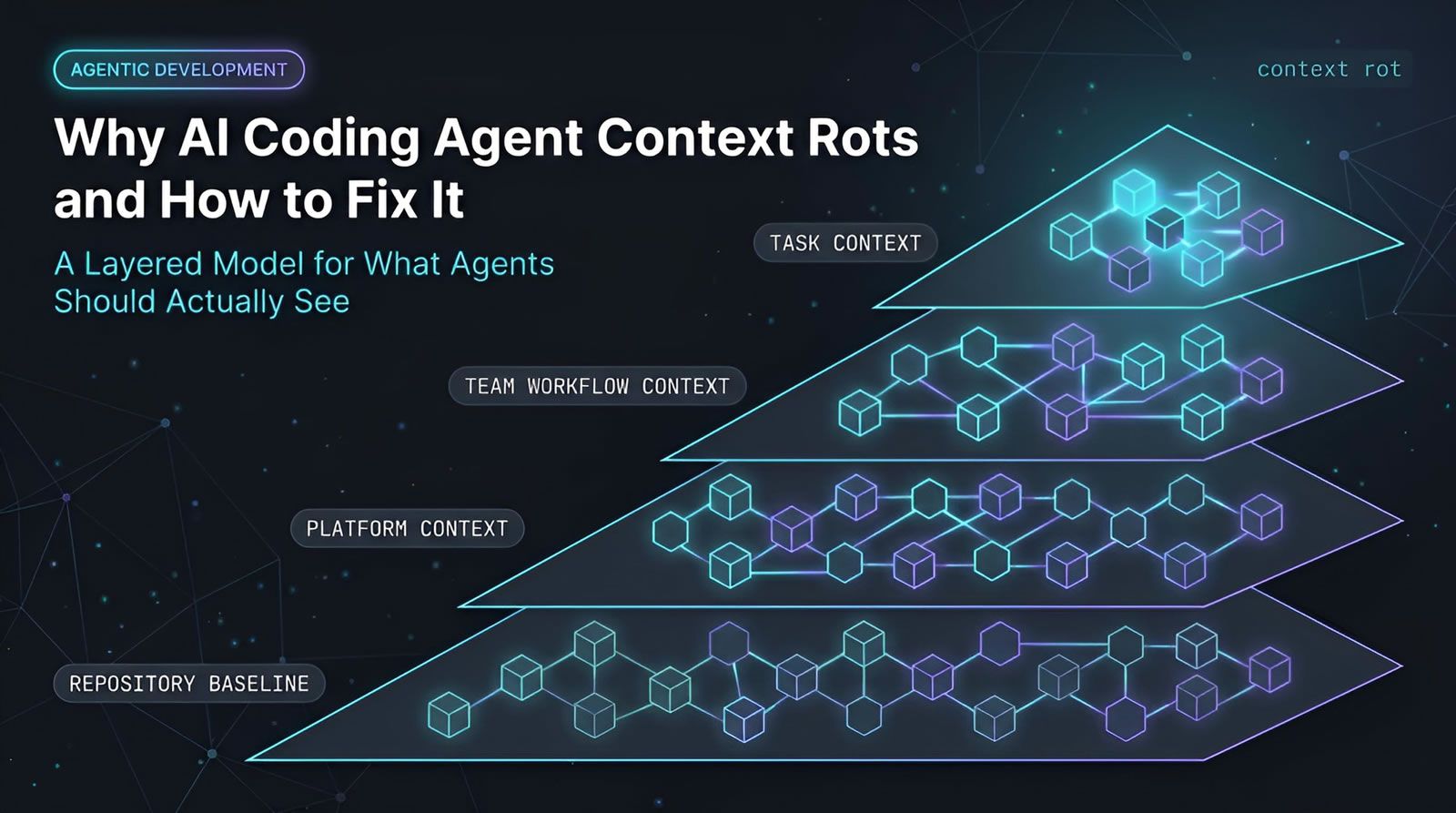
AI coding agent context is the instructions, repository guidance, skills, and tool information supplied to a coding agent beyond its base model knowledge. It can help an agent follow local conventions, find platform-specific workflows, and use the right commands. But context is not automatically beneficial: stale, redundant, or overly broad guidance can distract the model and reduce task performance. The practical goal is to keep only context development lifecycle that changes behavior for a real task, test it against representative work, and remove it when it no longer earns its place. An agent-first control plane such as Levr helps teams connect that context to issues, acceptance criteria, tests, and review gates.
At a Glance
Good agent context is specific, current, measurable, and available only when the task needs it.
- Context rot: Repository instructions can become redundant, outdated, or harmful as models, tools, and codebases change.
- Evidence over instinct: Evals let teams test whether a skill, instruction, or model change improves real engineering outcomes.
- Targeted guidance: Put task-specific knowledge near the relevant tool, platform, or workflow instead of loading everything globally.
- Operational ownership: Teams need clear owners for maintaining guidance, test scenarios, and the environments agents use.
- Real objective: Faster implementation matters, but better technical decisions and fewer delivery bottlenecks matter more.
Why can AI coding agent context make performance worse?
AI coding agent context can reduce performance when it is outdated, repetitive, too broad, or disconnected from the active task. Every extra instruction competes for attention, so guidance that once helped may later obscure the repository details, constraints, and evidence an agent actually needs.
Most teams begin by adding context aggressively. They create root-level instruction files, repository guides, reusable skills, command references, architecture notes, and platform-specific conventions. This is sensible during early adoption because coding agents need enough orientation to make useful changes safely.
The problem emerges later. A large context file can turn into a historical record of every issue somebody once encountered. It may explain basic package manager usage, repeat information now common in model training, or preserve workarounds for tooling that has since changed.
A reported experiment at Datadog illustrates the risk. An engineering group removed a large body of accumulated repository context and found that its coding-agent evaluations improved rather than declined. The lesson is not that all context is bad. It is that context has a maintenance cost and must justify its continued presence.
What context rot looks like
- Redundant instructions: Guidance restates standard language, framework, or package-manager behavior without adding local detail.
- Expired workarounds: A workaround remains after the original tool limitation, migration, or failure mode is gone.
- Conflicting rules: Different skill files prescribe incompatible commands, styles, or ownership boundaries.
- Global instructions for local tasks: A root file loads details for every platform even though the current task touches only one area.
- Unmeasured assumptions: A team keeps an instruction because it feels useful, not because a representative evaluation proves it helps.
Context rot is similar to software rot, but it can be harder to detect. A stale function may fail a test or trigger a compiler error. An unnecessary instruction can quietly make an agent less focused, more verbose, or less accurate without producing an obvious failure.
How should teams evaluate coding agent context?
Teams should evaluate coding agent context against repeatable tasks with known outcomes, then compare results with and without the proposed guidance. Strong evaluations use realistic repository state, a clear scoring method, and enough repeated runs to distinguish genuine improvement from normal model variability.
The best starting point is work with a concrete definition of correct. Code review is a useful example. Instead of judging whether an agent gave generally helpful feedback, replay pull requests that later caused incidents and measure whether the agent identifies the failure that mattered.
This approach avoids vague questions such as, “Did the agent seem smarter?” It also gives teams an outcome that maps to engineering risk. If a context change helps the agent catch a known regression, it may be valuable. If it adds noise without improving detection, remove or revise it.
Datadog's approach to code-review evaluation used historical pull requests associated with incidents, agent-based review, and a separate judging step to assess whether the review surfaced the underlying problem. Historical incidents provide a practical corpus because the eventual failure is already known.
Build a context evaluation loop
- Select a recurring task: Choose work that occurs often enough to matter, such as code review, CI failure triage, formatting fixes, or a platform-specific migration.
- Define success before testing: Specify what a correct result must contain. For example, identify a dangerous change, execute the right command, or recommend a valid fix.
- Create representative cases: Start with known incidents, previous pull requests, common support requests, or recurring agent trajectories.
- Run a baseline: Measure the model and harness without the new context.
- Add one change at a time: Test one skill, instruction, tool configuration, or model version so results remain interpretable.
- Repeat and compare: Run enough trials to account for non-deterministic outputs.
- Decide and record: Keep, refine, scope down, or delete the context based on evidence.
Evaluation results should not become a substitute for engineering judgment. They are a decision tool. The most useful result may be evidence that a proposed skill does not help, which prevents an organization from adding another permanent layer of instructions to every agent session.
For broader delivery metrics, teams can pair agent-specific evals with established software delivery measures. The DORA research program provides a useful framework for observing delivery performance, but these metrics are usually lagging indicators. Agent evals supply a more immediate signal about whether a model, context file, or workflow change works as intended.
How do you maintain agent context at scale without creating chaos?
Maintain agent context at scale by separating global rules from team and platform guidance, assigning ownership, and loading specialized knowledge only when relevant. This preserves reuse without forcing every coding agent to process an organization’s entire accumulated operating manual on every task.
Centralized marketplaces and shared skill libraries can accelerate adoption, especially when teams are still learning what coding agents need. They also create a discoverability problem. When hundreds of plugins, skills, and instructions are available, developers may not know what applies to their repository or task.
A more durable pattern is layered context:
- Repository baseline: Keep only the rules that genuinely apply across the codebase, such as essential build commands, non-negotiable safety constraints, and core architectural boundaries.
- Platform context: Put service, framework, or domain-specific guidance near the relevant platform so it can be loaded when that platform is involved.
- Team workflow context: Let teams maintain focused guidance for their own repeated workflows, ownership patterns, and local tools.
- Task context: Use the issue, acceptance criteria, failing test, pull request, and current CI output as the most immediate source of truth.
This structure reduces the temptation to “teach” an agent everything before it starts. Often, a better answer is to improve the error message, tool output, or command documentation that the agent encounters at the moment it needs help. Context delivered at the point of failure is usually more relevant than a long instruction file loaded preemptively.
Agent environments also matter. A skill can perform well on its own but fail when combined with many other tools, instructions, and repository settings. Teams should evaluate both isolated skills and realistic environments that reflect the way their agents actually operate.
Give coding agents shared project context, not an instruction-file maze.
Levr keeps issues, acceptance criteria, test activity, and workflow gates connected so agents can work from live project state rather than disconnected prompts and scattered documents.
Explore an agent-first project control plane
What should engineering teams automate before increasing agent autonomy?
Engineering teams should automate narrow, low-ambiguity tasks before delegating design decisions or broad repository changes. CI formatting failures, lint corrections, routine test execution, and issue updates are safer initial targets because they have clear success conditions and limited impact on product intent.
Not every useful coding-agent task requires frontier-level reasoning. Some tasks have a prescribed sequence: inspect a failed CI run, run a known command, make a mechanical correction, re-run validation, and record the result. These are good candidates for lower-cost or open-weight models when local evaluation confirms adequate performance.
Start by identifying friction around the implementation loop. Common examples include:
- Formatting and lint failures that block a pull request.
- Tests that must be re-run after a predictable update.
- Routine defect creation from an automated failure.
- Status changes that should reflect completed verification.
- Requests for a standard diagnostic command or log summary.
The key boundary is meaning. An agent can correct a formatting error without changing the intended behavior of a pull request. Changing a core design decision, modifying security-sensitive access, or resolving an ambiguous product tradeoff needs stronger controls and often a human checkpoint.
The Model Context Protocol, commonly called MCP, provides a standard way for AI applications to connect with external tools and sources of context. That connection makes agents more useful, but it also makes environment design, permissions, verification, and activity records more important.
How can a control plane improve coding agent workflows?
A control plane improves coding agent workflows by making the task, acceptance criteria, verification evidence, and approval state available as connected project objects. This gives agents current operational context while giving engineering teams a clear record of what changed, why it changed, and what proved it.
One way to handle context drift in Levr is to move critical instructions out of static root files and into structured work. An issue can define the requested behavior and acceptance criteria. Linked tests can define the evidence needed to close the work. Workflow gates can require verification before a task reaches Done.
That produces a practical four-step loop:
- Define intent: Capture the requested change and its acceptance criteria in natural language.
- Assign or route work: A coding agent uses the relevant issue and repository context to implement a scoped task.
- Verify automatically: Record test runs, CI results, and regressions against the work item.
- Review and approve: A human reviews high-impact decisions and confirms that the required gates are satisfied.
Levr supports a heterogeneous workflow where Claude Code, Cursor, Codex, Copilot, and other MCP-compatible agents can operate against the same issues, tests, and gates. Its shared memory, message bus, and activity trail help teams preserve useful context across agent runs without treating one giant repository instruction file as the only source of truth.
For teams experimenting with multiple coding agents, the most important operational question is not which agent is universally best. It is whether each agent receives enough current task context, whether the work is independently verified, and whether the resulting actions remain attributable.
How does agent adoption change engineering management?
Agent adoption changes engineering management by shifting attention from individual implementation throughput toward workflow bottlenecks, decision quality, and verification capacity. When agents increase output quickly, teams often discover that review, CI, and coordination become the limiting factors rather than code generation itself.
Early adoption can be highly organic. Developers find value in a tool, request access, and usage spreads faster than the organization’s provisioning, identity, or cost-management processes. That demand is a useful signal, but it also creates a need for dedicated operational ownership.
A mature enablement effort typically needs two complementary functions:
- Signals: Evaluate models and harnesses, track usage and cost, maintain representative benchmarks, and identify regressions.
- Flows: Improve the day-to-day engineering experience by removing bottlenecks in review, CI, handoffs, and verification.
Agent productivity should not be measured only through token consumption, pull request counts, or raw coding speed. Those measures can indicate activity, but they do not establish that a team shipped a better outcome. The larger opportunity is to run more small experiments, compare viable approaches, and make investment decisions with more evidence.
This also changes expectations for engineers. Junior engineers may be able to own larger workstreams with agent assistance, provided they can ask useful questions, validate outputs, and recognize when to escalate. Senior engineers become even more responsible for technical judgment: choosing the right problem, evaluating tradeoffs, and deciding whether a promising prototype deserves production investment.
Technical Deep Dive FAQ
What is AI coding agent context?
AI coding agent context is the information supplied to a coding agent that helps it work in a specific environment. It can include repository instructions, architecture notes, skills, tool descriptions, issue requirements, acceptance criteria, test results, and command output. Context supplements the model’s general knowledge with local facts. Effective context is relevant to the current task and easy to validate. Ineffective context is broad, stale, contradictory, or included simply because somebody once found it useful.
What is context rot in agentic development?
Context rot is the gradual decline in usefulness of instructions, skills, and reference material given to coding agents. It occurs when the codebase, tools, models, workflows, or underlying assumptions change but the old guidance remains. Context may become redundant rather than factually wrong, yet still hurt performance by competing with more relevant task information. Teams can manage context rot by reviewing guidance regularly, testing changes with evaluations, and deleting material that no longer produces a measurable benefit.
Should you delete an AGENTS.md or CLAUDE.md file?
You should not delete a repository instruction file blindly, but you should be willing to test whether it still helps. Establish a baseline with representative tasks, run the same cases with the file removed or reduced, and compare results. If performance improves or stays stable, the file likely contains redundant or distracting material. If particular instructions help only certain workflows, move them into a scoped skill or platform guide instead of loading them for every task.
How often should coding agent evals run?
Run coding agent evals on a schedule that matches the cost and risk of the workflow. Nightly evaluations can detect model, harness, or context regressions without blocking routine engineering work. Run additional ad hoc evaluations when a team modifies agent instructions, changes a model, updates a major skill, or alters a tool environment. For fast feedback, use smaller and cheaper evaluation sets in CI, while reserving slower, broader suites for scheduled runs.
What makes a good coding agent evaluation dataset?
A good coding agent evaluation dataset represents tasks that matter in the real engineering environment and includes a clear way to judge success. Historical incidents, pull requests, recurring CI failures, support issues, and commonly repeated developer workflows are strong sources. Avoid building a dataset from idealized toy tasks that agents will never encounter. The dataset should evolve as the repository and team practices change, otherwise the evaluation itself will eventually suffer from the same rot as the context it measures.
Can open-weight models handle software engineering tasks?
Open-weight models can be useful for constrained software engineering tasks where the desired action is clear and measurable. Examples include formatting fixes, lint corrections, command execution, basic CI triage, and structured status updates. Their suitability depends on the task, repository, harness, and required level of judgment. Teams should use local evals rather than broad model rankings to decide. More ambiguous work, such as architecture, unfamiliar debugging, and product tradeoffs, may require stronger models and human review.
How do you prevent coding agents from creating a code review bottleneck?
Prevent a code review bottleneck by separating mechanical fixes from judgment-heavy review work. Agents can resolve routine formatting failures, summarize CI output, run tests, and identify known regression patterns before a human reviewer spends time on the pull request. Keep humans responsible for changes that alter product behavior, security posture, architecture, or business logic. Connect automated checks to acceptance criteria and record the results so reviewers can focus on the decisions that require context and accountability.
What should be included in a coding agent skill?
A coding agent skill should contain only the task-specific knowledge needed to complete a defined workflow reliably. Useful contents include the required commands, tool inputs and outputs, local constraints, expected verification steps, and common failure recovery paths. Avoid turning a skill into a general repository encyclopedia. Test it in isolation and in realistic combinations with other skills. If the task depends on changing project state, link the skill to live issues, tests, and workflow requirements whenever possible.
How do engineering managers measure coding agent impact?
Engineering managers should combine direct agent signals with delivery outcomes. Track adoption, cost, task completion, evaluation performance, verification health, blocked work, review time, and the quality of agent-generated changes. Delivery metrics such as lead time and deployment performance can show broader trends, but they rarely prove that one agent change caused an improvement. Use controlled evaluations and focused experiments to make local decisions, then use workflow metrics to confirm whether those decisions improve the engineering system over time.
Why should agent context be connected to issues and tests?
Issues and tests contain current, task-specific facts that static instructions often lack. An issue can state what should change, while acceptance criteria define what success means. Linked tests and CI results provide evidence that the implementation meets that contract. Connecting agents to these objects reduces reliance on tribal knowledge and long-lived prompt files. It also improves traceability because the team can see the task, agent action, verification outcome, and review decision in one connected workflow.
Key Takeaways
Static instructions are not a durable substitute for current, testable project context.
Use evidence to decide what agents need, then remove everything else.
- Audit context: Treat AGENTS.md files, skills, and steering documents as maintained engineering assets, not permanent documentation.
- Test behavior: Compare context changes against realistic, repeatable tasks with known success criteria.
- Scope knowledge: Keep global guidance minimal and load team, platform, and task context only when relevant.
- Automate carefully: Start with low-ambiguity work that has clear verification and limited impact on product intent.
- Improve decisions: Use agent speed to run more experiments and remove delivery bottlenecks, not merely to produce more code.
The most valuable agent workflow is one that improves engineering judgment while keeping implementation and verification observable.
Further reading
- Google Cloud DORA research program
- Model Context Protocol introduction
- Claude Code documentation
- Levr agent-first project control plane
- Levr features for agentic engineering teams
- How Levr's agentic workflow operates
- AI security and the agent-ready web
Ship at agent speed
Give your coding agents a control plane, not just a prompt.
Levr connects your coding agents, including Claude Code, Cursor, Codex, and Copilot, to shared project context with issues, gates, test suites, and memory. Free tier available. No credit card required.
Levr provides agent messaging, shared memory, cross-agent context, and an activity trail so humans and coding agents can work from the same project state.
No credit card required during beta.