
What is verifiable continual learning for AI agents?
Verifiable continual learning is a way to help AI agents improve from real failures without breaking skills that already work. Instead of treating production logs as enough on their own, it turns failures, traces, and feedback into replayable learning environments with clear success criteria. That m
Verifiable continual learning is a way to help AI agents improve from real failures without breaking skills that already work. Instead of treating production logs as enough on their own, it turns failures, traces, and feedback into replayable learning environments with clear success criteria. That makes fixes testable before and after an update. Improvements can happen in the model, harness, or memory layer, depending on the root cause. For teams running agents in real products, this matters because static benchmarks rarely capture production behavior. Agent-first systems such as Levr become more useful when agent changes are observable, reviewable, and tied to regression-aware workflows.
At a Glance
Why continual learning needs verification before it belongs in production.
- Core idea: AI agents should learn from failures, but every fix should be tested and measured.
- Main problem: Logs and feedback alone are not enough because they are not replayable or verifiable.
- Key mechanism: Convert failures into executable learning environments with simulators and evaluators.
- Best practice: Route fixes to the smallest durable layer, whether that is memory, harness, or model.
- Operational goal: Improve new cases without causing regressions in older behaviors.
Why do AI agents need continual learning in production?
AI agents need continual learning because real-world failures appear in production long after benchmark scores look acceptable. Once an agent interacts with users, tools, and policies, you need a way to improve it from experience while preserving prior capabilities, not just a static evaluation snapshot.
Human learning mostly comes from acting in the world, receiving feedback, and adjusting behavior. Continual learning applies the same general idea to agents. The difficulty is that production environments are messier than benchmarks. Agents deal with varied user intents, tool outputs, policy constraints, and edge cases that are hard to fully model ahead of time.
That gap between benchmark performance and production behavior matters more as agent use expands. The Stack Overflow Developer Survey 2024 shows widespread use of AI tools among developers, while concerns about reliability and correctness remain high. In practice, teams do not just need capable agents. They need agents that can improve safely over time.
What makes production failures harder than benchmark failures?
Production failures are harder because benchmarks already include tasks and scoring rules, while production mostly gives you traces and vague dissatisfaction. You often know something went wrong, but not exactly how to reproduce it, grade it, or confirm that a fix helps more than it harms.
In a benchmark setting, the setup is relatively clean. You run the agent on a task, score the outcome with evaluators, and get a signal such as pass, fail, or reward. That gives you a direct optimization target.
In production, the usual starting point is a session log. Maybe a user was unhappy. Maybe a reviewer noticed the agent cited the wrong policy, skipped a step, or handled a tool incorrectly. The problem is that a raw log is only one observed path through a situation. It is not yet an environment you can reliably rerun.
That is why production failures need more structure before they become useful for learning.
Where does feedback for agent learning actually come from?
Feedback usually comes from two sources: automated analysis of logs and targeted human review. Automated feedback scales better, while expert review adds domain judgment about what the agent should have done and how its behavior should align with real requirements.
Automated feedback can come from models, LLM-based critics, or code-based analysis. In some cases, the agent can inspect its own trace and identify flaws. This is useful because production generates more data than humans can manually inspect.
Human feedback still matters. Experts can spot subtle issues that simple evaluators miss, especially in support, compliance, or tool-using workflows. They can also define what a correct response looks like when the failure is not just factual, but procedural or policy-based.
The limitation is that both types of feedback are still incomplete if they remain attached only to the original log. You have feedback, but not yet a test.
Why are logs and feedback not enough for durable improvement?
Logs and feedback are not enough because they describe what happened once, not what should happen reliably in similar scenarios. To support durable improvement, you need a replayable learning environment that can rerun the case, score outcomes, and compare candidate fixes.
This is the central distinction. A production trace is evidence. A learning environment is executable. The move from one to the other is what makes continual learning verifiable.
A replayable environment typically needs several ingredients:
- User behavior: simulated or synthetic users inferred from the observed interaction
- Tool behavior: real tools or mocked tools, plus decisions about what data to preserve
- Task framing: a reproducible version of the scenario that triggered the failure
- Evaluators: explicit definitions of success, such as policy compliance, correct escalation, or task completion
Once that environment exists, you can run multiple candidate agents through the same scenario and compare outcomes. That is the difference between guesswork and measured improvement.
What is a replayable learning environment for an AI agent?
A replayable learning environment is an executable simulation of a failure pattern, complete with user behavior, tool interactions, and scoring logic. It turns a one-off trace into a reusable test so you can evaluate fixes, compare versions, and verify improvements.
The point is not to perfectly recreate history. The point is to capture the underlying distribution implied by the failure: what kind of user appeared, what tools were involved, what constraints mattered, and what success should have looked like.
If an agent mishandled a refund policy, for example, a good learning environment would not just store the original transcript. It would encode relevant personas, similar intents, tool calls, and evaluators for whether the agent followed the right policy behavior.
This creates a repeatable unit of learning. It also makes regression checking possible, because the same environment can be reused after future changes.
Which parts of an agent can actually be improved?
Agent improvements can happen in three places: the model layer, the harness layer, and the memory layer. The right fix depends on the cause of failure, and the best learning system looks for the smallest durable change rather than defaulting to model retraining.
The model layer includes changes to model weights or model selection. Techniques mentioned in this space include supervised fine-tuning, reinforcement learning style post-training, and parameter-efficient methods such as low-rank adaptation.
The harness layer covers context engineering around the model. That includes prompts, tools, code, workflows, and reusable skills. Many practical fixes live here because the problem often comes from what context the model sees or how the system routes work.
The memory layer stores facts, corrections, or distilled skills so the agent does not repeat the same mistake. This is often the cheapest and fastest place to update, but also easy to overtrust if you cannot verify the outcome.
How do model, harness, and memory updates differ in practice?
These layers differ mainly in cost, flexibility, and verifiability. Model updates can be powerful but expensive. Harness updates are flexible and often practical. Memory updates are cheap and fast. None of them should be used blindly, because each can help or create regressions.
- Model-layer updates usually need curated benchmarks and explicit evaluators. They can imitate correct trajectories or reinforce preferred behavior, but they are compute-heavy and harder to run frequently.
- Harness-layer updates can involve rewriting prompts, modifying tools, adding workflow gates, or changing surrounding code. They offer a lot of practical leverage, especially when the failure comes from context setup rather than core model capability.
- Memory-layer updates can store a fact, correction, or compressed skill. They are the fastest route to adaptation, but if you only write to memory without testing, you still do not know whether the issue is truly resolved.
A strong continual learning engine should treat these as options, not silos.
Why is verifiable continual learning different from ordinary agent tuning?
Verifiable continual learning is different because it requires every improvement to be replayed, measured, and regression-checked. Ordinary tuning often applies a change based on intuition or one successful example, while verifiable learning demands proof that the update helps and does not break older wins.
This matters because agents rarely fail for only one reason. A bad answer could come from stale memory, weak prompt structure, poor tool normalization, missing workflow logic, or limited reasoning strength. If you patch the wrong layer, you might hide the symptom without fixing the cause.
Verifiable continual learning adds discipline. It asks:
- Can the failure be replayed?
- Can success be scored before and after the change?
- Do prior tests still pass?
That makes it closer to software engineering than ad hoc prompt tweaking.
What principles make continual learning practical for real agent systems?
Practical continual learning depends on four principles: replayability, holisticness, lifelongness, and efficiency. Together, they let you turn production failures into testable tasks, route fixes to the right layer, protect past capabilities, and run the loop often enough to matter.
- Replayability means turning a failure into a rerunnable test. Without that, nothing downstream is truly measurable.
- Holisticness means a failure may have multiple possible causes. The system should choose the smallest durable fix at the right layer.
- Lifelongness means new fixes should not break old behavior. Regression control should be part of optimization, not just an afterthought.
- Efficiency means the loop must be cheap enough to run repeatedly. If improvement takes too long or costs too much, teams will stop doing it.
These principles line up with broader software delivery patterns. The GitHub Octoverse reports have consistently highlighted how quickly AI-assisted development is becoming part of normal engineering workflows, which raises the bar for testability and operational control as agents take on more work.
Give agent improvements a real control plane
If your team is testing agent changes, a shared workflow for issues, verification, and review makes regression-aware updates easier to manage across humans and coding agents.
See how Levr structures agent workflows
How do you prevent new fixes from breaking old agent behavior?
Preventing regressions requires learning against both new and past environments, not just the latest failure. The key is to treat regression control as part of optimization itself, so each update is constrained by previously successful behaviors that still need to hold.
This is the lifelong part of continual learning. Suppose an agent has already been improved on several learned environments, and then a new failure arrives. If you optimize only for the newest case, the system may overfit and damage earlier capabilities.
A better approach keeps a growing set of prior environments and checks that the candidate fix improves the new case without degrading previous ones. In practice, this cannot scale naively forever. The optimization loop has to stay efficient as the number of past environments grows.
That tradeoff between memory of the past and cost of evaluation is one of the main engineering challenges in continual learning.
How can engineering teams operationalize this learning loop?
Engineering teams can operationalize continual learning by treating failures as workflow objects with tests, root-cause routing, and reviewable changes. The goal is not just to patch prompts, but to create a repeatable loop from signal to environment to measured update and approval.
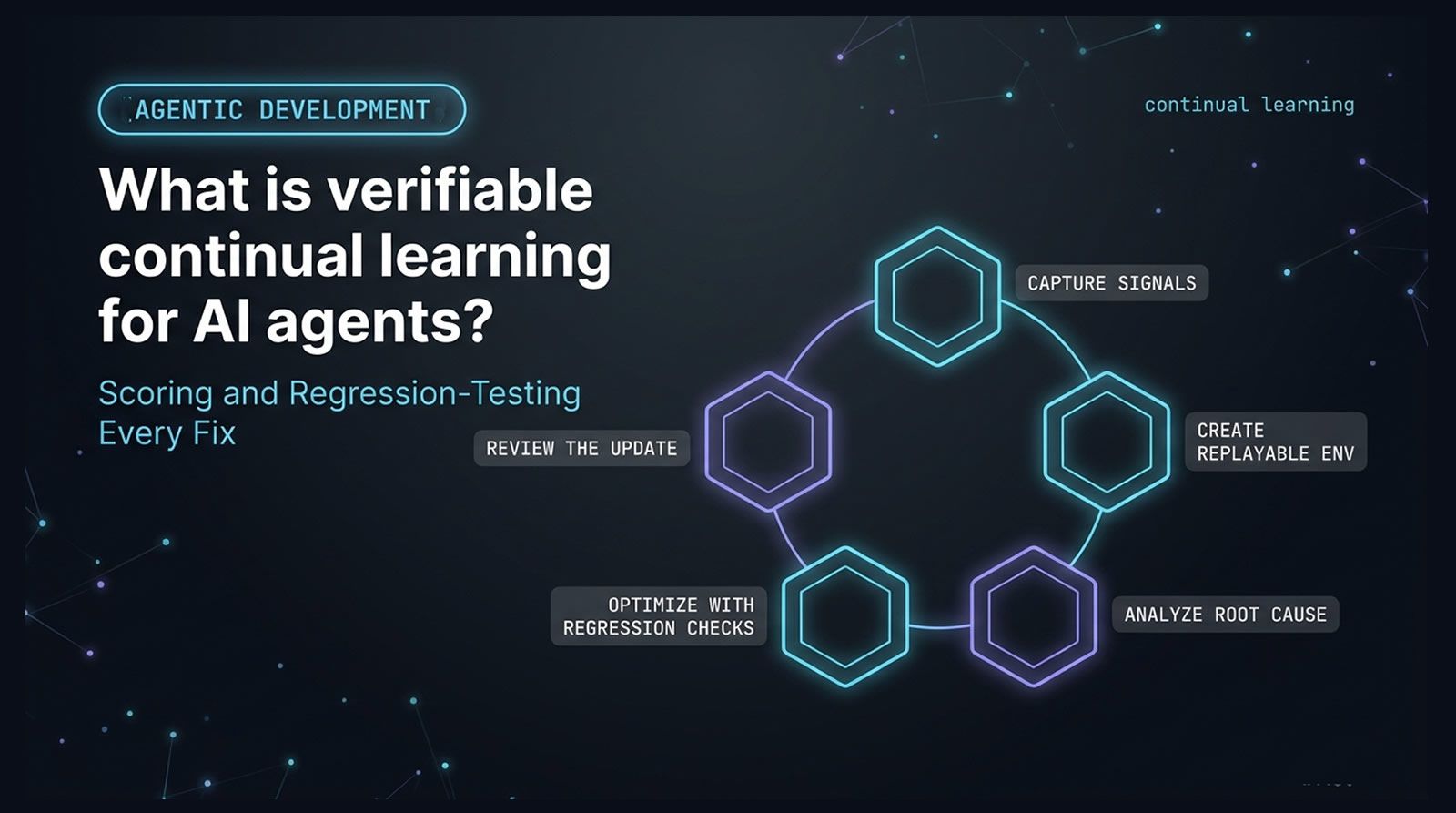
A practical operating model looks like this:
- Capture signals: collect logs, feedback, and failure reports from production.
- Create replayable environments: turn those signals into executable scenarios with evaluators.
- Analyze root cause: decide whether the issue belongs in memory, harness, or model.
- Optimize with regression checks: score before and after, while protecting prior behaviors.
- Review the update: ship changes as reviewable artifacts, not hidden runtime drift.
One way to handle this in Levr’s agentic workflow is to define intent in natural language, let agents pick up scoped work, run automated verification, and require human review before adopting the change. That pattern fits continual learning well because it makes agent updates visible and auditable.
How do agent-first platforms like Levr fit into continual learning?
Agent-first platforms fit continual learning by providing the operational scaffolding around learning itself: shared context, observable task state, verification gates, and coordinated execution. They do not replace learning methods, but they make it easier to run those methods in a disciplined way.
Continual learning is not just a modeling problem. It is also a systems problem. Teams need to know which issue triggered a change, what evidence supported it, what tests ran, and who approved the result.
That is where a shared control plane helps. In Levr’s feature set, projects, issues, tests, and observability live in one place, which is useful when an agent change needs to move through the same delivery process as any other software change.
When multiple agents are involved, coordination also matters. For workflows that require agent-to-agent messaging, persistent shared context, or routing work across specialists, Qinetic maps naturally to the infrastructure side of the problem through its message bus, shared memory, and routing model.
What mistakes do teams make when trying to improve agents from failures?
Teams usually make three mistakes: treating logs as tests, overfitting to the latest failure, and applying fixes at the wrong layer. These mistakes create fragile improvements that look good in one case but quietly reduce reliability across the broader system.
Common failure patterns include:
- Patching without replayability: changing prompts or memory based on one bad trace
- Ignoring regressions: checking whether the new case improved, but not whether old cases still pass
- Defaulting to fine-tuning: reaching for model changes when a harness or memory fix would be smaller and safer
- Skipping reviewability: letting the agent drift without a clear record of what changed and why
The safest habit is to insist on executable evidence. If a failure cannot be replayed and scored, it is too early to claim a durable fix.
Technical Deep Dive FAQ
What is continual learning for AI agents?
Continual learning for AI agents is the process of improving an agent from experience over time rather than relying only on static pretraining or one-time evaluation. The agent interacts with users, tools, and policies, receives feedback from those interactions, and updates its behavior. The hard part is doing this without forgetting capabilities that already worked. In practice, that means capturing failures, determining what caused them, and applying changes in a way that can be tested and measured rather than guessed.
What is verifiable continual learning?
Verifiable continual learning is a stricter form of continual learning where every fix is proven to help and proven not to damage prior behavior. It requires replayable tasks, measurable before-and-after scoring, and regression checks against earlier successes. This makes the learning loop more reliable for production use. Instead of saying an agent seems better after a prompt change or memory update, you can show that the change improved the target scenario while keeping previous scenarios intact.
Why can’t production logs be used directly as a learning benchmark?
Production logs capture one observed interaction, but they do not usually define reproducible task conditions or explicit success metrics. A benchmark needs tasks you can rerun and evaluators that consistently score outcomes. Logs often contain useful evidence, but they are only the raw material. To become a benchmark-like asset, they need to be lifted into replayable environments that model users, tools, and grading logic. Without that conversion, teams can inspect failures, but they cannot reliably compare candidate fixes or protect against regressions.
What does it mean to route a fix to the right layer of the agent?
Routing a fix means deciding whether the failure should be addressed in the model, harness, or memory layer. If the issue is a missing fact or correction, memory may be enough. If the issue comes from weak prompts, bad tool usage, or missing workflow logic, the harness layer is a better target. If the issue reflects deeper capability limits, model changes may be needed. The goal is to choose the smallest durable fix, because unnecessary changes increase cost and regression risk.
How is harness engineering different from model fine-tuning?
Harness engineering changes the system around the model rather than the model weights themselves. That includes prompts, tools, code, workflows, and reusable skills. Model fine-tuning changes internal model parameters through methods such as supervised fine-tuning or reinforcement learning style post-training. Harness engineering is often more practical because many production failures come from context or execution logic, not raw model ability. It is also usually cheaper and faster to iterate on, especially when paired with replayable tests and regression checks.
Why is memory the cheapest layer to update, and what is the catch?
Memory is usually the cheapest layer because writing a fact, correction, or reusable skill does not require heavyweight model training or major code changes. It can often work directly from logs and feedback. The catch is verification. Just because the system stored a correction does not mean the failure is fixed, and it does not mean other scenarios remain safe. Memory updates are fast, but without replayable tests and regression checks, they can become unverified patches that only appear to solve the problem.
What is regression-aware optimization for agents?
Regression-aware optimization means improving the latest failure while explicitly constraining the system not to break past successful behavior. Instead of optimizing only for a new learning environment, the optimizer considers both new and prior environments as part of the learning objective. This is different from running a separate post-hoc regression pass after the fact. The regression logic is built into the improvement loop itself. That makes continual learning more trustworthy, especially as the number of learned cases grows over time.
Can continual learning happen without changing model weights?
Yes. One of the main practical insights is that many useful updates happen outside the model layer. Prompt changes, tool adjustments, workflow edits, code modifications around the model, and memory updates can all improve agent behavior without touching weights. This matters because weight updates are usually the most expensive form of learning. For many production issues, the right answer is not retraining. It is finding a smaller, verifiable fix in the harness or memory layer and confirming that it solves the target problem cleanly.
How do you make agent improvements reviewable for an engineering team?
Agent improvements become reviewable when they are packaged like normal engineering changes. That means there is a clear source signal, a replayable environment, before-and-after measurements, and a documented explanation of what changed and why. Teams also need a place to track the issue, run verification, and approve the update. Agent-first control planes help here because they connect intent, task state, tests, and review gates. The core principle is simple: no silent drift, and no production learning without evidence.
What kind of failures benefit most from verifiable continual learning?
This approach is especially useful for repeated but hard-to-benchmark failures in tool-using or policy-sensitive agents. Examples include citing stale policies, mishandling escalation rules, applying the wrong threshold logic, or behaving inconsistently across user personas. These cases often appear in production before they show up in curated benchmarks. Verifiable continual learning helps because it can turn those incidents into reusable tests, then apply and validate targeted fixes. It is less about chasing novelty and more about compounding reliability from actual operational experience.
Key Takeaways
Verifiable continual learning turns agent improvement from reactive patching into a repeatable engineering loop.
The important shift is from raw failure evidence to replayable, regression-aware improvement.
- Logs are inputs: They help identify failures, but they are not enough on their own.
- Tests are the foundation: Replayable environments make continual learning measurable and defensible.
- Layer choice matters: The best fix may live in memory, harness, or model, depending on root cause.
- Regression control is non-negotiable: Durable gains require preserving what already works.
The teams that benefit most will treat agent learning like software delivery, not like prompt folklore.
Further reading
Stack Overflow Developer Survey 2024
Ship at agent speed
Give your coding agents a control plane, not just a prompt.
Levr connects your coding agents, Claude Code, Cursor, Codex, and Copilot, to a shared project context with issues, gates, test suites, and memory. Free tier available. No credit card required.
Levr includes agent message bus, shared memory, and cross-agent context at no extra cost.
No credit card required during beta.